
You can’t just show up to the gym once and expect to be strong. The same is true for your mind.
Mental training is all about systematically practicing specific mental skills to sharpen your focus, build rock-solid confidence, and develop gritty resilience. It’s not a quick fix or some abstract pep talk. It’s strength and conditioning for your mind.
What Is Mental Training and Why It Matters

Think about it this way: mental training is a structured, intentional process for sharpening the psychological tools that separate good performers from truly great ones. We’re moving way beyond vague ideas like “being tough” and into a practical toolkit you can actually use to manage what’s going on inside your head.
These aren’t theories; they’re trainable abilities. Just like you drill footwork or dial in your free throws, you can practice techniques to control your thoughts, regulate your emotions, and lock in your focus when the pressure is on.
The Real-World Impact of a Trained Mind
A strong mental game isn’t just a nice-to-have—it shows up in tangible results on the field, court, or track. It’s the difference-maker when everything is on the line.
Here’s what that looks like in action:
- Staying Calm Under Pressure: The clock is ticking down, the crowd is roaring, but instead of letting anxiety hijack the moment, you use a quick breathing technique to stay centered and execute. Actionable Tip: Practice 4-4-4 box breathing (inhale 4s, hold 4s, exhale 4s) for one minute before every training session.
- Bouncing Back from Mistakes: A bad call or a missed shot doesn’t derail you. You’ve trained yourself to reset instantly and lock back in on the very next play. Actionable Tip: Develop a physical “reset” cue, like tapping your wrist or adjusting your helmet, to signal to your brain that the last play is over.
- Pushing Through Exhaustion: Your body is screaming to quit, but your mind gives you the motivation and grit to push past those perceived limits. Actionable Tip: Use a powerful mantra like “One more rep” or “Push through” during the toughest part of your workout.
- Maintaining Unshakable Confidence: You build a genuine belief in your abilities that isn’t fragile—it doesn’t vanish after one bad performance. Actionable Tip: Before each game, spend two minutes visualizing three of your past successes in vivid detail.
The ultimate goal of mental training is to give you control over the one thing you always have power over—your own mindset. It empowers you to perform at your best, regardless of the chaos happening around you.
Why Mental Training Is Gaining Momentum
The secret is out. Mental preparation is no longer reserved for a handful of elite pros. The global market for sports mental-training products was estimated at around USD 300 million in 2024, and it’s growing fast. This boom is fueled by clear, undeniable results, with teams from the youth level to the pros making it a core part of their training.
This shift shows we’re finally starting to understand what athletic excellence really takes. Coaches and athletes now get it: raw physical talent just isn’t enough to guarantee success anymore.
For a deeper look into this critical connection, you can explore our guide on the relationship between sports psychology and performance. When you build a tough mental framework, you create a competitive edge that holds up when things get intense, unlocking the potential you always knew you had.
How to Build Your Own Mental Training Program
Knowing what the core mental skills are is one thing, but actually turning them into a consistent, performance-boosting habit? That’s a whole different ballgame.
Think of a structured program like a physical training plan. It’s what turns abstract concepts and good intentions into a reliable routine—and ultimately, into real strength. The goal here is to make mental training a non-negotiable part of your preparation, right alongside stretching or hydration.
Building your own program doesn’t need to be some complicated affair. It really boils down to a simple, four-stage cycle that keeps your efforts focused, consistent, and effective. By making this framework your own, you can create a mental workout that fits right into your existing schedule and hits the specific needs you have as a competitor.
This flowchart breaks down the three core skills that are the foundation of any solid mental training program.
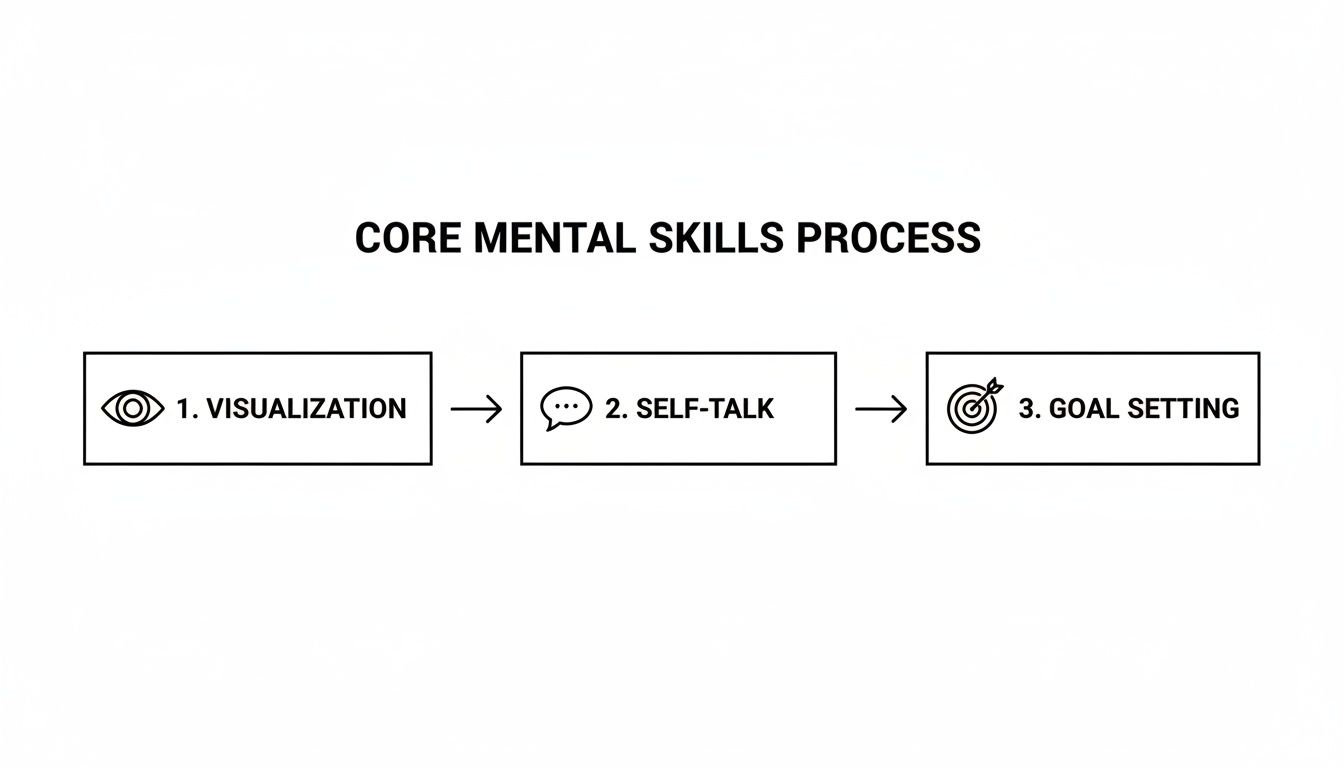
These three pillars—Visualization, Self-Talk, and Goal Setting—aren’t just separate tools. They work together to build a complete mental toolkit that you can pull from at any time.
Stage 1: Assess Your Mental Strengths
Before you can build anything, you have to know what you’re working with. A quick, honest self-assessment is the best way to see where you’re already solid and where you have the most room to grow. This isn’t about judging yourself; it’s just about gathering good data to make your training targeted and efficient.
Actionable Tip: Grab a notebook and rate yourself on a scale of 1-10 in these key areas immediately after a competitive game or a tough practice:
- Focus: How well do you stay locked in on the task at hand, especially when distractions pop up?
- Confidence: How stable is your belief in your abilities, particularly right after a mistake?
- Composure: How effectively do you manage nerves and frustration in those high-pressure moments?
- Motivation: How consistent is your drive to train hard and chase down your long-term goals?
The areas where you scored lowest? That’s your starting line. If composure is a 4, for example, then your initial plan should be heavy on drills like controlled breathing and emotional regulation.
Stage 2: Plan Your Drills and Routines
Once you know your focus areas, it’s time to build a weekly schedule. The secret is to start small. Weave these mental exercises into moments you already own—your commute, your warm-up, your cool-down. This simple trick removes the friction of trying to add “one more thing” to an already packed day.
Here are a couple of sample routines you can steal and adapt:
10-Minute Mental Warm-Up for Game Day
- Centering (2 mins): Find a quiet spot. Close your eyes and take 10 deep, slow breaths. Your only job is to focus on the air moving in and out.
- Highlight Reel Visualization (5 mins): Mentally replay three of your best past performances. Don’t just see it; feel the confidence and success from those moments.
- Cue Word Activation (3 mins): Repeat a simple, powerful cue word to yourself—something like “Execute,” “Relentless,” or “Focus.” Use it to anchor your mindset for the game.
Off-Season Resilience Building (15 mins, 3x per week)
- Mistake Rehearsal (5 mins): Visualize making a common mistake in your sport. Then, immediately visualize yourself responding perfectly—resetting your focus and flawlessly executing the very next play.
- Self-Talk Reframing (5 mins): Write down one negative thought that crept in during your last practice. Now, write down a more powerful, instructional replacement for it.
- Process Goal Setting (5 mins): Before your next physical training session, set one small, controllable process goal (e.g., “Maintain perfect form on every single lift”).
Effective planning isn’t about adding hours of work. It’s about strategically placing short, high-impact mental drills into your existing schedule to build consistency.
Stage 3: Execute Consistently
This stage is the simplest to understand but often the hardest to do: you just have to do the work. Consistency is what forges mental skills into automatic habits. Think of each drill as a single rep in the gym. One rep won’t make you stronger, but hundreds of them over time build undeniable strength.
Actionable Tip: A great way to stay on track is to link your mental drills to a habit you already have. For example: every time you put on your cleats, you run through your visualization script for two minutes. This “habit stacking” technique makes it much harder to forget or skip.
Stage 4: Review and Adjust Your Progress
The best programs evolve. Every two weeks or so, set aside 15 minutes to reflect on what’s working and what isn’t. This is where a simple journal becomes one of your most valuable pieces of equipment.
Actionable Tip: Use this post-game reflection journal template. It takes less than five minutes.
- One Thing That Went Well Mentally: Did you stay calm after a bad call? Did you use your cue word to get back on track?
- One Mental Challenge I Faced: When did you feel your focus slip or your confidence take a hit?
- How I Responded: What was your internal reaction when that challenge popped up?
- One Adjustment for Next Time: What specific mental drill can you practice this week to handle that situation better?
This kind of structured review is what ensures you’re constantly learning and sharpening your approach. It’s not just guesswork, either—the research confirms that systematic practice delivers real results. Meta-analyses on Psychological Skills Training show that committing to a structured program for 6–12 weeks leads to meaningful outcomes, like a 10%–30% reduction in competitive anxiety and big gains in performance consistency. You can discover more insights about these performance metrics and see exactly how a dedicated plan can make a measurable difference in your game.
The Link Between Pressure and Mental Health
It’s critical to acknowledge that the intense pressure of high-level competition can take a real toll on an athlete’s well-being. These aren’t just passing moments of game-day jitters; they can contribute to significant mental health challenges over time.
Research consistently shows that symptoms of anxiety and depression are common in elite athletes, with some large-scale reviews finding prevalence rates between 17%–45%. This really highlights why mental training must address the whole person, not just their performance anxiety.
That’s why skills like tactical breathing and cognitive reframing are so valuable. They build the resilience you need to perform at your best, but they also equip you to handle the pressures of life far beyond the field.
A Few Common Questions About Mental Training
Even after seeing all the benefits, I find that athletes and coaches still have some practical questions when they’re ready to get started. It’s only natural.
Let’s clear up some of the most common ones to give you a better sense of the road ahead.
How Long Until I See Results?
This is probably the most common question I get. While many athletes tell me they feel a shift in confidence in just a few weeks, the deep, lasting changes take time. Think of it like strength training—you don’t walk into the gym and expect to double your max lift in a week.
Real, measurable improvements in things like focus under pressure usually start to lock in after about 6 to 12 weeks of consistent, structured work. Consistency is everything; it’s what turns these conscious efforts into automatic, go-to skills when the pressure is on.
Can I Do This on My Own?
You absolutely can. Many athletes start building a solid mental foundation on their own with practices like visualization, journaling, and managing their self-talk. There are plenty of great books and resources out there to get you going.
However, bringing in a qualified sports psychologist is like hiring a world-class strength coach instead of just using the free weights. A professional will build a program just for you, spot the mental blocks you can’t see, and provide advanced strategies to break through plateaus that are incredibly tough to solve alone.
Key Takeaway: Going it alone is a fantastic start. But partnering with an expert is how you get to the elite level, with targeted guidance that accelerates your growth.
Is This Just for the Pros?
Not a chance. Mental training is for every athlete at every level—from kids just starting in youth leagues to collegiate competitors and seasoned pros. The core skills we work on—focus, confidence, resilience—are universal. They’re essential for anyone who wants to perform their best when it matters most.
In fact, starting these habits early gives young athletes a massive advantage. It builds a mental framework that not only helps them on the field but also teaches them how to handle stress and bounce back from setbacks in life.
What’s the Difference Between a Sports Psychologist and a Mental Coach?
This is a critical distinction, and it’s important you understand it. A mental coach is great for focusing on performance skills—things like goal setting, focus techniques, and pre-game routines. They provide valuable tools to sharpen your game.
A licensed sports psychologist, however, has advanced clinical training. We can do all of that, plus we’re qualified to diagnose and treat underlying mental health issues like performance anxiety or depression that can sabotage an athlete’s career. This allows for far more comprehensive care that addresses the whole person, not just the athlete, creating a foundation for both well-being and peak performance.
For more information on mental performance coaching or psychological services, or to schedule a consultation, visit my Sports Psychology Services page.