Mental toughness is all about building the resilience and laser-sharp focus you need to perform when the pressure is on. It’s not about ignoring or stuffing down your emotions. Far from it. It’s about managing them effectively so you can stay locked in on your goals, especially when stress and adversity are screaming for your attention.
What Mental Toughness Really Means for Elite Performers
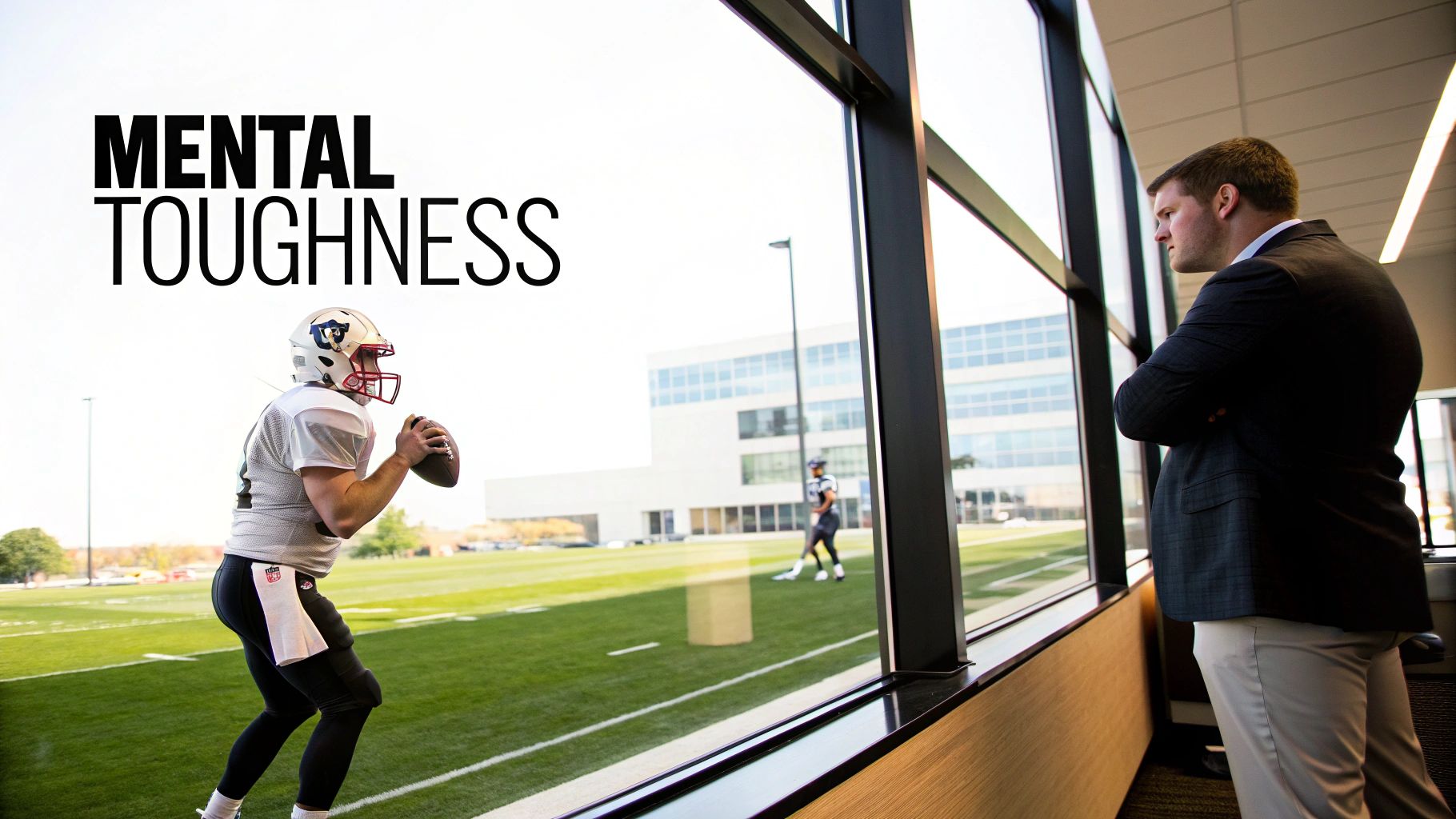
When you hear “mental toughness,” what comes to mind? Probably some stoic, unflinching character from a movie who never breaks a sweat. Let’s toss that cliché right out the window. True mental toughness isn’t about being a robot; it’s a dynamic, trainable skill set that helps you thrive when the stakes are highest.
This ability is what separates the good from the truly great. In fact, research shows that in 77.8% of studies, higher mental toughness was directly linked to superior performance and success in sports. A major meta-review of nine key studies drove this home, concluding that mentally tougher athletes simply outperform their peers, powered by traits like grit, optimism, and an unwavering will to persevere.
The Four Pillars of Peak Performance
So, what does this skill set actually look like? It’s not some vague, mystical quality. At its core, mental toughness is built on four distinct pillars. Once you understand these, you can start to build them in yourself.
Let’s break them down into what they look like in the real world, both on the field and in the boardroom.
| Pillar | Definition in Action | Athlete Example | Executive Example |
|---|---|---|---|
| Control | Staying composed and focused on what you can manage—your attitude, your effort, your next move—no matter the chaos around you. | A golfer misses a simple 3-foot putt but immediately refocuses on their pre-shot routine for the next tee shot, leaving the mistake behind. | An unexpected market downturn hits. The CEO focuses the team on controllable factors like customer retention and operational efficiency. |
| Commitment | Having an unshakeable dedication to your goals, pushing through the grind even when motivation is low and the finish line seems miles away. | A marathon runner hits “the wall” at mile 20 but digs deep, remembering their training and sticking to their pacing strategy to finish strong. | A project lead faces multiple setbacks and team burnout but maintains the vision and rallies everyone to push through to the deadline. |
| Challenge | Viewing obstacles not as roadblocks, but as opportunities to learn, adapt, and grow stronger. Failure is just feedback. | A tennis player loses a tough three-set match, then spends the next day analyzing video with their coach to identify tactical errors. | A product launch fails to meet initial projections. The leader treats it as valuable market data, pivoting the strategy based on feedback. |
| Confidence | Possessing a deep, quiet belief in your ability to succeed, grounded in your preparation and experience. It’s not arrogance; it’s trust. | A quarterback steps onto the field for a game-winning drive, fully believing in their ability to read the defense and make the right throws. | A founder walks into a high-stakes pitch meeting with VCs, calmly and clearly articulating their vision, backed by months of preparation. |
Each of these pillars is crucial. Recognizing how they work together is the first step. For instance, the “Challenge” pillar is deeply connected to cultivating a growth mindset for resilience and perseverance—a foundational trait for anyone looking to perform at an elite level.
Mental toughness is the psychological edge that allows you to cope better than your opponents with the demands of performance and to be more consistent and better than your opponents in remaining determined, focused, confident, and in control under pressure.
Your Daily and Weekly Mental Training Regimen
Just like you build physical strength with consistent reps in the gym, mental toughness is forged through a dedicated training schedule. This isn’t about finding extra hours in your already packed day. It’s about weaving small, powerful exercises into your routine that build mental muscle over time.
Think of this as your workout plan for the mind. We’re talking daily habits and weekly drills designed to sharpen your focus, harden your confidence, and make you more resilient when the pressure is on.
This is where the self-assessment you just did becomes your roadmap. The blueprint below shows how to turn that assessment into targeted, effective training.
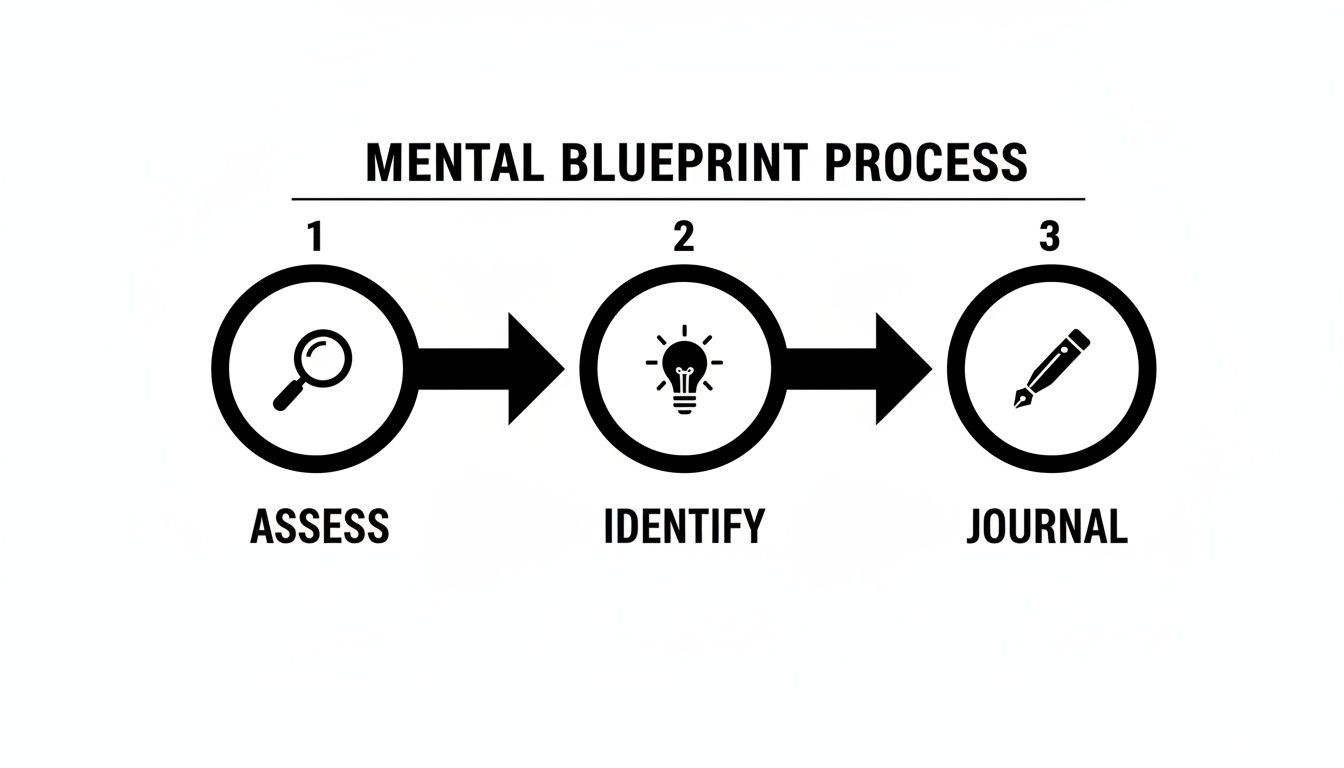
This simple flow—Assess, Identify, and Journal—is how you turn vague feelings into actionable data. It ensures you’re always working on what matters most.
Mastering Your Daily Five-Minute Drills
Consistency is everything. These quick daily exercises are designed to be non-negotiable parts of your day, and each takes less than five minutes.
- Morning Visualization: Before you even think about checking your phone, spend five minutes visualizing your day. Picture yourself crushing your biggest challenge, whether it’s nailing a client presentation or sinking a game-winning free throw. Engage all your senses. What do you see? What do you hear? Crucially, how do you feel when you succeed? This simple act primes your brain for success and sets a confident tone for the whole day.
- Pre-Performance Ritual: This is your mental on-switch. Create a simple, repeatable sequence to lock in your focus before any big moment. It could be as simple as taking three deep, slow breaths and repeating a key phrase like, “I’m ready for this.” A sales exec might do this in their car before a big meeting; an athlete might do it in the locker room. The ritual signals to your brain that it’s time to perform.
If you need a hand staying on track, some of the best daily routine apps can be a huge help in keeping these new habits consistent.
Your Weekly Resilience Training
Daily habits build your foundation, but weekly exercises are where you actively practice handling pressure. This is where we move from theory to application, creating controlled challenges to build real-world toughness.
The point of weekly training isn’t to avoid stress, but to expand your capacity to handle it. You’re deliberately stepping outside your comfort zone in a structured, productive way.
One of the most powerful weekly practices is stress inoculation. The idea is to build up an immunity to stress—much like a vaccine—by exposing yourself to it in controlled, low-stakes scenarios.
- Practical Example: A public speaker could practice their big speech in front of a hypercritical friend who has full permission to interrupt and grill them with tough questions. A basketball player could practice free throws while their teammates are actively trying to distract them. This kind of controlled exposure makes the real thing feel far more manageable.
Applying Your Skills When It Actually Counts
It’s one thing to practice mental exercises in the quiet of your own home, but it’s a completely different ballgame to pull them off when a championship, a big presentation, or a critical surgery is on the line. This is where your mental toughness training really shows its worth.
The goal is to close the gap between practice and performance. You want these mental tools to become so ingrained, so automatic, that they just happen when you need them most. It’s not about trying to wish away the pressure—that’s impossible. It’s about having the right moves to perform brilliantly right in the middle of it.
Master Your Reset Routine
Look, mistakes happen. A missed putt, a flubbed line in a speech, a negotiation that hits a wall—these moments can send you into a tailspin. Mentally tough people don’t avoid mistakes; they just recover from them faster. They have a pre-planned ‘reset routine’ that allows them to instantly park the error and get their head back in the game.
Think of it as hitting a mental circuit breaker. Your routine can be dead simple, but you have to practice it until it’s a reflex.
- Physical Cue: It could be something as small as clapping your hands once, pulling on your earlobe, or adjusting your watch. This physical action draws a line in the sand, separating you from the mistake.
- Mental Cue: Pair that action with a short, powerful phrase. After a turnover, a point guard I worked with would tap his chest and think, “Next play.” A surgeon facing an unexpected issue might take a deep, centering breath and tell himself, “Calm and steady.”
This quick one-two punch yanks you out of that emotional, reactive spiral that mistakes trigger. It puts you back in the driver’s seat, focused on what you need to do right now, not what just went wrong.
“A common mistake is believing that mental toughness means never feeling the pressure. In reality, it means having practiced, reliable strategies to manage that pressure so it doesn’t manage you. Your reset routine is your most trusted ally in those critical moments.”
The mental load of high-stakes performance is no joke, and it often goes unseen. Did you know that up to 35% of elite athletes deal with mental health crises like severe stress and anxiety? Those with real mental toughness are simply better prepared to handle it. Having practical tools like a solid reset routine helps protect their well-being and maintain their competitive edge. You can discover more insights about the mental health landscape for athletes and how toughness provides a buffer right here.
Narrow Your Focus When It Counts
When the pressure cranks up, our attention scatters. We start worrying about the score, what our boss is thinking, or the fallout from failure. The trick to mental toughness is learning to consciously shrink your world. Narrow your focus down to the smallest, most immediate thing you can control.
A surgeon doesn’t think about the entire six-hour operation at once. Before making the first incision, their focus is only on the final mental checklist for that single step. A baseball closer isn’t thinking about winning the World Series; he’s thinking about executing this one pitch.
Here are practical examples for figuring out your “spotlight” for any big task.
- Before a Presentation: Your spotlight isn’t on the whole 30-minute talk. It’s just on your opening sentence. Nail it. Then the spotlight moves to your next point.
- At the Free-Throw Line: The spotlight isn’t on the scoreboard. It’s on the feel of the ball’s texture and the look of the front of the rim. Nothing else exists.
- In a Tense Negotiation: The spotlight isn’t on closing the deal. It’s on asking your next planned question in a calm, clear voice.
This intentional narrowing of focus is a powerful antidote to performance anxiety in sports and other high-pressure arenas. It takes a huge, overwhelming situation and breaks it down into one simple, doable task.
Control Your Body with Strategic Breathing
That racing heart, the shallow breathing, the sweaty palms—those aren’t just feelings. They’re physiological responses you can get a handle on. Strategic breathing is one of the quickest ways to send a message to your body that you’re still in charge.
Before a big moment, find 30 seconds. That’s all you need for a simple box breathing exercise:
- Inhale slowly through your nose for a count of four.
- Hold your breath for a count of four.
- Exhale slowly through your mouth for a count of four.
- Hold the exhale for a count of four.
Do this three to five times. This simple pattern physically slows your heart rate, dials back cortisol, and shifts your nervous system from “fight or flight” back to “calm and focused.” It’s a tool you can use anywhere, anytime—in the boardroom, the locker room, or backstage—to stop your body from hijacking your mind.
How Do I Know If Any of This Is Actually Working?
You’ll see it and you’ll feel it. The subjective proof is often the first thing you notice. You might find yourself feeling calmer under pressure, or you’ll bounce back from a mistake in seconds instead of minutes. You’ll just have a stronger sense of belief in yourself when things get chaotic.
For more objective proof, look at your performance. Are you more consistent? Are you hitting your process goals more often? A great tool is to create your own “Mental Performance Index.” After a game, a presentation, or any key event, rate your focus, confidence, and emotional control on a scale of 1-10. Track those numbers over time. An upward trend is concrete proof that your mental training is paying off.
Ready to go from troubleshooting to true mastery? Having the right guide in your corner can accelerate the entire process. At Dr. John F. Murray, we use proven, evidence-based strategies to help elite athletes, executives, and anyone motivated to perform at their best build the mental skills they need to win.
For more information on mental performance coaching or psychological services, or to schedule a consultation, visit my Sports Psychology Services page.