Cognitive behavioral therapy techniques are your toolkit—practical, proven strategies to manage your thoughts, feelings, and actions so you can deliver under pressure. This isn't abstract talk therapy. Think of CBT as structured mental skills training, like strength conditioning for your brain, designed to build resilience and sharpen focus when everything is on the line.
Why CBT Is a Game Changer for High Achievers
For elite athletes, executives, and other driven performers, the gap between good and great is almost always mental. You’ve put in the reps, honed your physical skills, and mastered your business acumen. But what happens when the pressure hits?
The core principle of CBT is simple but incredibly powerful: your thoughts directly control your emotions and behaviors. A single flash of self-doubt before a big presentation ("What if they ask a question I can't answer?") or a crucial play can kick off a cascade of anxiety and physical tension, sabotaging the very performance you’ve worked so hard to perfect. This isn't about fuzzy "positive thinking." It's a systematic approach to identifying and rewiring the specific mental habits that are holding you back.
A Proven Framework for Mental Toughness
The power behind cognitive behavioral therapy techniques isn’t new; it’s built on decades of solid proof. These methods came about when psychology began demanding measurable results. In fact, a landmark 1977 trial showed cognitive therapy was even more effective than antidepressants for major depression.
This history has shaped the modern expectation that mental resilience—from an athlete's focus to an executive's stress management—should be trained with evidence-based strategies, just like any other professional skill.
For the high achiever, CBT provides a clear blueprint for mental mastery. It transforms abstract concepts like "confidence" and "focus" into concrete actions and habits you can practice and perfect daily.
This is the secret weapon for those who refuse to leave their mental game to chance. Instead of just reacting to pressure, you learn to proactively control your internal state, giving you a decisive edge. To further support these benefits, many of my clients also explore brain health supplements for cognitive performance.
Building Your Mental Toolkit
Think of these strategies as high-performance training for your mind. They're built to give you a real, actionable advantage by helping you:
- Master emotional control in high-stakes environments.
- Dismantle performance anxiety and self-sabotaging thoughts.
- Build unshakable confidence based on evidence, not just hope.
- Sharpen focus and decision-making under duress.
By integrating these methods, you develop the mental architecture needed to thrive under pressure. My comprehensive guide on stress management techniques for athletes offers additional strategies that perfectly complement this approach. Now that you understand the "why," this guide will give you the "how"—the actionable steps to start building your mental edge today.
How to Reframe Performance Killing Thoughts
High-stakes moments have a nasty habit of inviting unwelcome guests into your mind. I call them Automatic Negative Thoughts (ANTs)—those knee-jerk, pessimistic predictions that just show up, no invitation needed. For a salesperson, it's that sinking feeling, "I'm going to lose this deal." For an athlete, it's the all-too-familiar whisper, "I always choke under pressure."
These thoughts feel incredibly real in the moment, kicking off a chain reaction of anxiety, tight muscles, and outright self-sabotage. The solution isn't to just ignore them or paste on a fake smile. The most powerful CBT techniques I teach my clients involve systematically dismantling these thoughts with cold, hard evidence. You learn to become a detective of your own mind, questioning every assumption and building a case for a more balanced, realistic perspective.
Identifying Your Automatic Negative Thoughts
You can't challenge a thought you don't even realize you're having. The first step is simply to notice. These ANTs are sneaky, but they often fall into predictable patterns, what we call cognitive distortions. Learning to spot these is like learning to read a pitcher's tell—it gives you an immediate upper hand.
Some of the most common performance-killers I see include:
- Fortune Telling: You're predicting a negative future without any actual proof. "This presentation is going to bomb."
- Mind Reading: You act like you know what others are thinking, and it's always bad. "The coach thinks I'm not ready for this."
- All-or-Nothing Thinking: Everything is black-and-white. If you aren't perfect, you're a complete failure. "I missed that deadline, so now the whole project is ruined."
- Labeling: You take one event and slap a permanent, negative label on yourself. You miss one shot and the thought isn't, "I missed that one," but rather, "I'm a choker."
Actionable Tip: For the next week, set a reminder on your phone for midday. When it goes off, take 60 seconds to jot down any negative thought you've had. This simple act of observation builds the awareness you need to start making changes.
The Thought Record: A Practical Tool for Clarity
A thought record is my go-to tool for getting this stuff out of your head and onto paper (or a screen), where you can deal with it logically. It forces you to stop the chaotic spiral and analyze your thoughts with some objectivity.
Let's take an executive I worked with, Sarah. She would feel a wave of panic before every board meeting. Her ANT was, "They're going to see I'm an imposter and that I don't deserve this role."
Here’s how we used a thought record to break it down:
| Situation | Automatic Thought & Emotion | Evidence For | Evidence Against | Balanced Reframe |
|---|---|---|---|---|
| Preparing for board meeting | "They'll see I'm an imposter." (Anxiety: 90%) | I'm nervous about a couple of the slides. One board member can be very critical. | I've successfully led this department for three years. My last performance review was "exceeds expectations." I know this material inside and out. | "I feel nervous, which is normal for a big meeting. But I am well-prepared and have a proven track record. Even if I get a tough question, I have the knowledge to handle it." |
See what happened? Sarah didn't just "think positive." She built a rational, evidence-based case against her own fear. The goal isn't to magically erase anxiety; it's to cut it down to size by grounding yourself in reality.
Mastering Your Challenge Questions
When the pressure is on, you need a reliable process. That's where having a script of challenge questions comes in. It’s like a golfer's pre-shot routine. You're not searching for an answer that feels good; you're hunting for the one that's true.
The Best Friend Test: This is one of the simplest yet most effective techniques I use. Just ask yourself, "What would I say to my best friend if they were in this exact situation with this exact thought?" We are almost always kinder, fairer, and more rational with our friends than we are with ourselves. It's an instant perspective shift.
Develop your own list of go-to questions. Here are a few to get you started:
- What's the actual evidence for this thought? What's the evidence against it?
- Am I mistaking a feeling for a fact?
- How many times has this thing I'm afraid of actually happened?
- What's the most likely scenario here, not just the absolute worst-case one?
- And if the worst-case scenario did happen, how would I handle it?
Let’s put this into practice with a basketball player struggling with free-throw anxiety. His automatic thought is, "I'm going to miss this and let the whole team down."
He can run through his questions right there on the line:
- Evidence Against: "I've made 80% of my free throws in practice all week. My routine is solid."
- Most Likely Scenario: "The most likely thing to happen is that I make it, just like the thousands of times I have before. Even if I miss, the game isn't over."
- Coping Plan: "If I miss, I take a breath, get back on defense, and lock in on the next play. One shot doesn't decide the game."
This kind of structured self-talk short-circuits the panic. It replaces that vague, overwhelming fear with specific, logical reasoning. That's the core of cognitive reframing—you're not changing the situation, you're changing the destructive story you tell yourself about it.
Testing Your Limiting Beliefs in the Real World
Once you’ve wrestled with your negative thoughts on paper, it's time to take the fight into the real world. Thinking is one thing; doing is another. This is where one of the most powerful cognitive behavioral therapy techniques comes into play for high achievers: the behavioral experiment. It’s a structured way to gather cold, hard evidence against your biggest anxieties.
This isn’t about being reckless. Think of yourself as a scientist of your own performance, methodically testing the assumptions that are holding you back. Your limiting beliefs aren't facts—they're just hypotheses waiting to be disproven.
From Hypothesis to Hard Evidence
A behavioral experiment is your chance to prove your anxieties wrong with undeniable data. It's a safe, controlled process that puts you in charge, letting you challenge fears with action, not just internal arguments.
I see this all the time with executives. Take a manager who's drowning in work because she believes, "If I delegate this important task, it won’t get done right and I’ll have to fix it anyway." This thought forces her to micromanage and burn out, all while stunting her team's growth. Her experiment? Delegate one small, low-risk piece of a project and see what actually happens, not what she fears will happen.
It’s the same on the field. I coached an athlete recovering from a knee injury who was haunted by the thought, “My knee is still too weak; if I push it, I’ll get hurt again.” This fear paralyzed him. So, we designed an experiment with specific, controlled drills. We gradually increased the intensity to gather objective proof of what his knee could truly handle.
The basic flow is simple: you spot the negative thought, challenge its logic, and then reframe it into something more balanced before you put it to the test.
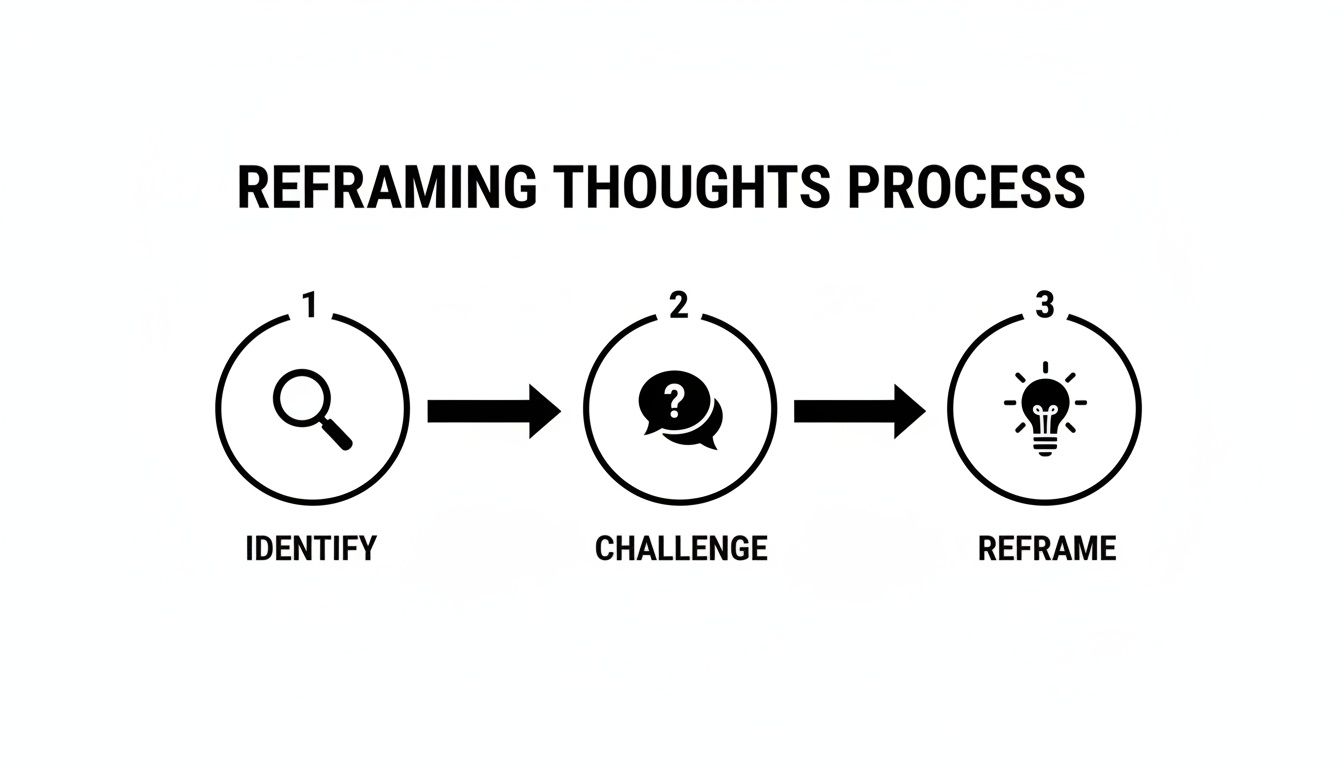
This process turns a more balanced thought into real, confident action. It's the bridge from your mind to the material world.
Designing Your First Behavioral Experiment
A good experiment doesn't need to be complicated. In fact, simplicity is key. All you need is a focused plan to systematically gather evidence that can reshape your entire mindset from the outside in.
Here's a straightforward template to help you design your own experiment. It's a practical way to structure your thinking and your actions.
Designing Your Behavioral Experiment a Practical Template
| Step | Guiding Question | Athlete Example (Fear of Re-injury) | Executive Example (Fear of Delegating) |
|---|---|---|---|
| 1. Identify the Belief | What core belief or assumption do I want to test? | "My knee is too weak for explosive movements, and I'll reinjure it." | "If I delegate a critical client email, my team member will miss key details and damage the relationship." |
| 2. Make a Prediction | What is the worst-case scenario I expect to happen? How likely is it (0-100%)? | "I predict I will feel a sharp pain and have to stop. I believe this is 75% likely." | "I predict the email will contain errors and the client will be upset. I believe this is 80% likely." |
| 3. Design the Test | What is a small, safe, and measurable action I can take to test this? | "I will perform three sets of five box jumps on a 12-inch box under my trainer's supervision." | "I will ask my senior team member to draft the client email and send it to me for a quick review before it goes out." |
| 4. Analyze the Results | What actually happened? What did I learn from the evidence? | "I completed all sets with no pain. My knee felt strong. The fear was much worse than the reality. My prediction was wrong." | "The draft was excellent and only needed one minor tweak. The client responded positively. My team is more capable than I assumed." |
This approach works because it moves beyond endless internal debate. You stop trying to think your way into a new belief and start acting your way there. Every piece of concrete evidence builds a stronger foundation of confidence.
Practical Tips for Effective Experiments
To really make this technique work for you, keep a couple of things in mind.
First, start small. The goal here is to build momentum, not to bite off more than you can chew. If you fear public speaking, don't sign up for a keynote. Instead, volunteer to speak for just 30 seconds in the next low-stakes team meeting. A small, definitive win is far more valuable than a huge, terrifying test you keep putting off.
Second, get specific and make it measurable. A vague goal like "be more confident" is impossible to test. But an action like "speak up with one idea in the next team meeting" gives you clear, hard data. This specificity makes the whole process less intimidating and the results undeniable. It's one of the most powerful cognitive behavioral therapy techniques precisely because it creates a direct feedback loop between insight and action, sparking real, sustainable growth.
Building Resilience with Pressure Inoculation Training
What if you could vaccinate yourself against pressure? That’s the core idea behind Pressure Inoculation Training (PIT), a powerful strategy I've adapted from the systematic exposure techniques found in cognitive behavioral therapy. It’s all about methodically building your tolerance to stress, so that when the stakes are high, you’re already conditioned to perform.
This isn't about just throwing yourself into the fire and hoping for the best. Instead, you intentionally and incrementally expose yourself to increasing levels of stress in a controlled training environment. With each exposure, the pressure loses its psychological power, allowing you to stay calm, clear, and effective when it truly counts.
How Pressure Inoculation Works in the Real World
I once coached a surgeon who used high-fidelity simulations of complex, high-risk procedures. By repeatedly facing equipment malfunctions and unexpected complications in a simulated OR, the chaos of a real-life crisis became familiar territory. His mind and body simply learned to stay steady under duress.
The same principle applies to a public speaker terrified of stage fright. They might start by rehearsing in front of a mirror, then for a supportive friend, then a small group of colleagues, and finally a larger, more critical mock audience. Each step up the ladder "inoculates" them against the anxiety of the final performance.
These principles come from a long history of evidence-based practice. CBT is one of the most rigorously studied approaches in psychotherapy, with more than 2,000 outcome studies backing its effectiveness. Exposure-based methods, which are the foundation of pressure inoculation, have been repurposed from clinical settings to help top performers build real-world resilience.
Creating Your Personal Pressure Hierarchy
The secret to making pressure training work is building a "pressure hierarchy"—a ladder of challenges that takes you from minimal stress to your ultimate performance goal. This systematic approach ensures the training is productive, not overwhelming. We're looking for that sweet spot where you're challenged but not completely flooded with anxiety.
First, you need to clearly define the high-pressure situation you want to master. Is it nailing a sales pitch to a skeptical client? Sinking the winning putt? Leading your team through a corporate crisis? Once you have your peak scenario in mind, you can reverse-engineer the steps to get there.
Let’s map out a sample hierarchy for a young quarterback I might work with who struggles on game day:
- Level 1 (Low Stress): Execute plays perfectly against cones, with no defense.
- Level 2 (Mild Stress): Run the same plays against a scout team defense that isn't allowed to rush the passer.
- Level 3 (Moderate Stress): Practice against the scout team with a simulated pass rush and crowd noise blasting over speakers.
- Level 4 (High Stress): Add a time constraint with a simulated game clock ticking down.
- Level 5 (Peak Stress): Run a full scrimmage against the first-team defense with real consequences for failure (e.g., push-ups for an interception).
By mastering each level before moving to the next, the quarterback’s brain learns that he can execute his skills even as the environmental stress increases. The pressure becomes a familiar signal to focus, not a trigger for panic.
This gradual, structured exposure is a cornerstone of building unshakeable mental fortitude. For those who want to dig deeper, our guide on how to build mental resilience offers complementary strategies.
Knowing When to Push and When to Pause
Effective pressure inoculation is a balancing act. It requires self-awareness to know when to push your limits and when to avoid burnout. The goal is to stretch your comfort zone, not snap it.
Follow these practical guidelines to keep your training productive:
-
Stay at Each Level Until It's Boring: Don't rush. You need to remain at one level of your hierarchy until the task feels almost routine and your anxiety is minimal. This ensures you've fully adapted before cranking up the difficulty.
-
Use a Subjective Stress Scale: Before and after each session, rate your stress on a scale of 1 to 10. You want to find a moderate challenge (around a 5-7) that drops significantly by the end. If you’re consistently hitting 8s or 9s, it's a sign to dial the pressure back.
-
Prioritize Recovery: Mental stress requires recovery, just like physical training. Balance intense pressure simulations with lower-stress activities and plenty of rest. Pushing too hard, too often, only leads to burnout and diminished returns.
This disciplined application of cognitive behavioral therapy techniques transforms pressure from a threat into an opportunity. By systematically inoculating yourself, you build the robust mental resilience needed to not just survive high-stakes moments, but to thrive in them.
Integrating CBT Techniques into Your Daily Routine
Knowing these powerful cognitive behavioral therapy techniques is just the first step. The real challenge—and where the magic happens—is making them a reflex. The goal is to move these strategies from a conscious effort to second nature, integrating them so deeply they become part of your mental operating system.
Great ideas are useless without consistent action. We want to weave these skills into the fabric of your life so you’re practicing mental toughness without even thinking about it. This is done by creating simple, repeatable rituals that anchor your mental training to your existing schedule.
Small Habits Big Impact
You don't need to carve out an hour a day for "mental practice." Instead, I tell my clients to hunt for small windows of opportunity to apply these skills in real-time. The secret is to connect a specific CBT technique to a common trigger you already face every day.
This approach makes getting started easy and builds consistency that feels effortless. Think of it as doing mental reps throughout your day. You're strengthening your psychological muscles with each small, deliberate action.
Here are a few micro-habits I've seen work wonders:
- The 5-Minute Mental Reset: After a brutal meeting, a missed sale, or a frustrating mistake on the field, take just five minutes. Instead of letting your mind spiral, grab a notebook and run through a quick thought record. Pinpoint the automatic negative thought ("I completely blew that pitch"), challenge it with evidence ("The client actually agreed with two of my main points"), and write down a more balanced perspective ("It wasn't a home run, but I gathered useful feedback for the next attempt").
- Schedule One Weekly Experiment: Every Sunday night, identify one small behavioral experiment to try that week. Maybe you'll finally delegate a task you always hoard, or you'll try a new drill in practice that you're afraid of failing at. Whatever it is, put it in your calendar. Treat it like any other appointment.
- The Commute Cool-Down: Use your drive or train ride home to actually process the day. Don't just let the stress marinate. Mentally review one challenge you faced and ask: What was my automatic thought? How did I react? What’s one thing I could do differently next time?
Weaving CBT into Your Performance Routines
High performers live and die by their routines. So, one of the most effective ways to make these CBT techniques stick is to piggyback them onto the pre- and post-performance rituals you're already doing. This forges a direct link between the mental skill and the high-stakes environment where you need it most.
Your pre-game warm-up isn't just for your muscles; it's for your mind. Adding a quick visualization exercise is incredibly powerful. Before you walk onto the court or into the boardroom, take three minutes to mentally rehearse success. See yourself executing your plan flawlessly, handling unexpected problems with calm confidence, and achieving the outcome you want. For a deeper look at this, I've written extensively about the crucial connection between visualization and sports.
Just as tracking thoughts and emotions is crucial for CBT, high achievers often find value in maintaining a comprehensive progress log for other aspects of their development, such as their physical fitness routine.
The same idea applies after you perform. Don't just celebrate a win or agonize over a loss. Make a quick journal entry part of your cool-down. Note one thing that went well mentally ("I stayed focused after that early mistake") and one challenge where you could have applied a CBT skill more effectively ("I let that bad call get to me; next time I'll use my reframing questions"). This systematic reflection turns every performance—good or bad—into a valuable data point for growth. It ensures these cognitive behavioral therapy techniques are delivering real, measurable results where it counts.
Your Questions About CBT for Performance Answered
Whenever I introduce powerful mental tools like CBT to athletes and executives, a few key questions always come up. It's natural to be curious about how these techniques work outside of a clinical setting and in the high-stakes world of performance. Let's tackle some of the most common ones I hear.
Can I Use These CBT Techniques on My Own or Do I Need a Coach?
Absolutely, you can get started on your own. Many core CBT skills, like keeping a thought record or running small behavioral experiments, are designed for self-application. Think of them as mental drills—the more you practice, the stronger and more resilient you become.
That said, bringing in a qualified sports psychologist or executive coach can be a game-changer. An expert can spot blind spots in your thinking you might miss, help you design more effective challenges, and provide the accountability needed to push through plateaus. For stubborn performance blocks or significant anxiety, professional guidance is always the fastest and safest path forward.
How Long Does It Take to See Real Results?
This is the big one, and the answer is: it varies. But many performers feel an immediate shift—a sense of restored control—the very first time they successfully reframe a negative thought. You'll start noticing tangible changes in your mindset and performance within just a few weeks of consistent practice.
And consistency is everything. You wouldn't expect to get physically stronger by hitting the gym once a month. The same goes for your mental game. Committing to just 10-15 minutes a day—like doing a quick thought record during your coffee break—builds the foundation, and within four to six weeks, you can see profound, lasting improvements in how you handle pressure.
The biggest mistake I see is treating mental training like a quick fix. True mental toughness isn't about learning a trick; it's about building habits that kick in automatically when the stakes are highest.
Are There Times When CBT Techniques Are Not the Right Tool?
While CBT is incredibly powerful, it's not the solution for every single problem. These techniques are at their best when tackling issues rooted in your thought patterns and behaviors.
If a slump is caused by something external, like a toxic team culture, or a physical injury that needs medical attention, CBT is a fantastic tool for support, but it won't fix the root cause. For example, you can use CBT to manage the frustration of being injured, but it won't heal the torn ligament. Likewise, for serious clinical conditions like severe depression or complex trauma, CBT should be one part of a comprehensive treatment plan supervised by a licensed clinical professional. The goal is always to use the right tool for the job.
Ready to stop guessing and start building a systematic mental training plan? At Dr. John F. Murray, I provide evidence-based strategies tailored to the unique pressures faced by elite performers. Schedule a consultation today and learn how to build an unshakeable mental edge. Learn more at https://www.johnfmurray.com.