To truly overcome a mental block, you have to get your hands dirty. It’s a process of facing down those negative thoughts, challenging them head-on, and building new, stronger mental habits to keep them from coming back. This guide is your roadmap—not just for getting past the block, but for turning that barrier into a launchpad for growth.
Your First Step to Breaking Through Performance Barriers

Every performer knows the feeling. You’re in a high-stakes moment, everything is on the line, and then… your mind goes blank. Whether you’re an athlete staring down the final shot, an executive about to give a critical presentation, or an artist facing a blank canvas, that invisible wall can feel impossible to climb.
But here’s the good news: mental blocks are not a sign of weakness or a personal failure. They are a trainable challenge, and you absolutely have the power to conquer them.
This guide gives you a practical, no-nonsense plan filled with the same science-backed strategies used by elite performers to stay at the top of their game. You’ll walk away with real techniques you can start using today.
What You Will Learn
Forget vague advice. We’re diving deep into proven methods that deliver real, measurable change. Here’s a glimpse of what’s ahead:
- Cognitive Reframing Techniques: You’ll learn to catch that negative inner voice that fuels the block and actively replace it with thoughts that are constructive and empowering. For example, changing "I'm going to fail" to "I am prepared to handle this challenge."
- Powerful Visualization Exercises: I’ll show you how to mentally rehearse success with such clarity that confident performance starts to feel like second nature. You'll learn a step-by-step process to see, feel, and hear a successful performance before it happens.
- Structured Pre-Performance Routines: We’ll build a consistent warm-up ritual that locks in your focus, quiets the nerves, and sets the stage for you to perform at your best. This includes physical, mental, and emotional steps to get you in the zone.
A mental block is simply your brain's protective response to perceived pressure or threat. The key isn't to fight it, but to understand its trigger and systematically dismantle its power over you through consistent mental training.
Why This Matters for Peak Performance
Look at any top-tier performer, and you’ll find stories of them facing and conquering career-threatening mental hurdles. NBA All-Star Tracy McGrady, for example, famously broke through a slump after working with sports psychologist Dr. John F. Murray, crediting those cognitive-behavioral strategies for helping him regain his elite form.
This isn't just an athlete’s problem, either. The anxiety that often drives these blocks is a massive global issue. Back in 2019, anxiety disorders affected a staggering 301 million people worldwide. You can discover more about these findings and see just how deeply this impacts performance in every field. The strategies that work on the court or field are the same ones that can help you excel in the boardroom or on stage.
Understanding What Causes Mental Blocks
To tear down a mental block, you first have to play detective and figure out how it was built. These frustrating walls don’t just pop up overnight. They’re constructed brick by brick from very specific psychological triggers, and understanding their source is the only way to start breaking through.
At its core, a mental block is often a misguided protective mechanism. Your brain senses a high-stakes situation, labels it a "threat," and slams on the emergency brake. This “freeze” response is meant to protect you, but in a performance setting, it cuts you off from the very skills you’ve spent thousands of hours honing.
I’ve seen it countless times. A golfer suddenly gets the "yips" and can't sink a three-foot putt. A seasoned executive freezes mid-presentation. The problem isn't that their skill vanished—it's that their brain's threat-detection system went haywire, shutting down the neural pathways needed for fluid, automatic performance.
The Role of Performance Anxiety
Performance anxiety is probably the most common culprit I see in my practice. It's that intense dread tied to performing in front of others, where the pressure to deliver feels completely overwhelming. Your heart pounds, palms get sweaty, and your breathing goes shallow—that’s your body’s fight-or-flight response taking over.
When your body is in that state of high alert, it’s nearly impossible to stay present and focused. Your attention flips from the task to the chaos inside your own head and the fear of what everyone else is thinking. For a practical tip, try the "box breathing" technique: inhale for four seconds, hold for four, exhale for four, and hold for four. This simple exercise can calm your nervous system in minutes. To get a better handle on this, exploring the dynamics of performance anxiety in sports offers a great look into how pressure affects athletes and performers in any field.
The Crippling Effect of Perfectionism
Perfectionism is another major architect of mental blocks. It sets an impossible standard where the only acceptable outcome is flawless execution. This mindset turns every single attempt into a high-stakes test, where anything less than perfect feels like a catastrophic failure.
The result? Total paralysis. A writer stares at a blank page for hours, terrified of typing a sentence that isn't perfect. An athlete hesitates during a key play, overthinking every option instead of trusting the instincts they’ve trained for years. Perfectionism whispers that it’s safer to do nothing at all than to risk making a single mistake. An actionable tip is to set a "good enough" goal. For example, tell yourself, "I'm going to write a rough draft for 25 minutes without hitting the backspace key." This lowers the stakes and gets you moving.
The great irony of perfectionism is that in its relentless pursuit of an ideal outcome, it often produces no outcome at all. It fuels the very hesitation and self-doubt that create the mistakes it’s so desperate to avoid.
Fear of Failure and Past Setbacks
A deep, nagging fear of failure is another primary driver. This isn't just about losing or missing a goal; it's about what you believe that failure says about you. You start worrying it proves you aren't good enough, that you’ll let people down, or that you’ll have to face public embarrassment.
This fear is almost always amplified by negative memories. If a pitcher gave up a game-winning home run in last year's championship, that single moment can haunt them every time they step back on the mound. The brain flags the situation as dangerous, triggering a mental block to prevent that emotional pain from happening again.
It becomes a self-fulfilling prophecy. The fear of repeating a mistake makes you so tense and hesitant that you end up freezing, making the very error you were trying to avoid. To combat this, try a "fear-setting" exercise: write down the worst-case scenario, what you could do to prevent it, and how you would recover if it happened. This often reveals the fear is more manageable than you thought. Pinpointing these triggers is your first major win in this battle.
Proven Techniques to Systematically Dismantle Mental Blocks
Okay, we've unpacked the why behind mental blocks. Now, let's get into the how—your practical playbook for tearing down those invisible walls, piece by piece. There's no single magic bullet here. The real key is consistently applying a combination of powerful, evidence-based strategies.
We're going to focus on three pillars of mental training that I've seen deliver incredible results with clients: rewiring your thoughts with cognitive-behavioral techniques, building a mental blueprint for success through visualization, and sharpening your concentration with focus drills to stay grounded when the pressure hits.
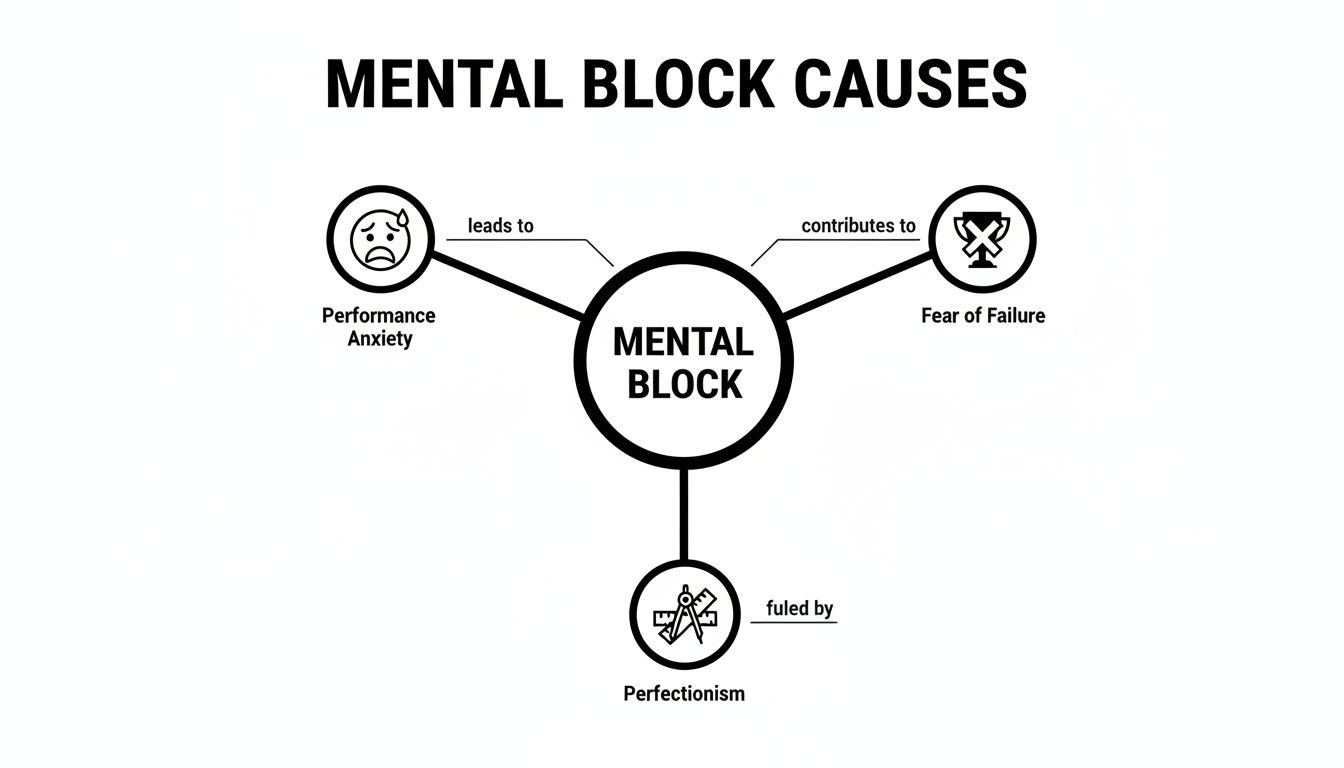
This diagram shows how the common culprits we discussed—performance anxiety, fear of failure, and perfectionism—all funnel into that central feeling of being blocked.
Because each trigger is different, you need a versatile toolkit. Relying on just one method is like trying to build a house with only a hammer. It just won't work.
Reframe Your Inner Dialogue with Cognitive Strategies
Your internal monologue is the director of your performance. When you're stuck, that inner voice often becomes your harshest critic, running a non-stop loop of doubt, fear, and worst-case scenarios. Cognitive-behavioral strategies are all about grabbing the remote, identifying that destructive script, and rewriting it.
The first step is simply to notice the negative self-talk without judging it. Catch the thought before it spirals. The moment you feel that familiar dread or hesitation, just pause and ask yourself, "What am I telling myself right now?"
Once you’ve caught the thought (like "I'm going to completely mess this up" or "They're all going to see I'm a fraud"), you start to poke holes in it. Is that thought 100% true? Can you find any evidence that contradicts it? Most of the time, you’ll find these automatic negative thoughts are massive exaggerations, not hard facts.
Then, you consciously replace it with something more realistic and helpful. This isn't about slapping on a fake positive attitude; it’s about finding a statement that is both true and empowering.
Here’s what that reframing looks like in the real world:
- Negative Thought: "I can't do this. I always choke under pressure."
- Challenge: "Wait, do I always choke? I remember nailing that presentation last quarter. Pressure is hard, but I've handled it before."
- Replacement Statement: "This is a tough moment, but I am prepared. I'm just going to focus on my process and execute one step at a time."
This process of catching, challenging, and changing your thoughts starves the mental block of its fuel. Over time, you're literally building new neural pathways, making constructive self-talk your new automatic response.
Actionable Intervention Techniques
To make this even clearer, here’s a breakdown of which techniques work best for specific challenges. Think of this as your quick-reference guide for choosing the right tool for the job.
| Technique | Best For… | Example Application |
|---|---|---|
| Cognitive Reframing | Overcoming negative self-talk, fear of failure, and perfectionism. | A public speaker changes "I'm going to forget my lines" to "I know my material and can handle a minor slip-up." |
| Visualization | Building confidence, reducing performance anxiety, and automating skills. | A basketball player mentally rehearses the perfect free throw, feeling the ball and hearing the swoosh. |
| Focus Drills | Managing in-the-moment distractions, anxiety, and loss of concentration. | A golfer uses the trigger word "Smooth" before each swing to quiet their mind and focus on their technique. |
Each of these interventions targets a different aspect of the mental block, which is why combining them is so incredibly effective for long-term change.
Harness the Power of Structured Visualization
Visualization is so much more than just daydreaming. It's a structured mental rehearsal that gets your brain and body ready for action. When you vividly imagine yourself executing a skill flawlessly, you activate the exact same neural circuits as you would during the real thing.
This builds a deep sense of familiarity and confidence, essentially lowering the "threat level" your brain assigns to a high-stakes situation. Top performers, from surgeons to Olympic athletes, use it to make their skills automatic and stay cool under pressure. Digging into the role of visualization in sports and performance can give you a powerful look at how the elites apply this.
To really make it work, you have to engage all your senses. Don't just see yourself succeeding; feel the grip on the tennis racket, hear the applause, smell the chlorine in the pool. The richer your mental movie, the more powerful its effect.
Try This Simple Visualization Routine:
- Find a Quiet Space: Give yourself 5-10 minutes without distractions.
- Control Your Breathing: Take a few slow, deep breaths to calm your nervous system.
- Create the Scene: Put yourself in the performance environment. See the lights, the faces in the crowd, the specific equipment.
- Rehearse the Process: Go through the entire performance from a first-person view. Imagine every single movement, decision, and successful outcome.
- Feel the Success: End by connecting with the feeling of pride and confidence that comes with a job well done.
Sharpen Your Concentration with Focus Drills
A mental block thrives on distraction. It yanks your attention away from the present moment and throws it into a storm of "what-ifs" and past mistakes. Focus drills are like weight training for your attention span, helping you anchor yourself in the here and now, even when things get chaotic.
Many of these techniques are designed to boost concentration; learning how to improve focus at work is a critical skill, as the same principles apply whether you're in an office or on a playing field.
One of my go-to drills is the "trigger word" routine. It's simple but incredibly effective. Pick a single, powerful word that embodies your desired mindset—like "Execute," "Center," or "Present." When you feel your focus start to slip or anxiety creeping in, silently repeat this word to yourself as you take a deep breath. It's a mental reset button that pulls you right back to the task at hand. Another tip is the "5-4-3-2-1" grounding technique: name five things you can see, four you can touch, three you can hear, two you can smell, and one you can taste. This pulls your attention out of your head and into your immediate environment.
Building Long-Term Resilience to Prevent Future Blocks
Getting past a mental block feels like a huge win, and it is. But the real goal is to build the kind of mental fortitude that stops them from showing up in the first place. You have to move from simply reacting to proactively preventing. That’s how you build a foundation for sustained, long-term success. It’s about training your mind like a muscle so you’re ready for whatever comes your way.
Think of it like this: fixing a block is like putting out a fire. Building resilience is like fireproofing the whole building. You become fundamentally less vulnerable to those sparks of pressure, anxiety, and self-doubt.
Develop a Bulletproof Pre-Performance Routine
One of the most potent tools in your arsenal is a consistent, reliable pre-performance routine. This goes way beyond a simple physical warm-up. It's a structured sequence of actions that signals to your brain and body, "Okay, it's go time." This routine becomes your anchor, grounding you in the present moment and silencing the mental chatter that fuels performance anxiety.
A great routine is deeply personal and easily repeatable. It could be a simple 10-minute sequence you run through before every big meeting, presentation, or game.
Here’s what a pre-performance routine might look like for a public speaker:
- 30 minutes out: Casually review your key talking points. The goal isn't to memorize, but to reconnect with your core message.
- 15 minutes out: Find a quiet spot to run through some deep breathing exercises. This will help lower your heart rate and calm your nerves.
- 5 minutes out: Put on a specific, empowering song while you visualize the first two minutes of your speech going perfectly. See the audience engaged, feel the confidence.
- The final step: Take one last deep breath and say a trigger word to yourself, like "Engage," right before you walk out.
This sequence creates a psychological runway to peak performance, making focus feel automatic and keeping those potential blocks from ever forming.
Shift to Process-Oriented Goals
Fixating on the outcome—"I have to win this match," or "I must close this deal"—is a perfect recipe for pressure and mental blocks. Why? Because it ties your entire sense of success to something that's not fully in your control. This is exactly where shifting to process-oriented goals becomes a total game-changer.
Process goals zero in on the actions you can control. Instead of obsessing over the final score, you concentrate on executing each step perfectly. This keeps your mind locked on the task at hand, which is the natural enemy of a mental block. For instance, a salesperson's process goal might be "make 10 high-quality calls today" instead of "close one deal." This focuses them on controllable actions, reducing pressure and increasing consistency.
Setting process-oriented goals dismantles the fear of failure. When your mission is simply to execute your technique flawlessly on the next play, the weight of the final outcome lifts, freeing you to perform with confidence and clarity.
Embrace a Growth Mindset
The way you view setbacks has a direct line to your resilience. Someone with a fixed mindset sees failure as a final verdict on their abilities, which makes them terrified of making a mistake. On the other hand, a growth mindset completely reframes those setbacks into essential opportunities to learn.
When you truly adopt a growth mindset, a mistake is no longer a catastrophe; it’s just data. It becomes a chance to analyze what went wrong, tweak your approach, and come back even stronger. A practical way to do this is to keep a "learning journal." After a challenging performance, write down one thing that went well and one thing you learned for next time. This powerful mental shift transforms pressure from a threat into a challenge, a critical step in building mental toughness.
Mental blocks almost always strike under intense pressure, but resilience training has a long and proven history of success. Over two decades of working with high performers, I’ve seen executives use these workshops to shatter decision-making paralysis, later reporting 30-40% faster resolutions. This is especially critical when you consider that mental disorders drove 15.6% of the global non-fatal disease burden, with rates among young people climbing 3.5% between 1990 and 2021. And while only about 25% of people in lower-income countries get the care they need, the outcomes for those who do are incredibly positive.
To truly bulletproof yourself against future mental blocks, focusing on your emotional foundation is paramount. Exploring practical strategies to build emotional resilience can give you even more tools to fortify your mind for whatever challenges lie ahead.
When to Seek Professional Guidance for Mental Blocks
The strategies we’ve covered are powerful, and most performers can work through blocks on their own with the right tools. But there are times when a mental block digs in its heels.
Sometimes, it’s a stubborn signal that something deeper is at play, requiring a more specialized approach. Recognizing when to call in a professional isn’t a sign of weakness—it’s a smart, strategic move to protect your long-term performance and well-being.
Deciding to get help can feel like a huge step, but a few clear indicators can make the choice more straightforward. If you've been battling the same block for weeks or even months with no real progress, that's a major red flag.
You also need to pay close attention to the block's ripple effect. Is it just messing with your game, or is it starting to poison your daily life? If it's causing serious stress, anxiety, or making you lose interest in things you used to love, it’s time to bring in an expert.
Key Signs It’s Time for Professional Help
The line between a frustrating slump and a more serious problem can get blurry. Here are a few tell-tale signs that it’s time to reach out to a performance psychologist or therapist:
- The Block is Unshakeable: You've been diligent with reframing, visualization, and focus drills, but you're still stuck at square one.
- Significant Emotional Distress: The block is creating persistent anxiety, a low mood, or irritability that impacts your work, relationships, and health.
- Complete Avoidance Behavior: You're starting to dodge the performance situation entirely. Think of the musician who suddenly stops booking gigs or an athlete who fakes an injury to skip a competition.
- Connection to Past Trauma: You have a gut feeling the block is tied to a past injury, a major failure, or another tough event that you haven't really worked through.
Seeking professional help is about adding an expert to your team. A performance psychologist provides a confidential, structured environment to dismantle the block's foundation, not just manage its symptoms.
What Does a Performance Psychologist Do?
The thought of seeing a psychologist can be intimidating for some, but a performance psychologist is basically a mental skills coach with deep clinical expertise. Their job is to work with you to figure out what's really driving the block.
They won’t just talk about your feelings; they'll help you build a concrete, personalized action plan. Here’s what that typically looks like:
- A Thorough Assessment: First, they’ll dig in to pinpoint the specific thoughts, feelings, and situations that are triggering your block.
- Advanced Techniques: They might use evidence-based therapies like Cognitive Behavioral Therapy (CBT) for thought patterns or even Eye Movement Desensitization and Reprocessing (EMDR) if the block is linked to trauma.
- Building a Mental Toolkit: You’ll learn advanced strategies for emotional regulation, focus control, and confidence-building that are specifically tailored to you and your performance demands.
Taking that step is a proactive investment in your career and your mental health. It’s the ultimate commitment to learning how to overcome mental blocks for good, giving you the resilience to thrive under any kind of pressure.
Your Action Plan for Mental Toughness
We’ve pulled apart the inner workings of mental blocks. Now, let’s get our hands dirty and build your personal toolkit for unshakable mental toughness.
Real mastery isn't about a quick fix. It’s about building a sustainable practice that makes you more resilient when the pressure is on. Think of this as your blueprint for turning all that theory into consistent, powerful action.
You already have the core strategies needed to tackle these performance barriers head-on. This plan is all about progress, not perfection. Every time you use these techniques, you're forging stronger mental armor.
Your Four Pillars of Mental Mastery
I like to think of a solid action plan as a structure built on four essential pillars. If you consistently reinforce each one, you’ll not only smash through existing mental blocks but stop new ones from ever taking root.
-
Pinpoint Your Triggers: It always starts with awareness. Get in the habit of noticing the specific thoughts, feelings, or situations that pop up right before a block hits. Is it the fear of messing up? A perfectionist streak? Maybe classic performance anxiety? Nailing down the source is half the battle. Action Tip: For one week, keep a small notebook and jot down when you feel blocked. Note the situation, your thoughts, and your feelings. Look for patterns.
-
Reframe Your Inner Dialogue: Once you catch that negative thought in the act, challenge it. Don't just let it run wild. You need to actively replace that destructive internal script with something that's both realistic and empowering. This cuts off the block's main fuel source. Action Tip: Use the "Three C's": Catch the thought, Challenge it (is it true?), and Change it to a more balanced statement.
-
Visualize Success Vividly: Make time for structured mental rehearsal. And I mean really rehearse. Don’t just picture the successful outcome—feel it. Feel the confidence, the smooth execution, the positive result. This practice creates a deep sense of familiarity with success, making it feel like second nature when it's game time. Action Tip: Spend five minutes each morning before starting your day visualizing one key task going perfectly.
-
Build Proactive Resilience: Don't wait for a block to show up. Get ahead of it. Lock in a pre-performance routine to anchor your focus. Set process-based goals that keep you dialed in on what you can actually control. Cultivate a mindset that sees every stumble not as a failure, but as priceless data for next time. Action Tip: Design a simple, 5-minute pre-task routine. It could be two minutes of deep breathing, one minute of visualization, and repeating a power phrase.
Mental mastery is an ongoing journey, not a final destination. View each challenge as an opportunity to sharpen your skills, knowing you have a reliable framework to guide you through any obstacle.
Pick just one of these techniques and start putting it into practice today. That small commitment is the first real step toward unlocking a new level of confidence and gaining a lasting competitive edge.
Your Questions Answered
When you start digging into the mental side of performance, a lot of questions come up. Let's tackle some of the most common ones I hear from clients to give you a bit more clarity.
Is This a Mental Block or Just a Bad Day?
This is a big one, and it’s vital to know the difference. We all have bad days. That’s just being human. You might feel off, unmotivated, or a step behind, but you can usually shake it off by tomorrow.
A mental block is a whole different animal. It’s a persistent and recurring inability to execute a skill you’ve already mastered. It feels like hitting an invisible wall, and it’s often paired with intense anxiety or a total mental freeze-up when you try to perform. It doesn't just go away.
How Long Does It Take to Overcome a Block?
There's no magic number here. The timeline really depends on how deep the block is, what caused it, and how consistently you apply these mental training techniques.
I've seen athletes clear minor blocks in just a few weeks with focused work. But deeper blocks, especially those tied to a major fear or a past failure, can take several months of dedicated effort to unravel.
The goal isn't speed; it's consistent application of the right strategies. Progress is rarely a straight line. It comes in fits and starts, so celebrating those small wins along the way is crucial for staying motivated.
Do These Strategies Work Outside of Sports?
Absolutely. While my work often centers on athletes, the psychological principles are universal. The same brain mechanics that give a golfer the "yips" are at play when a writer gets writer's block or a student freezes up during a final exam.
Think about it: performance anxiety, perfectionism, fear of failure—these are human experiences. The cognitive reframing, visualization, and resilience-building tools we've discussed are just as effective for an executive giving a keynote as they are for a quarterback on game day. The challenge is the same: learning to manage your inner world to unlock your outer potential.
Ready to build your personalized action plan and achieve a lasting competitive edge? Dr. John F. Murray offers one-on-one coaching, team workshops, and proven mental training programs to help you break through barriers and reach your peak potential. Contact Dr. Murray today to start your journey.