Performance anxiety is so much more than just getting the “pre-game jitters.” It’s a genuine, often debilitating, fear of failure that can completely sabotage an athlete’s hard-earned skills. It’s the force that turns productive, energizing nerves into a paralyzing distress that messes with both your mind and body right when you need them most.
Understanding What Performance Anxiety Feels Like
Have you ever felt your heart pound before a big game, not with excitement, but with a crushing sense of dread? That’s the grip of performance anxiety in sports.
I like to think of an elite athlete as a high-performance engine. A little shot of adrenaline is like premium fuel—it sharpens focus, primes the muscles, and gets you ready for action. Anxiety, on the other hand, is like pouring diesel into that finely tuned engine. It sputters, chokes, and stalls out at the starting line.
This distinction is everything. It’s the difference between feeling “up” for a challenge and feeling completely swallowed by it. One state elevates your game; the other dismantles it from the inside out.
Eustress vs. Distress: The Two Faces of Pressure
Not all stress is bad. In sports psychology, we’re constantly working with the two sides of this coin: eustress (the good stuff) and distress (the bad stuff).
- Eustress is that positive, motivating pressure that helps you rise to the occasion. Practical Example: A quarterback feels a surge of energy before a game-winning drive, using the pressure to heighten their awareness of the field.
- Distress is the negative, draining anxiety that leads to choking under pressure. This is where a sense of dread, relentless negative self-talk, and a laser focus on everything that could go wrong takes over. Practical Example: A golfer standing over a simple 3-foot putt suddenly feels their hands tremble, convinced they are going to miss it.
“The key difference lies in perception. Eustress is perceived as a challenge you can overcome, while distress is perceived as a threat you cannot handle. Your mindset determines which path you take.”
This concept map breaks down how that initial feeling of anxiety can split into these two very different paths—one leading to peak performance and the other to a steep decline.
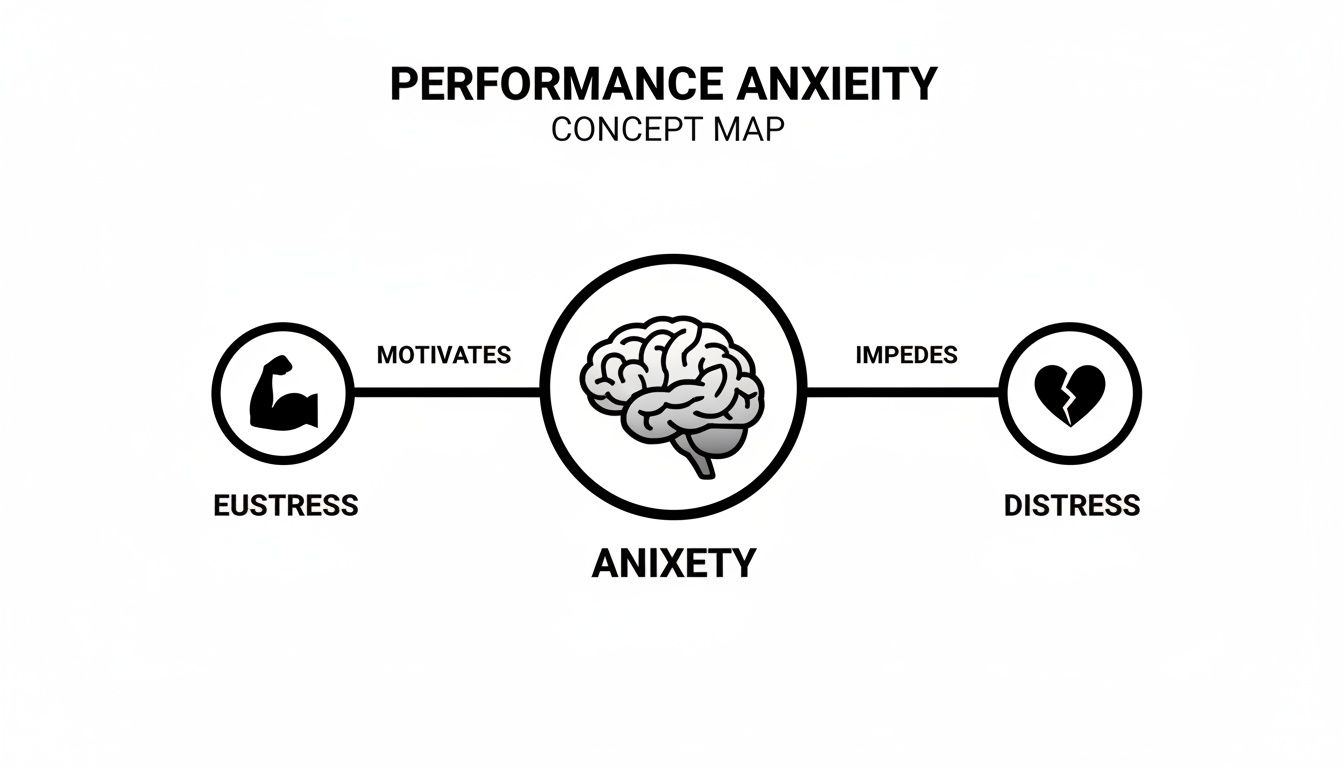
As you can see, the same initial trigger can either fuel positive action (eustress) or kick off a destructive cycle of fear and poor performance (distress). It all comes down to how you process it.
Recognizing which side of the line you’re on is the first step. Here’s a quick breakdown of how to tell the difference between nerves that help and anxiety that hurts.
Productive Nerves vs. Performance Anxiety
| Symptom | Productive Nerves (Eustress) | Performance Anxiety (Distress) |
|---|---|---|
| Heart Rate | Elevated but steady; feels like energy. | Racing or pounding; feels uncontrollable. |
| Breathing | Quick but controlled. | Short, shallow, or feeling breathless. |
| Focus | Sharpened and clear; zoned in on the task. | Scattered and distracted; fixated on negative outcomes. |
| Muscle Tension | Muscles feel “primed” and ready for action. | Tight, stiff, or shaky muscles that feel weak. |
| Thoughts | “I’m ready for this.” “This is a challenge.” | “I’m going to fail.” “Everyone is watching me.” |
| Feeling | Excitement, anticipation, readiness. | Dread, fear, panic. |
Ultimately, eustress feels like a manageable challenge that sharpens your abilities. Distress feels like an overwhelming threat that sabotages them.
The Physiological Hijack
When your brain pulls that false alarm, it couldn’t care less that you’re holding a golf club instead of running from a lion. It immediately starts rerouting the body’s resources for pure survival, leading to a host of physical changes that directly interfere with athletic skill.
- Racing Heart: Your heart pounds faster to pump oxygen to your large muscles—the ones you’d need to fight or run. Unfortunately, this can divert oxygen from the brain, making complex decisions and strategic thinking much more difficult.
- Shallow Breathing: You start breathing quickly and shallowly to gulp in more air. This often leads to lightheadedness and prevents the calm, deep breathing required for focus and endurance.
- Muscle Tightness: Blood floods your major muscle groups, causing them to tense up for action. For an athlete, this is a disaster. It destroys fine motor control, ruins flexibility, and makes fluid movements feel robotic and stiff.
Imagine a golfer standing over a simple putt. Their hands start trembling, and their swing tightens up, making a smooth stroke almost impossible. This isn’t a lack of skill; it’s a physiological response that has hijacked their body.
Understanding this biological process is the first, most critical step toward getting back in the driver’s seat. Once you can recognize these signals for what they are—a faulty alarm system—you can start to manage them instead of letting them control you. This is where expert guidance in sports psychology and performance becomes so valuable, as it focuses on retraining these automatic responses.
Recognizing the Warning Signs in Yourself and Others
Performance anxiety is a sneaky opponent. It rarely storms the field announcing its presence with a full-blown panic attack before a big game. Instead, it’s more like a quiet whisper of doubt that starts to creep in, showing up in small, easy-to-miss changes in an athlete’s behavior, thinking, and physical state.
Learning to spot these warning signs—both in yourself and in your teammates—is the first real step toward getting a handle on them. It’s about building awareness so you can be proactive before anxiety truly starts to sabotage performance. Think of it like a coach noticing a slight limp in a star player; you address it early to prevent a season-ending injury down the line.
Physical Red Flags
When it comes to anxiety, the body often keeps the score. These physical symptoms are the most direct fallout from the fight-or-flight response kicking into high gear, getting the body ready for a threat that, in reality, isn’t there.
A few pre-game butterflies are perfectly normal, even helpful. But when these physical feelings become persistent or just plain overwhelming, it’s a clear signal that anxiety has crossed the line from helpful to harmful.
- Persistent Muscle Tension: Do you feel constantly stiff or sore, even after a thorough warm-up? This isn’t just fatigue; it’s like your muscles are permanently braced for impact, completely wrecking your ability to move fluidly.
- Stomach Issues: Nausea, cramps, or that sudden, urgent need to find a restroom are classic signs. The digestive system is one of the first things to go haywire when your body is under intense stress.
- Shakiness and Trembling: That uncontrollable tremor in your hands, legs, or even your voice can make the fine motor skills needed for sports like golf, archery, or sinking a free throw feel utterly impossible.
- Shallow, Rapid Breathing: You might feel like you just can’t get a full breath in, or you’re winded even when you’re not exerting yourself.
These physical signs aren’t just “in your head.” They are real, physiological reactions that directly get in the way of you performing at your peak.
Cognitive and Emotional Warning Signs
While the body is sounding the alarm, the mind is often where the real battle is happening. The mental and emotional signs of performance anxiety can be tougher to spot, but they’re every bit as damaging. They signal a shift from a confident, challenge-ready mindset to one that’s dominated by fear and self-doubt.
Picture “The Perfectionist Gymnast” who, after one tiny wobble on the beam, completely unravels and obsesses over that single mistake for the rest of the competition. Or “The Star Striker” who, after missing one crucial penalty, suddenly starts passing up shots they used to take without a second thought.
“Your mind can become your biggest opponent. The internal critic grows louder, and your focus shifts from executing your skills to simply trying not to fail. This defensive mindset is a classic sign of anxiety taking control.”
Reframe Your Inner Monologue with Cognitive Restructuring
This is about becoming a detective for your own mind. It’s the process of catching, challenging, and changing the negative thought patterns that pour fuel on the fire of performance anxiety in sports. You learn to question the “evidence” behind your biggest fears.
Why does this work so well? Because our feelings almost always follow our thoughts, not the other way around. By changing a destructive thought like, “I’m going to choke,” you can fundamentally alter the emotional and physical response that follows. You stop the anxiety spiral before it even gets started.
Here’s a simple three-step process you can use:
- Catch the Thought: The second you feel that jolt of anxiety, hit the pause button. Ask yourself, “What am I telling myself right now?”
- Challenge It: Interrogate that thought. Is it 100% true? Is there another, more rational way to see this situation?
- Change It: Swap the negative thought for one that’s realistic and productive. For instance, instead of “I can’t miss this shot,” try “I’ve practiced this shot hundreds of times. I’m just going to focus on my routine and trust my training.”
This framework helps you seize control of your internal narrative, which is a cornerstone of professional mental skills training for athletes.
Control Your Physiology with Tactical Breathing
Also known as box breathing, this is a deceptively simple technique for hijacking your nervous system and telling it to calm down. It uses a controlled, rhythmic breathing pattern to manually slow your heart rate.
When you get anxious, your breathing becomes quick and shallow, kicking your body’s fight-or-flight response into overdrive. By deliberately slowing your breath, you send a direct signal to your brain that the danger has passed, effectively hitting the off-switch on your internal alarm system.
Connecting with Dr. John F. Murray for Your Competitive Edge
Tackling performance anxiety in sports is a journey. While self-help strategies and team support are crucial first steps, sometimes you need an expert in your corner to truly master the mental game. This is where a specialist like myself, Dr. John F. Murray, can make all the difference. My approach isn’t just about theory; it’s a blend of clinical psychology with practical, battle-tested performance tools that I’ve used to help the world’s top athletes.
With over 20 years in the field, I’ve developed a structured yet deeply personal approach to help athletes push past the mental blocks holding them back. The goal is simple: learn to perform consistently when the stakes are highest.
Customized Solutions for Peak Performance
There’s no one-size-fits-all fix for performance anxiety. That’s why my programs are built to address the specific challenges you face, whether you’re an individual athlete, a coach looking to support your players, or an entire team aiming for a stronger mental foundation. These services are designed to build skills that last a lifetime.
- One-on-One Coaching: This is where we get personal. Practical Example: A professional tennis player might develop a specific between-point routine involving tactical breathing and a mental cue word to reset after an unforced error.
- Team Workshops: These sessions are all about building a resilient team culture. Practical Example: A basketball team learns a “mental reset” routine to use collectively during a timeout after the opposing team goes on a scoring run.
- Proven Frameworks: I use powerful tools like the Mental Performance Index to provide clear, measurable feedback on your mental game. This turns abstract concepts like “focus” and “confidence” into concrete, trackable progress.
The statistics show a critical gap in how athletes are supported. While 30% of female and 25% of male student-athletes report struggling with significant anxiety, very few actually seek help. For professionals, that number can climb to 35%. My work directly addresses this need, offering real solutions to manage pressure and build confidence that endures.
Working with an expert gives you more than just coping skills—it gives you a genuine competitive advantage. It’s about learning to turn that nervous energy from a performance killer into a source of focused, powerful energy. If you’re ready to stop letting mental blocks dictate your performance, the next step is reaching out to an expert who can guide you there.
For more information on mental performance coaching or psychological services, or to schedule a consultation, visit my Sports Psychology Services page.