
By Dr. John F. Murray
Sports psychology is about training your mind to sharpen your game on the court. It’s how you turn mental skills like focus, confidence, and resilience into a real competitive advantage. And it’s not just some secret weapon for the pros—it’s a set of practical tools for any player who wants to be their best when the game is on the line.
What Is Sports Psychology in Basketball?
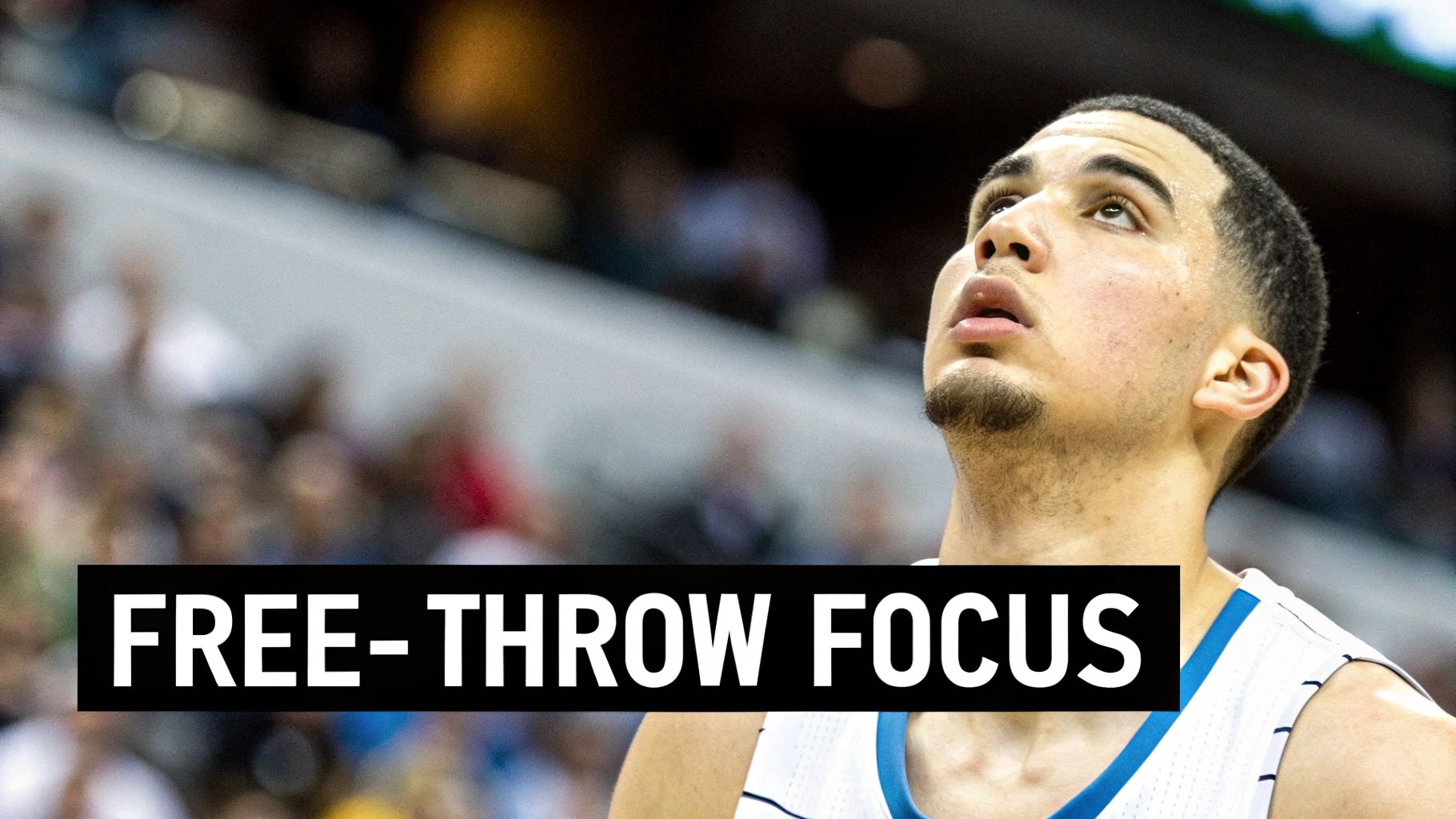
Picture this: You’re at the free-throw line, final seconds, your team is down by one. The crowd is deafening, your legs feel like lead, and the pressure is so thick you could cut it with a knife.
Physically, you know you can make this shot. You’ve done it a thousand times in practice. But the real game is happening between your ears. That’s the heart of basketball sports psychology: giving you the mental tools to win that inner battle.
It’s a huge misconception that psychology is only for fixing things like a shooting slump or game-day anxiety. The truth is, it’s a proactive system for building a better player. Think of it as a mental gym where you train your mind with the same intensity and discipline you bring to the weight room or the court. For example, a player who visualizes success before a game is actively building confidence, not just waiting for a good play to happen.
Building Your Mental Weapons
Just like you drill your crossover or your jump shot until it’s second nature, you can systematically build up your mental game. The end goal? To make mental toughness a reflex, not something you have to consciously think about in a big moment.
This isn’t some abstract concept. It’s targeted training in a few key areas that have a massive impact on your game. Here’s a quick overview of what that training looks like, breaking down the essential skills that separate good players from truly dominant ones.
Core Mental Skills for On-Court Dominance
| Mental Skill | Basketball Application | Actionable Tip |
|---|---|---|
| Emotional Control | Staying calm after a bad call or a turnover. | Use a “flush it” trigger: physically wipe your hand on your shorts and say “next play.” |
| Laser Focus | Blocking out the crowd, trash talk, and internal doubts. | Develop a pre-free-throw routine: one dribble, deep breath, lock eyes on the rim. |
| Unshakeable Confidence | Believing in your shot even after a few misses. | Keep a “success log” where you write down three things you did well after every practice. |
| Resilience | Bouncing back immediately after getting beat on defense. | Set “process goals” for the game, like “contest every shot,” to focus on effort, not mistakes. |
Each of these skills can be developed through specific exercises and a disciplined mindset, just like any physical part of your game. They work together to build a foundation of mental toughness that holds up when it matters most.
Sports psychology isn’t about becoming immune to pressure. It’s about developing the tools to thrive because of the pressure, not in spite of it. It’s about reframing those high-stakes moments as opportunities to prove yourself.
By making these practices a regular part of your routine, you turn your mind into your single greatest asset on the floor. If you’re looking to explore this further, there’s a ton of great information on how elite athletes use sports psychology for peak performance.
At the end of the day, when physical skills are evenly matched, the mental game is what makes the difference. It’s the ultimate competitive edge.
The Rise of the Mental Game in Basketball
Not too long ago, basketball was all about the physical. How high could you jump? How quick was your first step? Was your shooting form textbook? But over the last few decades, a quiet revolution has unfolded. The mental game has moved from an afterthought to a core pillar of elite performance.
Top teams and players now live by a new rule: what happens between the ears is just as critical as what happens on the hardwood.
This shift didn’t happen overnight. It was a slow burn, starting with a few pioneering coaches and players who saw an untapped competitive edge—one that couldn’t be measured with a stopwatch or a vertical leap test. They recognized that the most gifted athlete could be crippled by a moment of self-doubt, while a mentally tough player could consistently outperform their physical limitations.
They began treating the mind like a muscle, something that could be trained, conditioned, and strengthened with practical drills.
This evolution is what validates every technique in this guide. The drills and routines we’ll cover aren’t just ideas; they’re battle-tested strategies used at the highest levels to build champions. For a deeper dive, exploring some of the best books on sports psychology can offer incredible perspectives from the experts who shaped the field.
Today, incorporating sports psychology isn’t just about gaining an edge—it’s about meeting the standard. The mental game is no longer a secret weapon; it’s a fundamental part of what it means to be a complete basketball player.
Understanding this journey from academic curiosity to a core training principle is key. It proves that dedicating time to your mental workout isn’t just “extra” work—it’s one of the most powerful investments you can make in your game. The focus is no longer just on raw talent but on building mentally resilient athletes ready for anything.
Proper mental recovery is also important after a high-intensity game. Learn how to relax.
Building Your Mental Toolkit for the Court
Physical talent might get you a spot on the team, but your mental toolkit is what wins championships. This is where we stop talking theory and start putting in the work, building the core psychological skills that show up on the court. Think of this as your mental weight room—each skill is a muscle, and these drills are your reps.
Let’s break down five critical mental skills into simple, actionable exercises. These aren’t just abstract ideas; they are practical tools you can start using at your very next practice to see a real difference in your game.
Forging Unshakable Confidence
Confidence isn’t arrogance or just hoping you play well. It’s a rock-solid belief in your skills, built brick-by-brick through preparation and the conversations you have with yourself. In basketball, a confident player takes the open shot without a second thought, drives the lane hard, and doesn’t let one mistake derail their whole game.
Mastering Concentration and Focus
A basketball game is a storm of distractions—the roaring crowd, the scoreboard, trash talk, and the noisy thoughts inside your own head. Concentration is your filter, the ability to tune out all that noise and lock in on the only thing that matters: the next play.
Taming Pressure and Anxiety
Pressure is just perceived importance. That heart-pounding, palm-sweating feeling before a game-winning free throw is your body’s natural response to a big moment. The goal isn’t to make that feeling disappear, but to learn how to manage it.
When you’re anxious, your breathing gets shallow and quick. By intentionally slowing it down, you send a direct message to your brain that you are in charge, not the situation.
Winning with Visualization
Your brain has a hard time telling the difference between something you vividly imagine and something you actually experience. Visualization, or mental rehearsal, uses this to your advantage. When you mentally see yourself executing plays perfectly, you’re literally strengthening the neural pathways for those actions.
Developing Practical On-Court Mental Routines
Understanding the theory behind sports psychology is one thing, but actually turning it into a weapon on the court is something else entirely. This is where you start building mental muscle memory. Just like you drill your jump shot, your mental skills need structured, repeatable routines to become second nature, especially under pressure.
Mental routines aren’t complicated rituals. They are simple, deliberate sequences of thoughts and actions designed to anchor you in the moment, block out the noise, and get your mind right for peak performance.
The Science Behind a Clutch Performance
Ever wonder what’s actually happening in your rain during a huge momentum swing? That last-second shot, a critical turnover, or a sudden scoring run—these moments feel different because, neurologically, they are different. The science of clutch performance isn’t some kind of magic; it’s a measurable process happening inside your head. Understanding it is key to seeing why the mental skills we’ve talked about are so incredibly powerful.
When you’re in the zone, your brain operates with stunning efficiency. Actions feel automatic, almost effortless. This isn’t a coincidence. It’s the result of consistent practice—both physical and mental—that shifts control from your slow, deliberate prefrontal cortex (your thinking brain) to the faster, more intuitive parts like the cerebellum and basal ganglia.
In high-pressure moments, overthinking is the enemy. By drilling pre-performance routines, you automate your actions, freeing up precious mental resources to simply react and play. Your body knows what to do; the goal is to get your conscious mind out of the way.
This neurological shift is precisely why a well-rehearsed free-throw ritual works. It’s not just a superstition; it’s a trigger that tells your brain to bypass the anxious, analytical part and just run the “shoot a free throw” program it has perfected over thousands of reps.
Rewiring Your Brain for Clutch Play
Every single time you practice visualization, positive self-talk, or tactical breathing, you aren’t just thinking positive thoughts. You’re physically strengthening the neural circuits associated with composure and focus. This process, known as neuroplasticity, is your brain’s incredible ability to reorganize itself based on your experiences and training.
At the end of the day, sports psychology in basketball isn’t about wishful thinking. It’s a systematic method for rewiring your brain to be tougher, sharper, and more resilient when the game is on the line. The science is crystal clear: consistent mental training creates a very real, physical advantage.
Designing Mental Drills for Practice
To really make mental skills stick, they have to be part of the work you do on the court. You can easily tweak existing basketball drills or create new ones specifically designed to test players’ composure, focus, and communication when they’re tired and under pressure.
Here are a couple of practical ideas:
- Pressure Free-Throw Simulation: At the end of practice, pick one player to shoot two free throws. If they make both, everyone’s done. If they miss, the whole team runs. This is a classic for a reason—it simulates real game pressure and forces players to lean on their mental routines when the stakes are high.
- Communication-Focused Defense: Run a 5-on-5 shell drill where the only objective is perfect communication. Give out points for loud, clear calls like “Screen left!” or “I’ve got ball!” and take points away for silence. This directly trains team cohesion and collective focus.
- Adversity Scrimmage: Start a scrimmage with one team down 10-0 with only four minutes left on the clock. This forces them to manage frustration and work together under pressure, rather than just playing with a clean slate.
Measuring Mental Growth
While you can’t exactly put a number on “confidence,” you can absolutely track stats that reflect better mental performance. Showing players the data behind their hard work proves that their mental training is paying off in a tangible way.
Long-term studies on elite players back this up. Research shows that 91% of players show a positive trend in assists over their careers, while 73% improve their free-throw percentage. These numbers are deeply connected to mental skills—assists reflect sharp decision-making and court awareness, and free throws are the ultimate test of focus and anxiety control.
Looking at the team as a whole, even things like scheduling can impact mental readiness. For a different angle on how organization affects performance, check out this case study on interactive video in sports scheduling.
By intentionally building, practicing, and measuring these mental skills, you can create a culture where mental toughness isn’t just a slogan on a t-shirt—it’s your team’s defining competitive advantage.
For more information on mental performance coaching or psychological services, or to schedule a consultation, visit my Sports Psychology Services page.