
Sports psychology in tennis is all about sharpening your mental game to boost how you play on the court, handle the immense pressure, and build real resilience. It’s about cultivating unbreakable focus, rock-solid confidence, and total emotional control—skills that are every bit as important as your forehand or serve.
At its core, it’s about winning the battle in your own head long before you step out for the first point.
Why The Mental Game Is Your Biggest Weapon In Tennis
You’ve heard the old saying that tennis is 90% mental. But what does that really mean in the heat of a match? Think of it this way: modern tennis is like playing a high-stakes chess match at 120 miles per hour. Your physical tools—the serve, the footwork, the volleys—are the pieces on the board. Your mind is the grandmaster deciding how, when, and where to move them.
At the elite level, physical talent and technical skill are everywhere. The real separator between winning and losing often comes down to what happens in the six inches between your ears. This is where mastering the principles of sports psychology becomes a player's greatest weapon.
The Decisive Role of Mental Toughness
Think about those moments that truly define a match: staring down a break point, serving for the set, or grinding through a third-set tiebreaker. These are the moments where mental fortitude separates the champions from everyone else.
It's not just a feeling; it's backed by data. A massive study analyzing 650,000 tennis points found a direct link between pressure and unforced errors. Players who were mentally tougher held their ground, while less resilient competitors saw their error rates literally double in these high-stakes situations. You can discover more about the research on pressure and performance in tennis.
My own work is dedicated to building this mental armor. For example, I helped ATP professional Vincent Spadea snap a historic losing streak and climb back into the world's top rankings. This kind of turnaround isn't magic—it’s the direct result of targeted mental training that transforms psychological roadblocks into a genuine competitive edge.
Understanding The Pillars Of Mental Performance
To truly master the mental game, you have to understand its building blocks. When these pillars are strong, a player is poised, decisive, and in control. But when even one of them falters, the most technically sound game can completely unravel.
"The player who is armed with a strong mind is the most dangerous opponent on the court. They don't just react to the game; they dictate it, turning pressure into an opportunity."
I've broken down the four essential pillars of the mental game into a simple roadmap. The table below shows you exactly what they look like in action—both when they're holding up under pressure and when they start to crack.
The Four Pillars Of The Tennis Mental Game
| Mental Pillar | When It's Strong (Championship Behavior) | When It Breaks Down (Under Pressure) |
|---|---|---|
| Focus | Maintains concentration on the current point, blocking out all distractions. | Gets rattled by a bad call, crowd noise, or a previous mistake. |
| Confidence | Trusts their shots and plays aggressively in key moments without hesitation. | Becomes tentative, starts "pushing" the ball, and plays not to lose. |
| Resilience | Bounces back immediately from unforced errors or losing a set. | Spirals downward after a few bad points, showing negative body language. |
| Strategy | Adapts the game plan to exploit an opponent’s weaknesses and changing conditions. | Sticks to a losing strategy, unable to think clearly and problem-solve. |
These pillars are interconnected. A loss of focus can crush your confidence, and poor resilience makes it impossible to think strategically. Building all four is the key to becoming a complete player.
Mastering The Core Mental Skills For On-Court Success
We've talked about the big-picture pillars of the mental game. Now, let’s get our hands dirty and start building them, brick by brick. The best players in the world aren’t just lucky to be mentally tough; they actively train specific psychological skills with the same grit they apply to their footwork or their second serve.
Sports psychology isn't some abstract, high-level theory. It's about developing real, practical tools you can pull out of your bag when the pressure is on and you're staring down a break point.
These core skills—focus, confidence, emotional control, and routines—all weave together to create your on-court operating system. When you master them, you stop just playing tennis and start managing the entire competitive environment, controlling your performance from the inside out.
Let's break down each one with some simple, actionable drills you can use in your very next practice.
Unbreakable Focus And Concentration
Imagine your focus is a powerful spotlight. In a chaotic stadium, you can let that spotlight wander across the scoreboard, the heckler in row five, or the reel of your own negative thoughts. Or, you can tighten the beam to illuminate only what truly matters: the yellow ball, the feel of the strings, your opponent's movement.
Distraction is the absolute enemy of high performance. The ability to control that attentional spotlight is a complete game-changer.
This all comes down to staying locked in the present moment. The last point, good or bad, is history. The next point doesn't exist yet. Your only point of power is right now.
"The most common mental error is allowing your focus to drift to things you cannot control. The secret to on-court presence is ruthlessly bringing your attention back to the current point, over and over again."
Actionable Drill: The 15-Second Reset
You have roughly 20-25 seconds between points. This simple drill trains you to use the first 15 seconds to wipe the slate clean and get ready for what’s next.
- Acknowledge (5 seconds): As you walk back to the baseline, give a quick nod to the last point and any emotion that came with it—frustration, excitement, disappointment. Don't fight it, just notice it.
- Release (5 seconds): Take one deep, cleansing breath. As you breathe out, physically let the tension go. Fidget with your strings, wipe the sweat from your brow, or give the ball a firm bounce. This is your physical cue to let go.
- Refocus (5 seconds): Now, aim your spotlight squarely on the next point. State your specific intention in your mind: "High-percentage first serve to the body," or "Stay low on this return."
Rock-Solid Confidence
Confidence isn't some mystical feeling you hope shows up on match day. It’s a skill, and you build it through deliberate, consistent action. Real, unshakable confidence doesn't come from your win-loss record; it comes from a deep trust in your preparation, your process, and your ability to figure things out.
It's the quiet belief that you've put in the hours and have the tools to handle whatever the match decides to throw at you.
When a confident player shanks a forehand, their inner voice says, "Okay, bad shot. Bend your knees on the next one." The player lacking confidence hears, "I'm awful today, I can't hit a single ball in." One mindset leads to a simple adjustment; the other leads straight into a downward spiral.
Actionable Drill: The Confidence Log
For one week, grab a small notebook and dedicate it to finding proof of your competence. Each day, write down three simple things:
- One thing you did well in practice: "Held my own in baseline rallies for 20 minutes straight."
- One moment you showed mental toughness: "Was down 0-30 on my serve but fought back to hold."
- One part of your preparation you nailed: "Did my full dynamic warm-up without cutting any corners."
Reading this log before a match gives your brain concrete evidence of your abilities, grounding your confidence in fact, not fleeting feelings. This is a fundamental concept in athletic development, and you can explore more about general mental skills training for athletes to see how it applies across all sports.
Emotional Control And Composure
Let's face it: tennis is an emotional rollercoaster. The sting of a double fault, the thrill of a passing shot, the raw anxiety of a match tiebreaker—these moments trigger powerful physical and mental reactions. The goal isn't to become a robot, but to stop your emotions from hijacking your game.
A flash of anger can tighten your muscles, shorten your breath, and cloud your judgment, leading to wild, undisciplined shots. Learning to manage those emotional spikes keeps you clear-headed and physically loose, which is absolutely critical for executing fine motor skills under pressure.
Actionable Drill: The 4-7-8 Breathing Technique
Use this on a changeover to instantly lower your heart rate and calm your nervous system.
- Sit down and either close your eyes or just stare down at your racquet strings.
- Breathe out completely through your mouth.
- Quietly breathe in through your nose for a count of four.
- Hold your breath for a count of seven.
- Exhale forcefully through your mouth for a count of eight.
- Repeat this 3-4 times. In just 90 seconds, this physiological reset can completely shift your mental state.
The Power Of Routines And Rituals
In the storm of a tough match, routines are your anchor. They are a sequence of actions you perform over and over, especially between points, to keep your mind and body locked into a familiar, productive state. A good routine automates your behavior when the pressure is highest, giving your brain a predictable track to run on when everything else feels like chaos.
From Rafael Nadal’s obsessive bottle placement to Maria Sharapova’s pre-serve turn, these are not just quirks or superstitions. They are carefully designed psychological tools. They send a signal to the brain: "It's time to execute," creating a powerful buffer against distraction and doubt.
Actionable Tip: Design Your Between-Point Routine
Create a simple, repeatable sequence for yourself. It could look something like this:
- React: A quick, controlled emotional response (a quiet fist pump or a brief sigh).
- Relax: A deep breath as you turn your back to the net and walk to the fence.
- Prepare: Visualize the exact serve you want to hit while bouncing the ball three times.
- Execute: Step to the line and play.
Practice this routine relentlessly in training until it becomes second nature. Come match time, it will be an automatic habit that gives you a reliable mental foundation, point after point.
Evidence-Based Techniques To Build Mental Toughness
Knowing the core mental skills is one thing, but actually applying professional, evidence-based techniques is how you forge them into weapons on the court. Elite sports psychology in tennis isn’t about abstract ideas; it’s about using structured, concrete tools to systematically build mental toughness, rewire self-defeating patterns, and unlock your best performance when it counts.
As I explain in my book, Smart Tennis, mental toughness is a skill you can train, just like your forehand or backhand. The techniques that follow are the bedrock of that training, used by the pros to turn psychological weaknesses into match-winning strengths.
See Success Before It Happens With Visualization
Visualization, or mental imagery, is easily one of the most powerful tools in any athlete’s mental kit. It’s the practice of running a vivid, detailed movie in your mind of you performing flawlessly. This isn't just daydreaming about holding up the trophy; it's a deliberate, sensory-rich rehearsal. You feel the grip of the racquet, you hear the clean pop of the strings, and you see the ball paint the line.
This mental practice actually strengthens the neural pathways in your brain, essentially programming the desired actions to be more automatic in a real match. The more clearly and frequently you picture yourself nailing a perfect serve under pressure, the more likely you are to do it. You can explore a deeper dive into the power of visualization for athletes to see just how impactful it can be.
Actionable Tip: The “Clutch Point” Rehearsal
Before your next match, take five minutes to mentally rehearse a critical moment:
- Set the Scene: Picture it: you're serving for the set at 5-4, 40-30. Feel the sun on your skin, hear the faint murmur of the crowd, and notice the tension in the air.
- Feel the Motion: See your service toss go up exactly where you want it. Feel the smooth, explosive motion as your body uncoils and you connect with the ball.
- Witness the Outcome: Watch the ace kick up chalk on the corner of the service box. Feel that wave of confidence and satisfaction as you clinch the point—and the set.
Reframe Your Inner Dialogue With CBT
Cognitive-Behavioral Techniques (CBT) offer a structured method for catching, challenging, and changing the negative thoughts that sabotage your game. In tennis, that little voice in your head can be your biggest asset or your worst opponent. A single thought like, "I always choke on big points," can unleash a destructive cascade of anxiety, tight muscles, and terrible decisions.
CBT teaches you to intercept these thoughts and reframe them into something constructive and realistic. This isn't about forced, blind positivity. It's about shifting your perspective to one that empowers you to take effective action.
The goal is to transform your self-talk from a harsh critic into a supportive coach. Instead of berating yourself for an error, you learn to analyze it constructively and immediately focus on the next opportunity.
Actionable Tip: The A-B-C Thought Challenge
The next time you feel that surge of negativity, run through this simple framework:
- A (Activating Event): You just hit a double-fault on break point.
- B (Belief): Your automatic thought is, "I can't serve under pressure. I'm going to lose."
- C (Consequence/Challenge): That belief instantly creates anxiety and tightens you up. Challenge it. Reframe it to: "Okay, that serve was off. I'm going to trust my motion, toss the ball a little higher, and focus only on hitting my spot on this next point."
Set Goals That Fuel Motivation
Effective goal setting is your roadmap for improvement, but too many players get it wrong. They focus almost exclusively on outcome goals (like "win the tournament"), which are often completely outside their direct control. Sports psychology introduces two other types of goals that are far more effective at keeping you motivated and focused.
- Performance Goals: These are tied to your own performance standards, win or lose. A great example is, "I will get 70% of my first serves in." It’s measurable, and it’s all on you.
- Process Goals: These are the small, specific actions that lead to good performance. Think, "I will bend my knees on every single backhand," or "I will do my reset routine between every point."
When you lock in on your process and performance goals, you build the habits that lead to winning outcomes. This approach is also a fantastic way to manage pressure because your mind is on execution, not the anxiety of the final score.
Master The Present With Mindfulness
Mindfulness is simply the practice of paying attention to the present moment without getting caught up in judgment. During a tennis match, it’s so easy for your mind to drift back to a missed overhead or jump ahead to the fear of losing. Mindfulness is the skill that anchors your awareness right here, right now—the only place you can actually hit a tennis ball.
It trains you to notice your thoughts and feelings without letting them hijack your focus. Just as adventurers are skilled at harnessing challenges to build true resilience, elite tennis players learn to use the pressure of a match to sharpen their presence of mind.
Actionable Tip: Mindful Breathing Between Points
As you walk to the baseline for the next point, bring your full attention to your breath for just three full cycles. Notice the sensation of the air moving in and out. This simple act is a powerful anchor that pulls you out of swirling thoughts and grounds you in the present, ready for what's next.
Applying Psychology In Real Match Scenarios
Knowing the theory is one thing, but the real magic happens when you can actually use it under pressure. Mastering sports psychology in tennis isn’t about having abstract knowledge; it’s about having a clear, actionable mental playbook ready for the moments that matter most. It’s about knowing precisely what to do when your heart is pounding and the match is on the line.
These are the moments where matches are truly won and lost. Developing specific psychological game plans for these pressure points can shift you from a player who hopes to win into one who expects to. Let's dig into some of the most common high-stakes situations and the mental tactics you can use to own them.
Serving For The Set
It's a classic pressure cooker. You’re just a few swings away from taking the set, and suddenly, your arm feels like it weighs a ton. Your mind floods with "what ifs." The typical reaction is to get tentative—you start aiming the ball instead of hitting it, leading to a weak serve or, even worse, a double fault.
The pro-level strategy here is to shrink your focus entirely to your pre-serve routine.
- Actionable Tip: Forget the score. Instead, pour all your concentration into the physical cues of your routine. Feel the grip in your hand. See the exact spot you want to hit in the service box. Trust the thousands of serves you’ve hit in practice. Your routine is your anchor; it pulls you back into a state of automatic execution and silences the anxiety about the outcome.
Facing Down Break Points
Staring down a break point can instantly put you on the defensive. So many players tighten up, shifting into a mindset of "playing not to lose" instead of "playing to win." They start pushing the ball to the middle of the court, just hoping their opponent will miss. This passive approach hands all the control right over to your opponent.
The key is to reframe break points not as threats, but as opportunities to play with aggressive intent. This is a moment to trust your game, not abandon it.
Instead of backing off, commit to playing your patterns with confidence. If your big weapon is your crosscourt forehand, now is the time to go to it. Stay aggressive, aim for your high-percentage targets, and make your opponent come up with something brilliant to beat you. You're taking control of the point's narrative.
The decision tree below maps out a simple mental process for these exact moments, showing how to turn a negative trigger into a productive, on-court action.
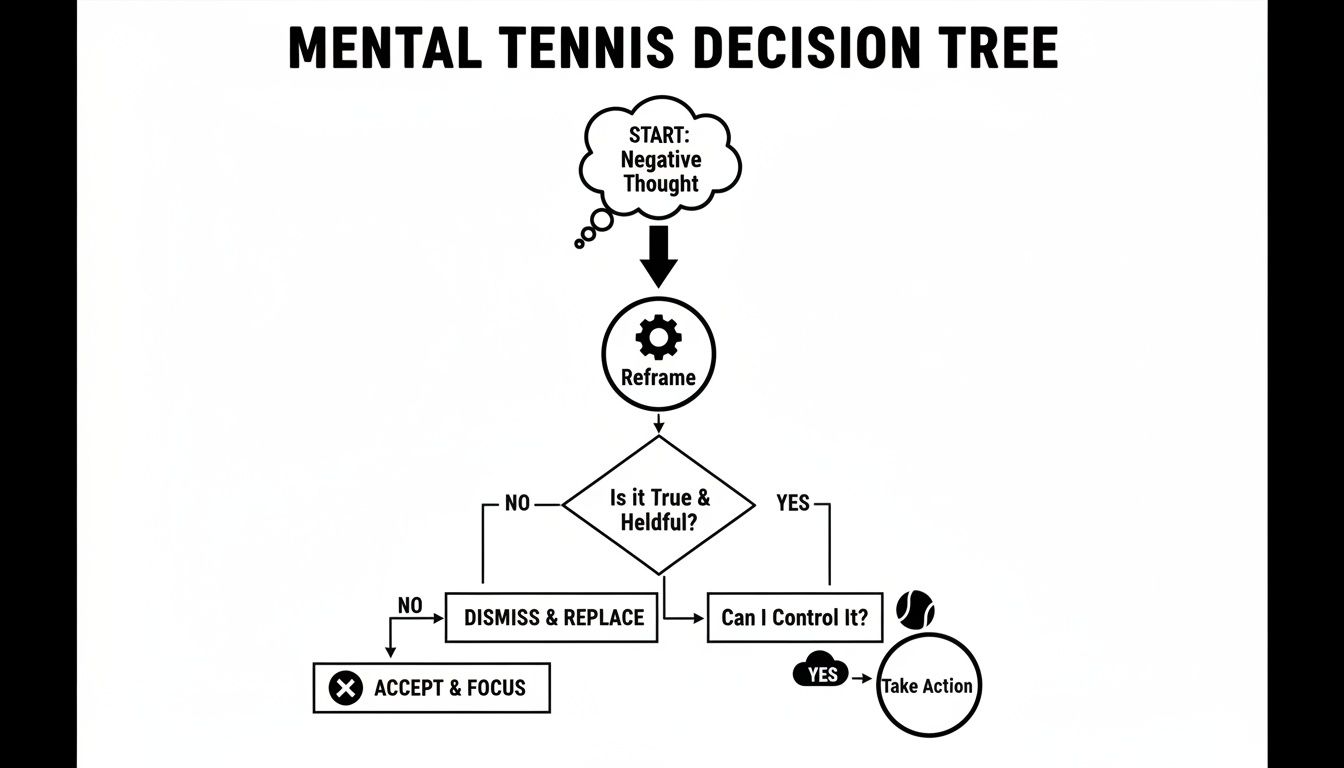
This visual guide simplifies the mental reset process. It highlights how a conscious choice to reframe a thought is the critical step toward taking effective action on the court.
Recovering From Errors Or Bad Calls
A shanked forehand or a brutal line call can send a wave of frustration through your entire system. Letting that anger linger is poison. It can easily cost you the next two or three points as your focus completely shatters. This is where the top pros use a mental "circuit breaker" to stop that emotional spiral dead in its tracks.
This is the perfect time to use the "15-second rule." You give yourself a strict, brief window to process and release the frustration before it takes root.
- Acknowledge (5 seconds): As you walk back to the baseline, vent in a controlled manner. A quick sigh or clenching your fist is fine.
- Release (5 seconds): Turn your back to the net, fix your strings, and take one deep, cleansing breath. As you exhale, imagine all that negative energy leaving with it.
- Refocus (5 seconds): Lock your attention onto the next point. State your specific intention clearly in your head, something like, "Deep return to the backhand."
This structured reset prevents one bad moment from infecting the next. It’s a skill that takes practice, but the payoff is enormous in keeping you mentally present and ready to compete.
Mental Game Plan For Critical Match Moments
To make this even more practical, here’s a quick guide comparing common negative reactions to the proactive mental strategies we've been discussing. Think of it as your on-court cheat sheet for staying mentally tough.
| Match Situation | Common Negative Reaction | Proactive Mental Strategy |
|---|---|---|
| Serving for the Set | Getting tight, "pushing" the serve in, double-faulting. | Shrink focus to the pre-serve routine. Trust your practice and execute automatically. |
| Facing a Break Point | Playing passively, hoping for an opponent's error. | Reframe it as an opportunity. Stay aggressive and play your patterns with confidence. |
| Making an Unforced Error | Lingering on frustration, losing focus for the next points. | Use the 15-second rule: Acknowledge, Release, Refocus. Break the emotional spiral. |
| Playing a Tiebreaker | Overthinking, playing tentatively due to magnified pressure. | Commit to your process goals. Focus on one point at a time and execute your routine. |
By preparing these responses ahead of time, you replace panic and anxiety with a clear plan of action.
Playing A High-Stakes Tiebreaker
A tiebreaker is the ultimate test of mental composure. The weight of every single point is magnified, and that pressure can lead to overthinking, muscle tension, and mistakes you'd never normally make. Players often abandon their game plans and just start pushing the ball in, terrified of being the first to miss.
Your strategy in a tiebreaker must be to stay committed to your process goals. Stop thinking about the score. Instead, focus entirely on the small, controllable actions you've practiced a thousand times. Concentrate on your footwork, your breathing between points, and your shot selection routine.
When you focus on execution rather than the outcome, you keep your nervous system calm and your mind clear. Play one point at a time. Celebrate the small wins—a good first serve, aggressive footwork to a short ball. This process-first mindset is the absolute foundation of clutch play when every single swing matters.
How Coaches And Parents Can Foster Mental Strength
No tennis player gets to the top alone. An athlete’s mental game is built, piece by piece, by their support system—and no one has more influence than coaches and parents. While the player is the one swinging the racquet, the team around them lays the psychological groundwork that helps them stand tall under pressure.
The real goal isn't just to churn out a champion. It's to raise a resilient person who has a lifelong love for the game. For both coaches and parents, this means taking the focus off short-term wins and putting it squarely on long-term development. It’s about creating an environment where effort is the hero, mistakes are just lessons in disguise, and the player’s own drive is fiercely protected.
A Coach's Role In Building Mental Fortitude
As a coach, you're the architect of a player's world on the court. Weaving the principles of sports psychology into every single practice is mission-critical. This goes way beyond just running drills; it’s baked into how you communicate, what you choose to reward, and the very culture you build around the net.
Confidence, for example, is built with specifics, not fluff. Instead of a generic "good job," try something like, "I saw you stay aggressive on that second serve, even at 30-40. That's the mindset we're after." This small shift reinforces a tangible, positive behavior that the player can repeat.
Here are a few ways to put this into action immediately:
- Integrate Pressure Drills: Don't just hit endless crosscourt forehands. Set up drills with real stakes, like playing tiebreakers where the loser does five push-ups. It’s a simple way to mimic match pressure in a controlled setting.
- Focus on Process Goals: During practice, make effort and execution the star of the show, not the outcome. Praise a player for sticking to their between-point routine, even if they ended up losing the drill.
- Encourage Problem-Solving: Resist the urge to give them the answer. Instead, ask questions. "What did you notice about your opponent's return position on that last point?" This teaches players to think for themselves on the court, which is where it counts.
How Parents Can Create A Positive Climate
Parents, you hold the keys to the emotional climate at home and on the sidelines. Your influence can either ignite a player’s passion or become a source of crushing pressure. The secret is to completely detach their self-worth from their win-loss record.
The rise of sports psychology has changed the game, showing just how critical a parent's role is. Scientific reviews have confirmed that educating parents helps create a positive, motivating environment for young players—a key factor in keeping them in the sport and preventing burnout. You can read the full research about parental influence in youth tennis to see just how deep the impact goes.
The most powerful thing a parent can say after a tough loss isn't, "You should have won." It's, "I love watching you play." This simple phrase reinforces that your love is unconditional and has nothing to do with their performance.
This is how you build true resilience and a genuine love for the sport. For a deeper dive, our guide on sports psychology for young athletes offers more powerful strategies for parents looking to support their child's mental game.
Here are a few practical tips you can use today:
- Praise Effort, Not Talent: Focus on what they can actually control. "You fought so hard for every single point today" is infinitely more powerful than "You're so talented."
- Practice the "24-Hour Rule": The car ride home is the worst place for a match post-mortem. Give your athlete space and time to process their own emotions before you try to have a constructive chat.
- Model Emotional Control: Your energy on the sidelines is contagious. Stay calm and supportive, no matter what the scoreboard says. When you handle adversity with grace, you teach them to do the same.
When To Seek A Sports Psychologist And What To Expect
Deciding to move from self-help mental drills to working with a professional is a pivotal moment for any serious athlete. Think of it this way: you’d see a physio for a nagging injury that won't heal. A sports psychologist is the specialist you see when your mental game is stuck in a rut.
Calling in an expert isn’t a sign of weakness. Quite the opposite—it’s a strategic decision to gain a competitive edge and unlock the potential you know you have.
The first step is simply recognizing the signs. If you consistently play lights-out in practice but can’t bring that same level to a match, that's a huge red flag. This gap almost always points to mental hurdles that a targeted, professional approach can help you clear.
Key Signs It Is Time For Professional Help
Most players seek help when they feel like they’ve hit a wall. Certain patterns are dead giveaways that an expert in sports psychology in tennis could be the game-changer you need. Be honest with yourself—are any of these issues holding you back?
- Crippling Performance Anxiety: Do your nerves hijack your performance in big moments? This often shows up as physical tension, a racing mind, and bad shot selection when it matters most.
- A Prolonged Confidence Slump: You’ve completely lost faith in your shots. No matter how much you drill, you can't shake that negative inner voice that expects a miss.
- Difficulty Returning From Injury: You're physically cleared to play, but the fear of getting hurt again is making you hesitant. You're playing not to lose instead of playing to win.
- Inability to Close Out Matches: You build leads and get to 5-3 or 40-15, but then you tighten up and let the opponent back in. Serving out a set or match feels impossible.
Working with a sports psychologist is like hiring a world-class strategist for your mind. It’s a proactive step to build mental weapons, not a last resort for when things are broken.
What The Process Looks Like
When you work with a professional like myself, we take the mystery and stigma out of mental training. The entire point is to build a clear, structured roadmap so you can see and feel the improvement.
It all starts with an initial consultation where I get to know you—your history, your biggest challenges, and what you ultimately want to achieve on the court. From that conversation, we establish a baseline and set clear, measurable goals.
Next, we build a customized mental training program just for you. This is never a one-size-fits-all template. It’s a targeted plan that weaves techniques like visualization, CBT, and routine development directly into your existing training regimen.
To make sure we're on the right track, we can use tools like the Mental Performance Index to objectively measure your progress in key areas like focus, confidence, and resilience. The whole process is a partnership, designed to empower you with the skills to perform at your absolute peak when it counts.
Your Questions About Sports Psychology in Tennis, Answered
Even after laying out the game plan, I find that players, parents, and coaches often have a few lingering questions as they start to put these ideas into practice. Let's tackle some of the most common ones I hear.
At What Age Should a Tennis Player Start Mental Training?
There’s really no wrong time to start, but the approach has to match the player's age and maturity. For the youngest players, maybe around ages 8-12, it's not about complex drills. It’s all about keeping tennis fun, building that initial spark of confidence, and praising their effort, not just the wins. We're planting the seeds for a healthy competitive mindset.
Once players hit their teens, the pressure starts to ramp up, and that's when more structured techniques really start to click. This is the perfect time to introduce the building blocks of the mental game—things like setting clear goals, simple visualization exercises, and on-court routines to manage those big-match jitters.
Formal, dedicated sports psychology work tends to deliver the biggest impact for athletes competing at the high school, college, and pro levels. At that point, the mental game isn't just a bonus; it’s often the single biggest thing separating good from great.
How Is Sports Psychology Different From Regular Therapy?
This is a great question. While both fields come from the world of psychology, their goals are worlds apart. Think of it this way: traditional therapy focuses on improving a person's overall well-being. It’s broad, often dealing with healing past issues and improving how someone functions in all areas of life.
Sports psychology, on the other hand, is laser-focused on one thing: performance. My entire job is to give athletes the specific mental tools they need to perform better on the court. While we might work on something like anxiety, it's always through the lens of how that anxiety is affecting their serve, their footwork, or their decision-making in a tiebreak.
The core mission of a sports psychologist is to help athletes smash through performance barriers, build rock-solid resilience, and hit very specific competitive targets.
How Quickly Can I See Results From Mental Training?
That really depends on the player and how dedicated they are to doing the work. I've had clients feel an immediate difference in their court presence after learning just one simple breathing exercise to use between points. That little bit of calm can be a game-changer right away.
But let's be realistic. Building true mental toughness is just like building physical strength in the gym—it doesn't happen overnight. Unshakeable confidence and the ability to bounce back from a tough loss aren't skills you just acquire; they are forged through consistent, daily practice in training and, most importantly, under the pressure of real matches.
Most of my clients see real, lasting shifts in their game and mindset within a few weeks to a couple of months of consistent effort. Consistency is the key—it’s what turns these mental skills into automatic, match-winning habits.
Ready to stop letting your mind get in the way of your best tennis? At Dr. John F. Murray, we specialize in building customized mental training programs that give athletes a real competitive advantage. Take the first step toward unlocking your peak performance by visiting https://www.johnfmurray.com to learn how we can help you win the mental game.