
Here’s a crazy idea: what if confidence isn't something you're born with? What if it’s a skill, just like a free throw or a backhand? It's a grounded, earned belief in your ability to get the job done under pressure, turning all that hard work in practice into clutch performance when it counts. This guide provides actionable tips and practical examples to help you build that skill.
Understanding Where Athletic Confidence Really Comes From
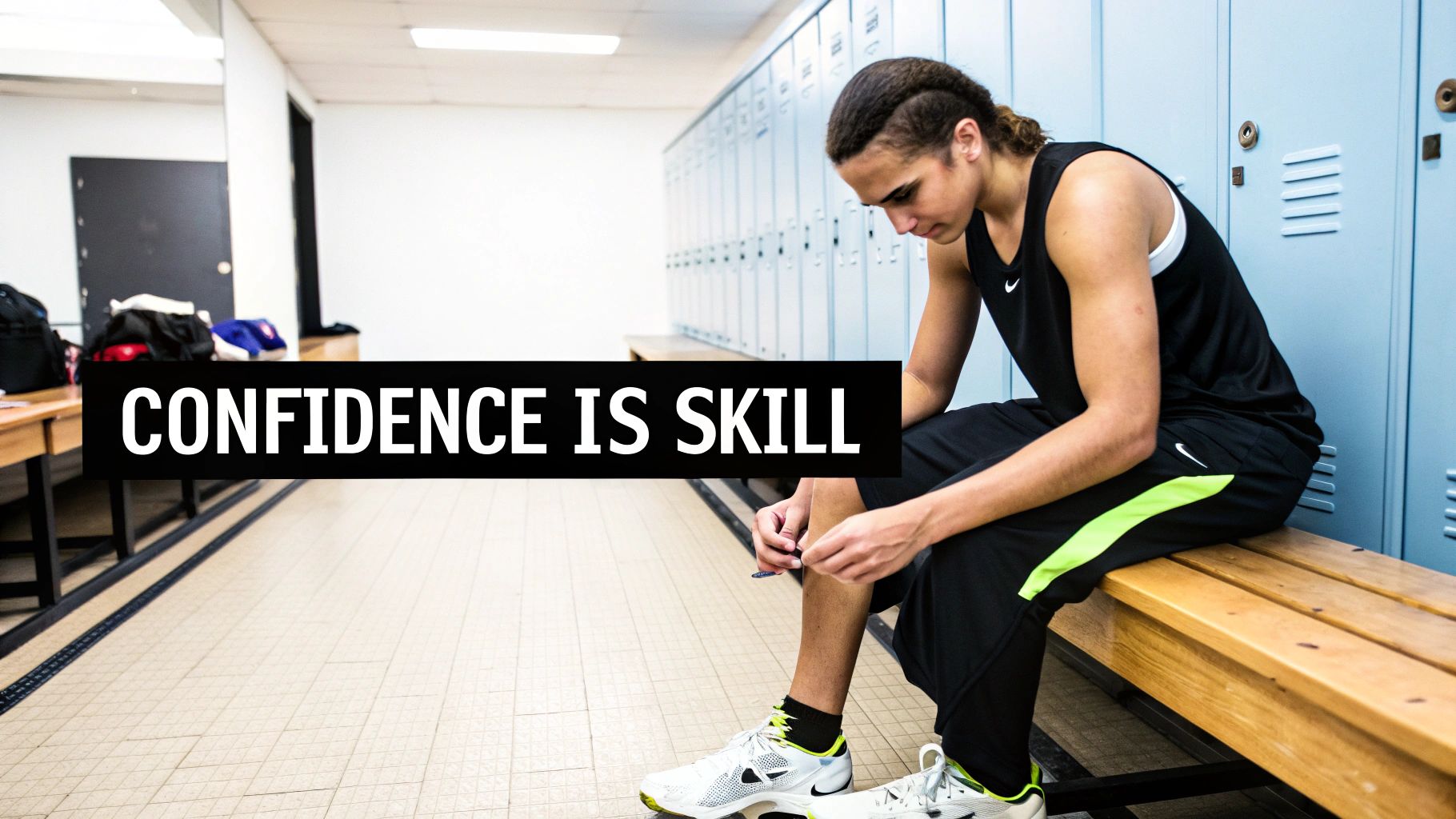
So many athletes fall into the trap of thinking confidence is a magic switch—either it's on or it's off. This mindset is a recipe for disaster. It creates a wild rollercoaster where your self-belief skyrockets after a win and crashes and burns after a single mistake.
The truth? Real, durable confidence is something you build, not something you find.
It all starts by understanding where it actually comes from. This isn’t about fuzzy feelings or wishful thinking. It’s about knowing, deep down, that you’ve done what it takes to succeed. You train your mind with the same discipline you train your body, creating a foundation of belief that won’t crack under pressure.
The True Sources of Self-Belief
So, how do we build it? We can look to the best in the world for the blueprint. Research on elite athletes—we're talking Olympic medalists and World Champions—has uncovered exactly what fuels their belief. A groundbreaking 2007 study actually identified nine different sources of confidence.
But out of those nine, three consistently rose to the top as the most powerful drivers: high-quality preparation, a track record of performance accomplishments, and a strong support system. This tells us confidence isn't some abstract concept; it’s the direct result of things you can actually do.
"I use the word cultivated intentionally. Traits like perseverance, compassion, and humility are not fixed. They can grow, wither, or be tended to." – Ty Walker, M.D., U.S. Olympic Snowboarder
Ty Walker nails it. Confidence, just like any other mental skill, needs to be intentionally grown and cared for over time.
The Three Pillars of Lasting Confidence
Authentic athletic confidence stands on three core pillars. By understanding and actively working on each one, you can build a mental game that’s just as tough and dependable as your physical skills.
This table breaks down these three essential sources of confidence and shows how they play out in the real world.
| Confidence Source | Description | Practical Example |
|---|---|---|
| Deep Preparation | The quality and focus of your training, not just the quantity. It's about mastering fundamentals and knowing you've outworked the competition. | A basketball player who has shot 500 free throws a day for a month walks to the line with a calm assurance that a less-prepared player simply can't have. |
| Performance Accomplishments | Recognizing and banking all the "small wins"—mastering a new skill, hitting a PR in the gym, or executing a tough play. | A young gymnast who finally sticks a new dismount in practice builds a mental deposit of success she can draw on during her competition routine. |
| Support Systems | The network of coaches, teammates, and family who provide constructive feedback, encouragement, and unconditional belief in you. | A quarterback who throws an interception knows his coach will help him break down the film, not just yell, giving him the security to take a risk on the next drive. |
Focusing on these three controllable factors—how you prepare, how you track your own progress, and who you surround yourself with—is the key. It's how you build the kind of confidence that doesn't just show up on your good days but carries you through the tough ones, too.
How to Honestly Assess Your Current Confidence Levels

Before you can build unbreakable confidence, you have to get brutally honest about where you are right now. Improving your mental game isn’t about guesswork; it requires a real starting point. If you don’t get an objective look at your self-belief, you’ll end up working on the wrong things or completely ignoring the moments where your confidence really cracks.
Think of this process as gathering data on your own mind. It’s a way to get past vague feelings of being "on" or "off" and start pinpointing the exact triggers, situations, and thought patterns that either fuel or drain your self-assurance. You’re essentially scouting your own mental performance to find your strengths and vulnerabilities.
Create Your Confidence Scorecard
A fantastic first step is to create a Confidence Scorecard. It’s a simple but incredibly revealing tool for rating your self-belief across different scenarios in your sport. What this does is help you see that confidence isn't some single, fixed trait but a dynamic state that changes depending on the context.
To start, list out the various situations you face. Get specific. Instead of just “practice,” break it down into the nitty-gritty. Then, on a scale of 1 (zero confidence) to 10 (total belief in your ability to succeed), rate how you feel in each scenario.
Here’s what this might look like for a soccer player:
- Taking a penalty kick in practice (Score: 9/10)
- Taking a penalty kick in the final minutes of a tied game (Score: 5/10)
- Defending a top player one-on-one (Score: 6/10)
- Making a simple pass when not under pressure (Score: 10/10)
- Executing a complex skill drill you’ve mastered (Score: 8/10)
This simple exercise instantly shows you where your confidence is solid and where it’s fragile. That gap between the practice PK and the game-time one? That’s gold. That's the area ripe for improvement.
Start a Performance Journal
The scorecard gives you a snapshot, but a performance journal helps you track the story of your confidence over time. This isn’t just a diary of wins and losses. Its real purpose is to connect your feelings to actual performance, helping you identify powerful patterns.
After every practice or competition, just take five minutes. Jot down answers to a few key questions. This act of reflection builds self-awareness, which is the bedrock of mental strength.
- Actionable Tip: Keep a small notebook in your gear bag. After practice, before you even leave the locker room, write down one thing that went well, one thing that challenged you, and how you felt physically and mentally. This habit makes journaling consistent and easy.
By honestly assessing your mental state, you turn abstract feelings into actionable data. You're no longer just hoping to feel confident; you're creating a strategy to build it where it matters most.
This journaling habit also reinforces the proven link between self-belief and results. A huge meta-analysis looking at over 3,700 athletes confirmed a strong positive relationship between confidence and performance in sports. What’s interesting is that the study found the link was even stronger in individual sports than in team sports, which makes sense—an individual's success is more directly tied to their own execution.
Ask Deeper Self-Reflection Questions
The final piece of your assessment is asking probing questions that get to the root of your thought processes. Your internal dialogue, especially when things go wrong, is a dead giveaway of your true confidence levels.
Mix these questions into your journal or just take a few quiet moments to think them over:
- After a mistake, where does my self-talk immediately go? Is it critical ("I can't believe I did that") or constructive ("Okay, reset, next play")?
- Which of my skills feel completely automatic? Which ones cause even a split-second of hesitation or overthinking?
- In which situations do I feel most in control? When do I feel like the game is happening to me?
- How does my confidence shift when I'm tired versus fresh?
Answering these honestly gives you a roadmap. If you realize your self-talk tanks after every single error, you've just identified a specific, trainable mental skill to work on. This is the kind of insight that lets you apply the strategies in this guide with surgical precision, targeting the exact moments your confidence needs a boost.
Actionable Techniques for Building Robust Confidence
Alright, so you’ve got a handle on where your confidence stands. Now for the fun part: building it brick by brick. Developing rock-solid confidence in athletics isn’t about just hoping for a good day. It’s about deliberate, systematic mental training that forges a sense of earned belief in yourself.
Think of these not as fuzzy concepts but as practical skills you can start weaving into your training sessions immediately. Just like you hit the gym to build physical muscle, these mental reps build psychological toughness and unshakable self-trust. We're going to cover how to take control of your inner voice, mentally rehearse success, and create powerful routines that put you in the zone.
Master Your Inner Self-Talk
Let's be honest, the most powerful coach you'll ever have is that voice inside your head. If it’s constantly tearing you down, highlighting every mistake, and predicting disaster, you’re playing with one hand tied behind your back. The idea isn't to get rid of that voice entirely—that’s impossible. The goal is to retrain it, turning it from your harshest critic into your most valuable teammate.
The first step is simply to listen. What are you telling yourself after a bad play? When you’re exhausted? When the pressure is on? Just notice the patterns without judgment. Once you’re aware of the script, you can start rewriting it with positive, instructional, and pre-planned thoughts.
This is where creating self-talk scripts comes in. These are quick, potent phrases you can pull out in the heat of the moment to refocus and remind yourself of what you're capable of.
-
Mistake Response Script: A basketball player who just threw a bad pass might switch from "How could I be so stupid?" to "Next play focus." It’s a simple cue that stops the downward spiral and pushes attention forward.
-
Fatigue Script: When a runner's legs are burning on the last lap, a phrase like "Strong legs, strong mind" can be a powerful anchor, linking their physical grit to their mental toughness.
-
Pressure Script: A golfer standing over a crucial putt could tell themselves, "I've trained for this. Trust my swing." This isn't hype; it's a reminder rooted in hours of practice.
-
Actionable Tip: Write your primary cue word (e.g., "FOCUS," "NEXT PLAY") on your wrist tape or inside your glove. This provides a physical reminder you can see during competition, helping to trigger your mental script when you need it most.
Harness the Power of Detailed Visualization
Too many athletes mistake visualization for just daydreaming about holding the trophy. Real mental rehearsal is so much more. It's about creating a vivid, multi-sensory movie of success in your mind—what you see, what you hear, what you feel. This actually builds the same neural pathways as physical practice, making success feel less like a hope and more like a memory.
The keys are detail and consistency. You're basically creating a mental blueprint. For a much deeper look into the science and how to apply it, I highly recommend exploring resources on mental training for peak performance.
The most effective visualization isn't just seeing the outcome; it's mentally rehearsing the entire process, including overcoming potential obstacles and feeling the emotions of successful execution.
Get started by finding a quiet spot for just 5-10 minutes a day. Close your eyes and run through a perfect performance. A tennis player wouldn't just see the ace. They would:
- See the fuzzy yellow of the ball and their opponent's stance.
- Feel the familiar texture of the racquet grip and the firm court under their feet.
- Hear the pre-serve silence from the crowd.
- Execute the entire motion in their mind—the toss, the explosive coil, the clean contact—and watch the ball zip into the corner.
That level of detail is what makes the mental practice stick, building a deep-seated belief that you can deliver when it counts.
Design a Pre-Performance Routine
Confidence loves control and predictability. A pre-performance routine is nothing more than a sequence of simple, controllable actions you do before every single competition. It's a ritual that tells your brain and body, "It's go time," calming nerves and locking in your focus.
The routine has to be personal to you and consistent. Crucially, it must be made up of things you can always control, no matter the venue, the weather, or the opponent. For athletes looking to boost their self-belief, incorporating practical mind-body connection exercises can be a powerful addition.
Here’s what a pre-game routine could look like for a hockey player:
| Step | Action | Purpose |
|---|---|---|
| 1 | Arrive at the rink 90 minutes before puck drop. Every time. | Establishes a calm, consistent rhythm and prevents rushing. |
| 2 | Tape stick the exact same way while listening to the same playlist. | Creates a personal bubble of focus and familiarity. |
| 3 | Go through a specific 10-minute dynamic warm-up. | Gets the body firing and signals it's time to perform. |
| 4 | Spend 5 minutes on quiet visualization, seeing successful plays. | Primes the mind for what it's about to do. |
| 5 | Take three deep, slow breaths right before stepping onto the ice. | Acts as a final mental trigger to center focus. |
The magic isn't in the specific actions, but in their unwavering consistency. It gives you an anchor of certainty in the chaotic world of competition.
Leverage Your Performance Accomplishments
At the end of the day, the strongest confidence comes from cold, hard proof of your ability. This means you need to get in the habit of actively noticing and logging your successes, no matter how small. Research consistently points to past accomplishments as the number one source of sport-confidence. This isn't just about winning games; it’s about mastering a new skill, hitting a personal best in training, or pushing through a tough drill.
- Actionable Tip: Start a "Confidence Log" or a "Win Jar." Seriously. After every single practice, write down at least one thing you did well on a small piece of paper and put it in the jar. This forces your brain to hunt for evidence of progress, not just dwell on mistakes.
Your log might look something like this:
- "Finally nailed that new offensive set piece."
- "My footwork felt quicker during defensive drills today."
- "Pushed through the last set of sprints even when I was exhausted."
Flipping through this log or pulling a few slips from your jar before a big game gives you concrete, undeniable evidence that you've put in the work and have the skills. It’s not about empty hype. It's a factual reminder of the competence you’ve built, day in and day out. This simple practice rewires you to see your own success, building a foundation of confidence that is real, earned, and incredibly tough to break.
Your Weekly Mental Training Plan for Peak Confidence
Knowing what to do is one thing. Actually doing it consistently is what separates the good athletes from the great ones. Building confidence in athletics demands the same discipline as lifting weights or running drills—you need a plan. So, let's lay out a clear, actionable weekly schedule you can weave right into your existing routine to make this process feel both manageable and incredibly powerful.
Instead of getting overwhelmed by trying to do everything at once, we'll assign a specific mental focus to each day. This approach prevents burnout and helps you build real momentum, ensuring your mental game sharpens right alongside your physical skills. Consistency is everything here.
This timeline shows how these mental skills build on one another over time. It’s a journey.

It all starts with getting control of your inner voice. From there, you use that positive foundation to visualize success, and finally, you lock it all in with rock-solid routines.
Designing Your Weekly Routine
Think of this schedule as your mental workout split. Each day has a specific job, and it’s designed to take just 15-20 minutes. The real goal is to make these exercises as automatic as your warm-up or cool-down. This kind of structured approach is at the heart of effective mental training for peak performance, making sure you cover all your bases week in and week out.
Here’s a sample schedule I often use with athletes. Feel free to tweak it to fit your sport and your unique challenges. The key is just carving out that small, consistent block of time to sharpen your mind.
Sample Weekly Confidence Training Schedule
| Day | Mental Skill Focus | Activity (15-20 mins) | Goal |
|---|---|---|---|
| Monday | Productive Self-Talk | Pull out your performance journal. Find one negative thought you had last week and script a positive, instructional replacement for it. | To reframe your inner critic and kick off the week with a constructive mindset. |
| Tuesday | Process Visualization | Do a detailed mental rehearsal of one specific skill you're trying to perfect. Feel the perfect execution in your mind, don't just see it. | To build the neural pathways for success and make that complex skill feel automatic. |
| Wednesday | Confidence Log | Write down three specific things you did well in practice today. Get detailed. "Good passes" isn't enough; "threaded a perfect through-ball" is. | To train your brain to actively hunt for and acknowledge evidence of your competence. |
| Thursday | Competitive Visualization | Mentally rehearse performing under pressure. Put yourself in a tough game situation and see yourself executing flawlessly and confidently. | To prepare your mind for those high-stakes moments and dial down performance anxiety. |
| Friday | Routine Refinement | Walk through your pre-performance routine step-by-step, either physically or just in your mind. Solidify the entire sequence. | To make your pre-game ritual an automatic trigger for focus and calm. |
| Saturday | Game Day Execution | Trust all the work you've put in. Execute your pre-performance routine and focus only on the very next play. Nothing else. | To apply your mental skills when it counts in a live competitive environment. |
| Sunday | Rest & Reflect | Take a complete break. Spend a few minutes reflecting on the week's mental progress without judgment. What worked? What felt good? | To give your mind a chance to recover and to reinforce the habit of self-awareness. |
This schedule is a fantastic starting point, but don’t be afraid to make it your own. If game-day focus is a struggle, maybe you add a second visualization session. If that inner critic is loud, you could spend a few minutes rewriting negative scripts every single day.
Your mental training plan should be a living document. Track what's working, notice where you still feel hesitant, and adjust your focus areas every few weeks to meet your evolving needs as an athlete.
Tracking Progress and Staying Consistent
So, how do you know if it's actually working? Your performance on the field or court will be the ultimate test, but you can track other things, too. At the end of each week, go back to that Confidence Scorecard we talked about. Have any of your ratings nudged up?
- Actionable Tip: At the end of each week, review your Confidence Scorecard and your journal. Circle one specific area that improved and one that you want to target for next week. This creates a focused, continuous improvement loop.
Another powerful technique is to jot down "mental wins" in your journal. Did you successfully use your reset cue after a bad play? Did you stick to your routine when you felt rushed and anxious? These are the small victories that build unbreakable confidence.
And remember, the goal isn't perfection—it's progress. Missing a day isn't a failure. Just get back to it the next day. This consistent, structured effort is how you forge a mind that's as tough, reliable, and well-trained as your body. It's how you develop an unshakable belief in your ability to perform when it matters most.
How Coaches and Parents Can Build or Break an Athlete's Confidence
An athlete doesn't develop their mental game in a vacuum. I've seen it time and again: the voices of coaches and parents become the loudest echoes in an athlete's mind, directly molding their self-belief. This support system can be an incredible asset, but it can also become an unintentional source of pressure that slowly erodes confidence.
The difference often boils down to subtle but powerful shifts in language and focus. If there's one thing to take away, it's this: creating an environment where an athlete feels supported regardless of the outcome is the cornerstone of durable confidence. Every single interaction is a chance to build them up or tear them down.
Coaching for Confidence Not Just for Wins
As a coach, your feedback is one of the most powerful tools you have. The words you choose after a great play—or a critical mistake—can define how an athlete internalizes that moment and carries it forward. The secret is to move away from purely outcome-based feedback and embrace process-oriented feedback.
Outcome-based feedback zeroes in only on the result: "You missed that shot," or "Great goal." While celebrating wins is vital, constant criticism of outcomes breeds fear and hesitation. I see athletes all the time who start playing not to lose instead of playing to win.
Process-oriented feedback, on the other hand, highlights the things an athlete can actually control: their effort, their technique, their decision-making.
- Instead of: "You struck out."
- Try: "I liked how you stayed aggressive on that 0-2 pitch. Let's work on recognizing the curveball a little earlier next time."
- Instead of: "You dropped the pass."
- Try: "Your route was perfect, you created the separation we needed. Let's get back to focusing on looking the ball all the way in."
This simple change shows that you value their execution and effort, not just what the scoreboard says. It builds trust and encourages athletes to take the risks necessary for growth. These concepts are universal and align with the core principles of coaching and leadership for high-performing teams, which apply just as well on the field as they do in the boardroom.
The best coaches I've worked with create a culture where mistakes are treated as learning opportunities, not reasons for punishment. This psychological safety is the soil in which athletic confidence truly grows.
The Parent's Role on the Sideline and at Home
For parents, the biggest challenge is often managing your own emotions and expectations. Remember, your child’s athletic career is theirs, not a second chance for you. Your job is to provide unconditional love and support—to be their safe harbor away from the pressures of the game.
One of the most defining moments is the car ride home. That conversation can either cement a positive experience or pour salt in the wound of a tough performance. The focus should always be on your child's experience, not your post-game analysis. For parents looking for more ways to help, digging into sports psychology for young athletes offers an incredible toolkit for nurturing their mental game.
To protect and build your child’s confidence, stick to these simple rules after a game.
Post-Game Communication Do's and Don'ts
| Do | Don't |
|---|---|
| "I love watching you play." | "Why did your coach take you out?" |
| "What was your favorite part of the game?" | "You should have shot instead of passing." |
| "You looked like you were having fun out there." | "We need to work on your defense this week." |
| Let them bring up the game analysis if they want to. | Immediately start breaking down their mistakes. |
Your role isn’t to be their second coach; it's to be their number one fan. When you praise their effort, their sportsmanship, and their joy for the sport, you send a powerful message: my love for you isn't tied to whether you win or lose. That, right there, is the ultimate confidence booster.
Answering Your Questions About Athletic Confidence
Even with a great game plan for building confidence in athletics, you’re going to run into questions and roadblocks. The mental game is never a straight line; what clicks one week might feel off the next. So, let's dive into some of the most common questions I get from athletes I work with.
Think of this as your field guide for navigating those tricky spots in your mental training.
How Long Does It Take to Build Real Confidence?
Let’s get one thing straight: building rock-solid confidence is a process, not a magic trick. You can't walk into the gym once and expect to be physically stronger, and the same goes for mental strength. It takes consistent, patient work.
The good news is that you can start feeling small but meaningful shifts in your mindset in just a few weeks of daily practice. Simple drills like running through a positive self-talk script or doing a quick visualization can make a difference pretty fast. But developing that deep, unshakable confidence that holds up under pressure? That’s a longer game.
For most athletes, it takes several months before these mental skills become second nature. The secret here is consistency over intensity. A focused 15-20 minutes of mental training every single day is far more powerful than cramming in a long session once a week. The goal is to weave these exercises into the fabric of your daily routine until they're as automatic as tying your shoes.
Is It Possible to Be Overconfident?
Yes, and it’s a dangerous trap. It’s critical to know the difference between genuine confidence and its toxic cousins: arrogance and complacency.
Real confidence is a quiet, internal belief that’s earned through hard work. It's rooted in an honest look at your skills and the quality of your preparation. You believe you can succeed because you've put in the reps and have the evidence to back it up.
Arrogance, on the other hand, is loud. It’s about underestimating opponents, cutting corners in practice, and feeling entitled to a win. That kind of mindset is a fast track to failure because it completely disconnects your belief from the work required to earn it.
To stay on the right side of that line, always tie your self-belief back to your work ethic. Stay humble, respect every opponent, and focus on your execution, not the outcome. A truly confident athlete believes they can win because they've earned the right to compete, not because they think they deserve to win.
What to Do When Confidence Disappears Mid-Game?
Every athlete knows this feeling. One mistake, one bad play, and suddenly all your confidence evaporates. It’s a gut-wrenching moment, but it’s also completely normal. Self-belief is rarely stable under pressure.
The trick isn’t to prevent your confidence from ever dipping—it’s to have a plan for when it does.
This is where having a "reset" routine is a game-changer. A reset routine is a quick, pre-planned action that snaps your focus back to the present moment. It’s a mental circuit breaker that stops a negative thought spiral in its tracks.
Your routine could be:
-
Physical: Something sharp and simple, like clapping your hands, re-adjusting your gloves, or tapping the turf with your cleat.
-
Mental: A short, powerful cue phrase you say to yourself, like "Next play," "So what?" or "Right here, right now."
-
Breathing: Taking a single, deliberate deep breath to reset your nervous system.
-
Actionable Tip: Practice your reset routine in training. For example, a basketball player can practice their routine after every missed free throw. A golfer can use it after every poor shot on the driving range. This repetition makes the response automatic in high-pressure situations.
The key is to practice this routine over and over in training. Make it your automatic response to a mistake in practice. If you drill it relentlessly when the stakes are low, it will be there for you when the pressure is on. You'll be able to acknowledge the error, let it go, and immediately get back to the task at hand.
At Dr. John F. Murray, we specialize in helping athletes build the mental toughness and elite confidence needed to perform at their best when it matters most. If you're ready to take control of your mental game, explore our proven sports psychology programs and start your journey today. Learn more at https://www.johnfmurray.com.