
Think of a mental performance coach as a personal trainer for your mind. Just like a physical trainer builds your strength and endurance, a mental coach strengthens the skills you need to win—focus, resilience, and unshakeable confidence. They help build the psychological armor needed to excel when the pressure is on, making them a game-changer for anyone serious about reaching the top.
What a Mental Performance Coach Can Do for You

Have you ever wondered what really separates the good from the truly great? It’s rarely just raw talent. More often than not, it's a superior mental game. A mental performance coach helps you tap into this massive advantage, arming you with proven strategies to thrive in high-stakes moments.
This isn’t about rah-rah speeches or fluffy motivation. It's a structured, scientific process designed to build mental skills that last. As a licensed clinical psychologist, I bring a unique blend of deep psychological understanding and practical, field-tested strategies to deliver real, measurable results for athletes, executives, and other elite performers.
Clarifying the Roles: Finding the Right Expert
It's easy to get confused by the different types of support out there, so let's clear things up. A therapist often focuses on healing past issues and managing mental health, while a life coach typically helps with broad personal goals. A mental performance coach, however, has one clear objective: optimizing your performance in a specific arena.
"A mental performance coach is the critical missing piece for those who have mastered the physical and technical aspects of their craft but still feel something is holding them back from their true potential."
This distinction is crucial. An athlete might work with a mental coach to conquer pre-game jitters before a championship, while an executive might use one to sharpen their decision-making during a high-pressure corporate merger. It's all about targeted, goal-oriented improvement.
A Growing Field of Expertise
The secret is out. More people than ever are realizing that mental skills are a key differentiator in achieving success. The coaching industry has exploded in recent years as a result. The life coaching market in the U.S. alone hit $1.98 billion in 2024, and it's set to keep growing as individuals and companies invest heavily in mental toughness. You can dig into more industry data on this trend over at IBISWorld.
To make it even clearer, here’s a simple breakdown of how these professionals differ.
Understanding Your Performance Support Team
This table breaks down the distinct roles of a Mental Performance Coach, a Therapist, and a Life Coach to help you decide which expert best fits your current needs.
| Professional Role | Primary Focus | Typical Client Goals |
|---|---|---|
| Mental Performance Coach | Optimizing future performance and mental skills in a specific domain (e.g., sports, business). | Overcoming performance anxiety, building confidence, improving focus under pressure, and achieving competitive goals. |
| Therapist | Healing past trauma, managing mental health disorders, and improving overall emotional well-being. | Addressing depression or anxiety, processing grief, improving relationships, and developing coping mechanisms. |
| Life Coach | Achieving broad personal and professional goals, finding life purpose, and improving general life satisfaction. | Changing careers, improving work-life balance, boosting self-esteem, and enhancing personal development. |
Each professional offers incredible value, but for targeted performance enhancement, a specialist is key.
Ultimately, choosing a mental performance coach is a strategic decision to invest in the one thing that controls everything else: your mind.
Inside the Mental Performance Toolkit
So, how does a mental performance coach actually forge the kind of mental toughness that separates the good from the truly great? It’s not about some vague pep talk or motivational magic. It's about a well-stocked toolkit filled with evidence-based psychological techniques that get real, measurable results.
These methods are designed to be practical and actionable, tailored to the specific pressures you face. Think of them like a master craftsperson’s instruments. Each tool has a specific job—sharpening focus, calming frayed nerves, or building unshakeable self-belief. A skilled coach knows exactly which one to pull out and how to teach you to use it, turning complex psychological theory into simple, repeatable actions that hold up under pressure.
Rewiring Your Brain with Cognitive-Behavioral Training
One of the most powerful tools in the kit is Cognitive-Behavioral Training (CBT). At its heart, CBT is about identifying and rewiring the negative thought patterns that sabotage your performance. The principle is straightforward: your thoughts dictate your feelings, which then drive your actions and, ultimately, your results.
Practical Example: A sales executive has a recurring thought: "If I don't close this massive deal, everyone will think I'm a failure." This thought triggers anxiety, leading them to stumble over their words during the pitch and lose the deal. A mental performance coach uses CBT to break that cycle.
Here's an actionable process they might use:
- Identify the Trigger: Pinpoint the exact moment that negative thought pops up (e.g., right before a big client presentation).
- Challenge the Thought: Ask tough questions. Actionable Tip: Write down the negative thought and then list three pieces of evidence that prove it isn't completely true. For instance, "I've closed major deals before," or "My team values my input."
- Reframe the Narrative: Actively replace the self-defeating thought with a more empowering one. Actionable Tip: Create a "power statement" to repeat, such as, "I am prepared, I know my value, and this is an opportunity to learn."
This isn’t just about "thinking positive." It's a disciplined mental drill that, with practice, literally carves new neural pathways in your brain. It puts you back in the driver's seat of your internal dialogue.
A key study on elite athletes revealed that those who consistently used psychological skills training, including CBT and visualization, showed significant improvements in performance, confidence, and anxiety control compared to those who didn’t.
The Power of Mental Rehearsal and Visualization
Another cornerstone technique is visualization, also known as mental rehearsal. This is a structured, focused practice where you vividly imagine yourself executing a flawless performance, engaging all your senses to make it feel completely real.
Practical Example: A surgeon mentally rehearses every incision and movement the night before a complex operation, picturing their hands moving with precision and seeing a successful outcome. This mental run-through makes the actual performance feel familiar, almost like second nature.
Actionable Tip: Don't just see it; feel it. If you're a public speaker, visualize yourself on stage. What does the microphone feel like? Hear the applause. Feel the confidence in your chest as you deliver your opening line. The more sensory details you include, the more effective the rehearsal.
For a closer look at how these principles are applied in the athletic world, you can explore the specifics of mental skills training for athletes.
Creating Consistency with Pre-Performance Routines
Finally, a mental performance coach is an expert at helping clients build and lock in powerful pre-performance routines. These are a consistent sequence of thoughts and actions you perform right before it’s "go time." A routine isn't about superstition; it's a psychological anchor that gives you control and predictability.
Practical Example: A basketball player's signature free-throw routine: bounce the ball three times, spin it, take one deep breath, then shoot. That sequence quiets the mind, tunes out the screaming fans, and triggers a state of focused calm.
Actionable Tip: Build your own 3-minute pre-performance routine. It could be:
- Minute 1: A simple breathing exercise (e.g., box breathing: inhale for 4 seconds, hold for 4, exhale for 4, hold for 4).
- Minute 2: Reviewing 1-3 key process goals (e.g., "Stay present," "Trust my training").
- Minute 3: A quick visualization of a successful start.
These small rituals send a clear signal to your brain: it's time to perform. They slash anxiety and ensure you can bring your A-game when it matters most.
Who Can Benefit From Mental Performance Coaching

When you hear “mental performance coach,” you might picture someone working courtside with a pro athlete. While that’s part of the picture, it’s far from the whole story. The tools for building a winning mindset are universal and offer a powerful advantage to anyone who operates under pressure.
This kind of specialized coaching is for the driven, the ambitious, and anyone who feels a gap between their potential and their actual performance. Whether you’re in a boardroom or a classroom, a mental coach helps build the psychological architecture needed for success.
Athletes Seeking Their Competitive Edge
For an athlete, the difference between winning and losing often comes down to millimeters and milliseconds. A mental performance coach helps close the psychological gap that physical training alone can’t bridge.
Here are practical ways a coach helps:
- Breaking Out of Slumps: A coach helps an athlete identify and reframe the negative thinking that turns a few bad games into a season-long struggle. Actionable Insight: They might shift focus from outcomes ("I have to score") to process ("I will get into a good position on every play").
- Building Comeback Confidence: After an injury, rebuilding trust in your own body is a huge mental hurdle. Coaching provides visualization and self-talk exercises to overcome the fear of re-injury.
- Performing in the Clutch: With techniques like anchoring (using a physical cue like touching a wristband to trigger focus), athletes learn to thrive under pressure instead of caving to it.
A classic example is the talented young tennis player who crushes it in practice but chokes on critical match points. A mental coach would help them develop a pre-serve routine to block out noise, calm their nerves, and anchor them in the moment—turning panic into an opportunity.
Executives and Business Leaders
The corporate world is a pressure cooker. Leaders are constantly making high-stakes decisions with limited information and guiding their teams through uncertainty. A mental performance coach becomes a strategic ally, sharpening the cognitive and emotional toolkit needed to lead with impact.
The arena changes from the field to the boardroom, but the core principles are identical. Coaching helps executives maintain clarity under fire, communicate with conviction, and cultivate resilient teams.
Case Study: An Executive Navigating a Merger
Picture a CEO steering her company through a stressful merger. Working with a mental performance coach, she learns mindfulness techniques to manage her own stress. Practical Tip: She starts each day with a 5-minute guided meditation to center herself before facing her anxious team, allowing her to project calm, decisive leadership. She also develops reframing skills to transform employee fears into a powerful, shared vision for the new company.
The demand for these skills is exploding. Mental well-being is now a major corporate priority, with 85% of professional coaches reporting that clients are asking for support in this area. This focus makes business sense, as anxiety and depression cost the global economy an estimated $1 trillion a year in lost productivity. In the U.S. alone, the business coaching market has swelled to $14.2 billion, with a heavy emphasis on leadership development and resilience.
Teams and Organizations
A team is far more than a roster of talented people. Its true power lies in its chemistry, communication, and shared mindset. A mental performance coach can be the catalyst that turns a group of individual high-achievers into a single, high-performing unit.
Actionable Insight: A coach might run a workshop where team members share their individual performance goals and then collaboratively identify three "team-first" behaviors they will all commit to, such as offering unsolicited help to a teammate once per day. This builds psychological safety and fosters a culture of trust.
Youth Performers and Students
The mental skills learned early in life can set a young person up for a lifetime of achievement. For students, youth athletes, and young performers, a mental coach provides the tools to build the confidence, focus, and resilience needed to handle academic pressure and intense competition.
Practical Tip for Students: A coach can teach a student struggling with exam anxiety to use a "mental reset" technique. If they get stuck on a question, they take 15 seconds to close their eyes, take three deep breaths, and repeat a mantra like "I am prepared for this" before re-reading the question calmly. This prevents panic from derailing their entire test performance. For coaches looking to connect with this audience, there are many great tools for mindset coaches available that can help streamline those efforts.
Dr. John F. Murray and His Unique Approach
In a crowded field, what separates a truly great mental performance coach from the rest? It boils down to a rare mix of deep psychological insight, decades of in-the-trenches experience, and a proven system for delivering a measurable competitive edge. Dr. John F. Murray brings all of this to the table, blending clinical expertise with practical, real-world application.
With over two decades of experience, Dr. Murray isn’t just a coach—he's a licensed clinical psychologist. That’s a critical distinction. It means his strategies are built on a scientific understanding of the human mind, allowing him to get past surface-level performance issues and address the deeper psychological roadblocks.
A Track Record Forged in High-Stakes Arenas
Dr. Murray's expertise has been tested and proven where it counts: in some of the most pressure-packed competitive environments imaginable. His client list, which includes names like NBA All-Star Tracy McGrady and ATP tennis pro Vincent Spadea, speaks for itself. Elite performers don’t settle for just any coach; they seek out an expert who delivers tangible results when everything is on the line.
The demand for this level of mental coaching is skyrocketing. The number of coaching practitioners worldwide jumped 54% between 2019 and 2022. With the U.S. life coaching market alone valued at $1.4 billion, discerning clients are looking for a mental performance coach with a proven ability to deliver. You can explore coaching industry trends and forecasts on TD.org. Dr. Murray’s long track record with top-tier talent solidifies his place as a leader in this space.
Quantifying the Mental Game: The Mental Performance Index
One of Dr. Murray’s biggest innovations is his creation of the Mental Performance Index (MPI) for football. Physical metrics are everywhere, but the MPI provides a concrete way to measure and improve the crucial mental skills that determine the outcome of a game.
The MPI evaluates key psychological traits and provides actionable data:
- Composure: How a player handles pressure and avoids critical mistakes. Practical Application: A quarterback with a low composure score might work on breathing exercises and focus cues to use in the pocket during a blitz.
- Focus: The ability to tune out distractions and execute assignments with precision.
- Resilience: How quickly a player can bounce back from a bad play. Practical Application: A cornerback who gives up a touchdown can use a "flush it" physical cue (like wiping their hands on their pants) to mentally move on to the next play.
This system takes mental training out of the abstract and makes it tangible. It transforms the "mental game" into a skill that can be developed, just like any physical technique. To really dig into this, check out our detailed breakdown of NFL mental performance secrets.
"The better we understand ourselves, our own beliefs and behaviours, the better we can support others. And the better we understand our subject, the more solutions present themselves."
This idea is at the very core of Dr. Murray’s work—giving clients the self-awareness and the tools they need to master their own performance. His book, Smart Tennis: How to Play and Win the Mental Game, further cements his authority by offering practical strategies that have helped countless athletes.
How to Find the Right Mental Performance Coach
Choosing a mental performance coach is a huge decision. It's less like hiring a contractor and more like finding a trusted partner for your most critical moments. The right choice can be the difference-maker you need to finally break through and hit your goals.
But how do you find that perfect fit? You have to look past the marketing and dig into what they bring to the table.
Vetting Your Potential Coach
Before you commit, do your homework on three core pillars: credentials, experience, and philosophy. Get these right, and you're building on a solid foundation.
Start with their qualifications. A coach who is also a licensed psychologist brings a scientific depth and understanding of the human mind that is invaluable. Next, make sure their experience lines up with your world. A great coach will know the specific pressures of your field inside and out.
This simple decision tree can help you visualize the process of narrowing down your options.
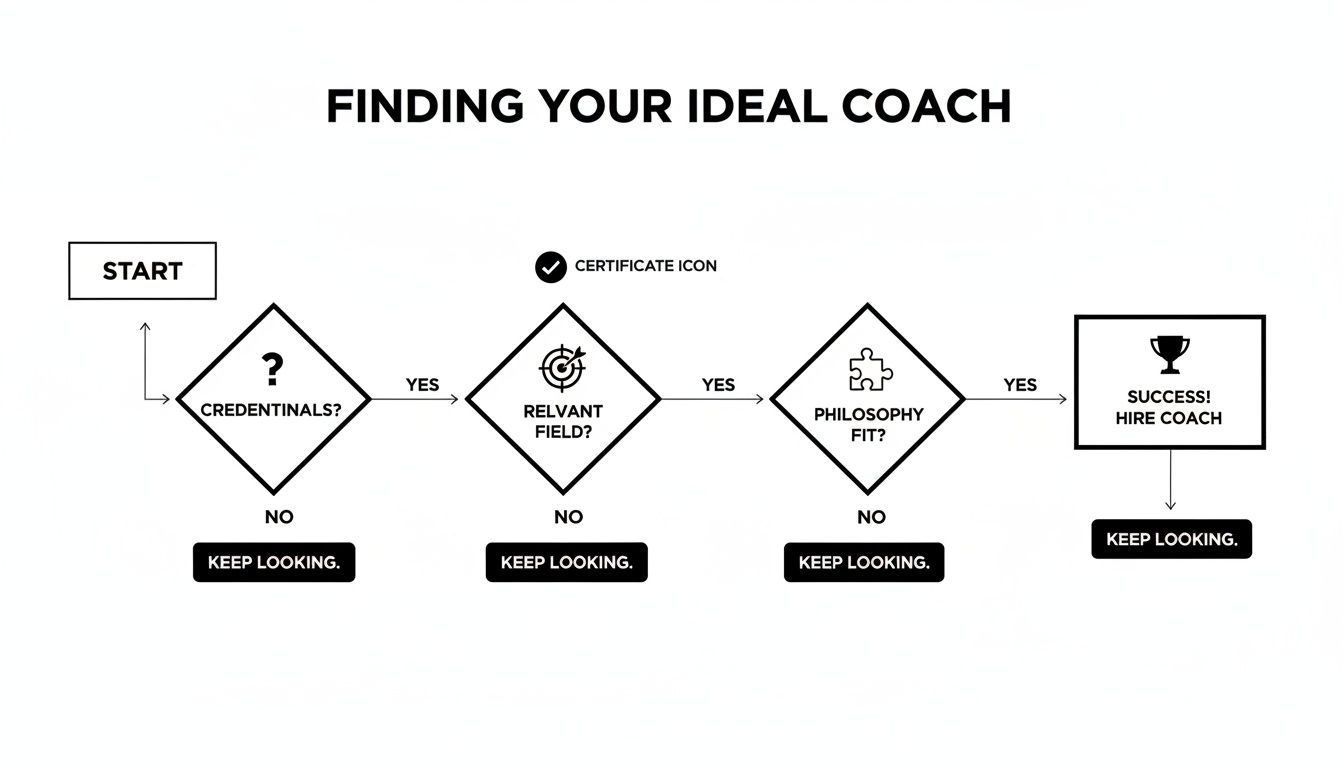
By following a clear path, you can systematically filter out the noise and zero in on a true professional who is equipped to help you win.
Asking the Right Questions
That first consultation call is your interview. You are the one doing the hiring. This is your chance to test their approach and see if you click. Don't hold back—ask tough, insightful questions.
Actionable Tip: Come prepared with a list of questions. Here are some sharp ones to get you started:
- What’s your specific methodology for helping someone in my exact situation?
- How do you actually measure progress? What does success look like in a practical sense?
- Can you walk me through an anonymous example of how you helped a client with a challenge similar to mine? What tools did you use?
- How does your background in psychology shape your coaching style in a practical way?
- What do you expect from me between sessions to ensure I get the most out of this?
The way they answer will tell you everything you need to know about their expertise, their process, and whether their approach aligns with what you’re looking for. A top-tier coach will welcome these questions and give you clear, honest answers.
To help you stay organized during your search, use this checklist to evaluate each potential coach.
Checklist for Selecting Your Mental Performance Coach
Use this checklist to evaluate potential coaches and ensure they meet the key criteria for a successful partnership.
| Evaluation Criteria | What to Look For | Why It Matters |
|---|---|---|
| Credentials & Education | Licensed psychologist (Ph.D./Psy.D.), relevant certifications (e.g., CMPC). | Ensures a deep, scientific understanding of human behavior and ethical standards. |
| Relevant Experience | Proven track record working with clients in your specific field (e.g., pro sports, business). | They'll understand the unique pressures and context of your environment. |
| Coaching Philosophy | A clear, evidence-based approach (e.g., CBT, mindfulness) that resonates with you. | You need a methodology you can believe in and commit to. |
| Client Testimonials | Specific, verifiable results from past clients who faced similar challenges. | Provides social proof that their methods work in the real world. |
| Personal Chemistry | Do you feel comfortable, respected, and understood during the initial consultation? | This is a partnership. Trust and rapport are non-negotiable for success. |
| Clear Process | A defined structure for sessions, goal-setting, and measuring progress. | A structured plan ensures accountability and a clear path toward your goals. |
| Communication Style | Direct, empathetic, and challenging in a constructive way. | The right coach will push you out of your comfort zone while providing support. |
This framework will help you move beyond a gut feeling and make a well-informed decision.
What a Typical Engagement Looks Like
Most coaching relationships kick off with a deep-dive discovery session where you and your coach get on the same page about your goals and roadblocks. From there, you'll map out specific, measurable goals. Your coach will arm you with mental tools, but the real magic happens between sessions when you put them into practice.
Practical Insight: Your "homework" might be to keep a "thought journal" for a week, noting every negative thought related to performance. In the next session, you and your coach will analyze these patterns and develop specific reframing techniques to counter them. This active participation is key to making progress.
For athletes in particular, understanding the nuts and bolts of sports psychology consulting can shed even more light on this dynamic process.
Ultimately, finding the right mental performance coach is about moving from being curious about your potential to confidently taking action with an expert guiding you.
Frequently Asked Questions About Mental Performance Coaching
It’s completely normal to have questions before diving into mental performance coaching. Making the decision to invest in your mental game is a big one. Let's tackle some of the most common questions to give you the clarity you need.
This isn't about vague theories. It's about the real, practical side of what our work together will look like.
How Is Coaching Different from Therapy?
This is the most important distinction. While both a mental performance coach and a therapist are experts in psychology, we focus on different things. Therapy is typically geared toward healing, looking at past traumas, or managing clinical conditions like anxiety or depression to improve your overall well-being.
Mental performance coaching is 100% goal-oriented and future-focused. Our mission is to sharpen your performance in a specific arena—on the field, in the boardroom, or on stage. We’re not digging into the past; we’re building concrete mental skills so you can nail it when the pressure is on.
How Long Until I See Results?
The honest answer? It varies. Some clients feel a shift in their mindset after just a couple of sessions. For others, it takes more consistent work to break old habits and lock in new mental skills.
Your progress depends on your commitment between sessions. Practical Tip: To accelerate results, dedicate 10-15 minutes each day to practicing the specific mental skill you're working on, whether it's a breathing exercise, visualization, or challenging negative thoughts. Consistent effort creates powerful, lasting change.
Is the Coaching Process Confidential?
Without question. As a licensed clinical psychologist, I'm held to the same strict ethical standards of privacy and confidentiality as any doctor or therapist. Everything we talk about in our sessions stays between us. Period. This creates a foundation of trust where you can be totally open about your goals and struggles.
Your privacy is paramount. Confidentiality allows for the honest, deep work required to unlock your peak performance, ensuring you can explore your mental game with complete peace of mind.
This isn’t just a promise; it’s a professional requirement that makes a successful coaching partnership possible.
What Is the Typical Investment?
I encourage clients to reframe this from "What does it cost?" to "What is the return on this investment?" Bringing on a mental performance coach is a strategic move to boost your long-term success. You invest in the best equipment and physical training; investing in your mental game gives you that same powerful edge.
The specific investment depends on what you need, from individual sessions to full team workshops. But the goal is always the same: to deliver value that far outweighs the financial cost by equipping you with mental skills that will pay you back for years to come.
Ready to invest in your mental game and unlock your true potential? At Dr. John F. Murray, we build the psychological skills that turn high-achievers into champions. Schedule a consultation today to start your journey toward peak performance.