
By Dr. John F. Murray
Losing a game isn’t just a loss. It’s one of the most critical parts of an athlete’s development. Real, meaningful progress kicks in when an athlete learns to see a setback not as a final judgment, but as a set of data points telling them exactly what to improve. Getting this mental shift right is what truly separates the good from the great.
Why Failure in Sports Is a Hidden Advantage

There’s no denying the sting of a big loss. It hits you with a wave of frustration, a creeping self-doubt, and that paralyzing fear you’ll make the same mistake again. For a lot of athletes, that’s where the story stalls out.
But for champions? It’s just the beginning. The best in the world don’t just put up with failure; they process it in a completely different way.
Imagine an athlete’s raw talent as a piece of steel. It has potential, sure, but it lacks real strength and a defined shape. It’s the intense heat of the forge and the repeated, hammering blows that shape it into an unbreakable blade.
In sports, pressure and setbacks are the hammer and the fire. They are the very forces that transform raw talent into hardened, resilient strength.
Adopting this perspective is the most powerful mental skill you can build. It’s not about pretending a loss doesn’t hurt. It’s about learning to channel that energy into productive, focused growth.
The Champion’s Mindset
Instead of getting stuck on what went wrong, top performers immediately ask what they can learn. A missed shot isn’t a sign of some deep personal flaw; it’s a mechanical issue that can be fixed. A tactical mistake isn’t proof of weakness; it’s a gap in strategy that can be closed.
This mindset is built on a few core beliefs:
- Failure is Feedback: Every setback gives you precise data on what needs work—physically, technically, and mentally.
- Embrace the Process: Lasting growth comes from the daily grind and the commitment to improve, not just from the final score.
- Control Your Emotional Response: You can acknowledge disappointment without letting it poison your next performance.
Building this kind of mental armor takes deliberate work. By understanding how to build mental resilience, you can start bouncing back faster and stronger from any challenge you face.
The Anatomy of a Performance Breakdown
When an athlete fails, it’s almost never just a physical mistake. A missed free throw, a shanked punt, a fumbled pass—these are often just the final, visible symptoms of a much deeper breakdown in the mental process. Understanding the anatomy of that failure is the first step toward preventing it.
Performance breakdowns don’t just happen out of the blue. They’re predictable and can almost always be traced back to specific triggers that derail an athlete’s focus, skill, and confidence.
These breakdowns typically fall into three distinct buckets. Once we identify the root cause, an athlete can move from feeling helpless and frustrated to taking targeted, effective action. This diagnostic approach demystifies failure in sports, showing that it’s not some deep character flaw but a solvable problem in an athlete’s mental machinery.
Cognitive Errors: The Mental Short-Circuits
Cognitive errors are what happen when the brain’s processing power gets compromised, leading to poor decisions on the field or court. Think of your mind like a high-performance computer; when it’s overloaded, running too many programs, or just plain tired, it starts to lag and make mistakes. This isn’t about lacking skill—it’s about a temporary inability to access that skill when it matters most.
This can show up in a few key ways:
- Mental Fatigue
- Analysis Paralysis
- Loss of Situational Awareness
Emotional Hijacking: When Feelings Take Over
Emotions are rocket fuel in sports. But when they’re unregulated, they can hijack an athlete’s performance in a split second. This is a real neurological event where the brain’s emotional center (the amygdala) overrides the rational, decision-making part (the prefrontal cortex). The result is impulsive, reactive behavior instead of calm, strategic execution.
Learning how to manage these emotional spikes before they take over is a core component of effective mental skills training for athletes.
Pressure-Induced Collapses: The Weight of Expectation
Pressure is that invisible force that can make a simple, everyday task feel impossibly hard. It can come from external sources—coaches, parents, a roaring stadium—or, just as often, from an athlete’s own sky-high expectations. Under intense pressure, the body’s stress response can kick into overdrive, triggering a racing heart, shallow breathing, and muscle tension, all of which are poison to peak athletic performance.
You can read more about how that monumental sports failure unfolded and its psychological underpinnings on Smithsonian Magazine. Understanding all the factors that can halt an athlete in their tracks is crucial, including physical ones, which is why a proper balance test for concussion is so important in assessing and managing setbacks. When we dissect these moments, we start to see failure not as a mystery, but as a series of preventable steps.
Actionable Strategies to Build Your Mental Armor
Knowing why you’re in a slump is one thing, but having the tools to climb out is a different game entirely. Elite athletes don’t just sit around waiting for confidence to reappear—they actively forge and protect it with deliberate mental drills. This is where the theory hits the pavement.
Think of these strategies as your mental armor. Just as you build physical strength with specific exercises in the gym, you must train your mind with proven routines to handle the inevitable moments of failure in sports. These aren’t abstract psychological theories; they are practical, repeatable actions you can deploy the second after a mistake to get back in control.
The goal is to make your mental recovery skills as quick and automatic as your physical ones. By practicing these drills, you create a buffer against the negative spiral, keeping you focused, resilient, and effective when the pressure is on.
The 3 Rs Reset Routine
Your most powerful tool for bouncing back in an instant is a simple reset routine. When you make a mistake, your brain’s emotional center—the amygdala—can hijack your focus in a split second. The “3 Rs” routine is a quick, structured process designed to interrupt that hijack and get your mind right back to the task at hand.
It’s a three-step process:
- Recognize: The second an error happens, consciously acknowledge it and the frustration that bubbles up. Don’t try to ignore or suppress it. A simple internal thought like, “Okay, that was a bad pass,” does the trick.
- Reset: Use a physical and a verbal cue to signal a hard reset. This could be clapping your hands, touching the logo on your jersey, or taking two deep, deliberate breaths. While you do the physical action, use a short, powerful cue phrase like “Next play” or “Reset.”
- Refocus: Immediately snap your attention to your next specific, controllable action. Don’t think about winning the game; think about your defensive stance, the mechanics of your next shot, or calling out a screen to a teammate.
Take a basketball player who just missed a critical free throw. They Recognize the miss and the feeling in their gut. They Reset by taking a deep breath while wiping their hands on their shorts. Then they Refocus entirely on the specific defensive assignment for the next possession. The whole thing takes less than five seconds, but it’s absolutely crucial for preventing one mistake from turning into two.
Guidance for Coaches and Parents
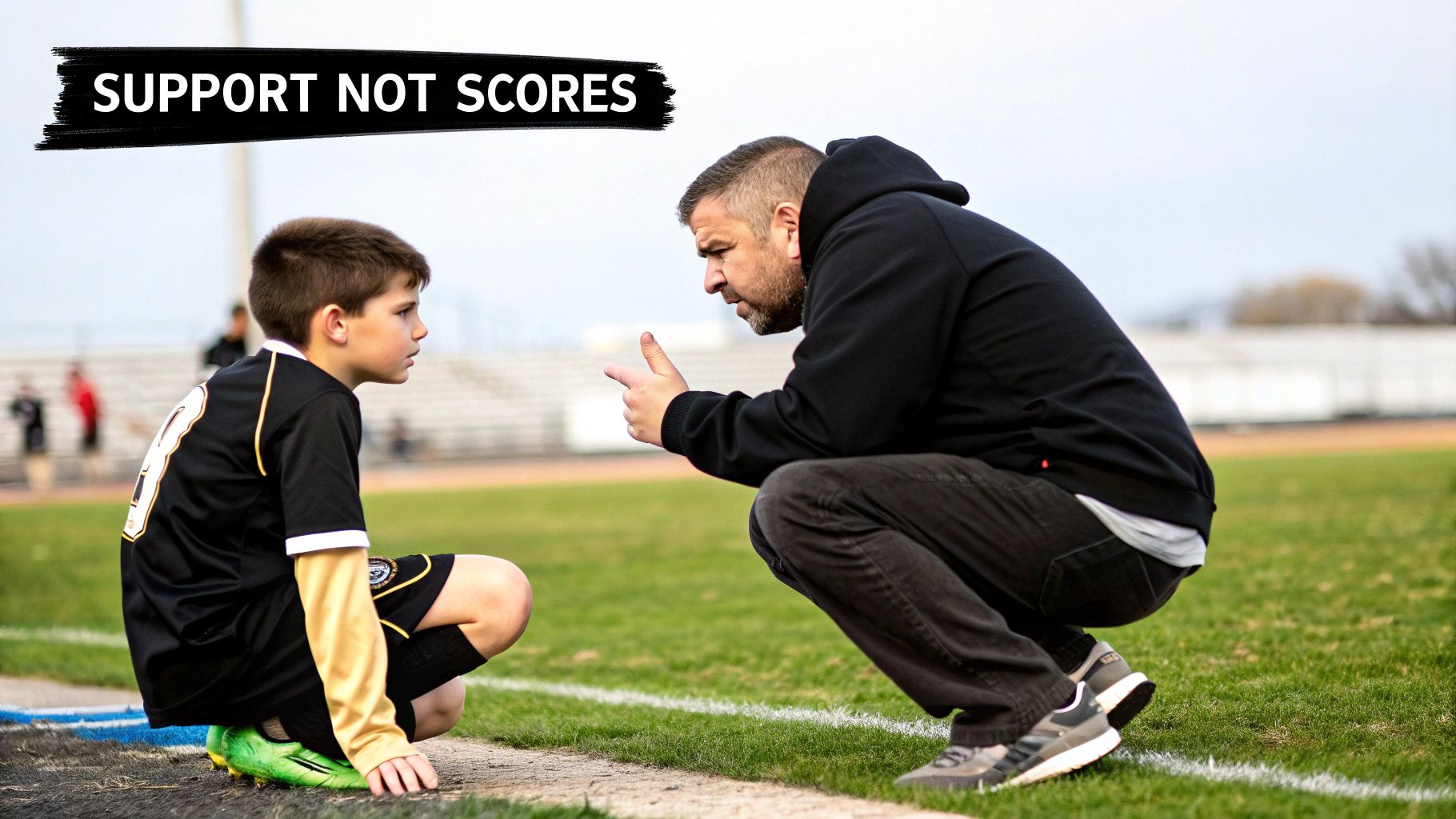
An athlete doesn’t develop their relationship with failure in sports in a vacuum. It’s profoundly shaped by the most important figures in their corner: their coaches and parents. The right support system can reframe a crushing loss into a powerful teaching moment, forging an athlete who is resilient, confident, and mentally tough.
The real goal is to build an environment where trying hard and falling short isn’t something to be feared. When the fear of a mistake starts to outweigh the desire to go for it, that’s when growth grinds to a halt. For the support network, this means deliberately shifting the focus from outcomes to the process, from criticism to curiosity, and from judgment to genuine support.
This requires a clear playbook—a set of practical strategies for communicating, teaching, and reinforcing the lessons hiding inside every setback.
A Coach’s Playbook for Building Resilience
As a coach, you’re the chief architect of your team’s culture. How you react after a tough loss sets the tone for how every single athlete processes failure. The key is to treat setbacks as data, not drama.
Here are a few actionable coaching strategies to put into play:
- Frame Feedback Constructively: Ditch the vague, emotional critiques. Instead of “You guys played terribly,” get specific: “Our defensive rotations were a step slow today. Let’s focus on our footwork drills this week to tighten that up.” This turns a negative result into a concrete, solvable problem.
- Design ‘Failure Drills’: You can actually practice failing. Intentionally create scenarios in practice that push athletes to their limits, where mistakes are likely. A basketball team might run a drill where they’re down four points with only 20 seconds on the clock. It normalizes the feeling of pressure and teaches them to execute when things aren’t going their way.
- Celebrate Intelligent Risks: When an athlete attempts a creative, high-level play that doesn’t quite pan out, praise the decision to try it. Acknowledging the courage behind the attempt encourages aggressive, confident play over safe, tentative actions.
A crucial aspect for coaches and parents is to cultivate a supportive environment. Understanding how to create a strong approach is about building a supportive learning community where shared goals and mutual support are the foundation.
A Parent’s Guide to Post-Game Conversations
For parents, the car ride home can be one of the most critical moments in an athlete’s development. What you say and how you say it can either add to the weight of a loss or start the process of building them back up. Your role isn’t to be a second coach; it’s to be a source of unconditional support.
The most powerful approach is to empower your child to own their experience and find their own lessons. It all comes down to asking the right questions.
Post-Game Communication Do’s and Don’ts
| Do This (Focus on Process & Learning) | Don’t Do This (Focus on Outcome & Blame) |
|---|---|
| “I love watching you compete.” | “Why did you lose?” |
| “What was one thing you learned today?” | “You should have made that shot.” |
| “What part of the game was the most fun?” | “Was that other player really better than you?” |
This simple shift in language makes a world of difference. It reinforces that your love and pride are not tied to the final score. When you focus on effort, learning, and enjoyment, you give your athlete the emotional safety net they need to take risks, bounce back from failure in sports, and develop a true, lasting passion for their game.
For more information on mental performance coaching or psychological services, or to schedule a consultation, visit my Sports Psychology Services page.