
Here’s the thing about confidence: it’s not something you just have. It’s something you build.
Think of it like any other skill in your sport. You wouldn’t expect to master a serve, a swing, or a shot without countless hours of practice. Confidence works the exact same way. It’s an active process of setting the right goals, drilling your mental game daily, locking in your routines, and, most importantly, learning how to bounce back when you get knocked down.
This isn’t about wishful thinking. It’s about turning that fragile sense of self-belief into a reliable, performance-driving asset.
The Real Difference Between Confidence and Doubt
We’ve all seen that critical moment in a game. One athlete steps up, composed and decisive, and nails the play. Another, with just as much physical talent, hesitates for a split second and the opportunity is gone. That’s not a gap in talent; it’s a gap in confidence.
Too many athletes treat confidence like the weather—something they hope is good on game day but have no control over. But elite performers know the secret: confidence is a skill you construct, piece by piece, through intentional work.
Forget the generic advice to “just believe in yourself.” This guide is your roadmap to building that belief from the ground up, with actionable pillars that give you a real mental edge when the pressure is on.
The Science Behind Self-Belief
This isn’t just talk; there’s solid science to back it up. A massive meta-analysis that looked at 47 different studies and more than 3,700 athletes found a clear, positive link between an athlete’s self-confidence and how they actually performed.
It’s not a magic pill, of course. But the evidence is undeniable. When you genuinely believe you can succeed, your body is far more likely to execute. To dig deeper, you can explore the research on self-confidence and athletic performance.
The key takeaway is that your mindset directly fuels your physical output. You just have to build that belief on a foundation of real preparation, not just hope.
Confidence is not walking into a room thinking you are better than everyone; it’s walking in and not having to compare yourself to anyone at all. It comes from a quiet, internal certainty built on hours of unseen work.
The process is straightforward. This diagram breaks down the four core pillars we’ll use to build your confidence brick by brick.
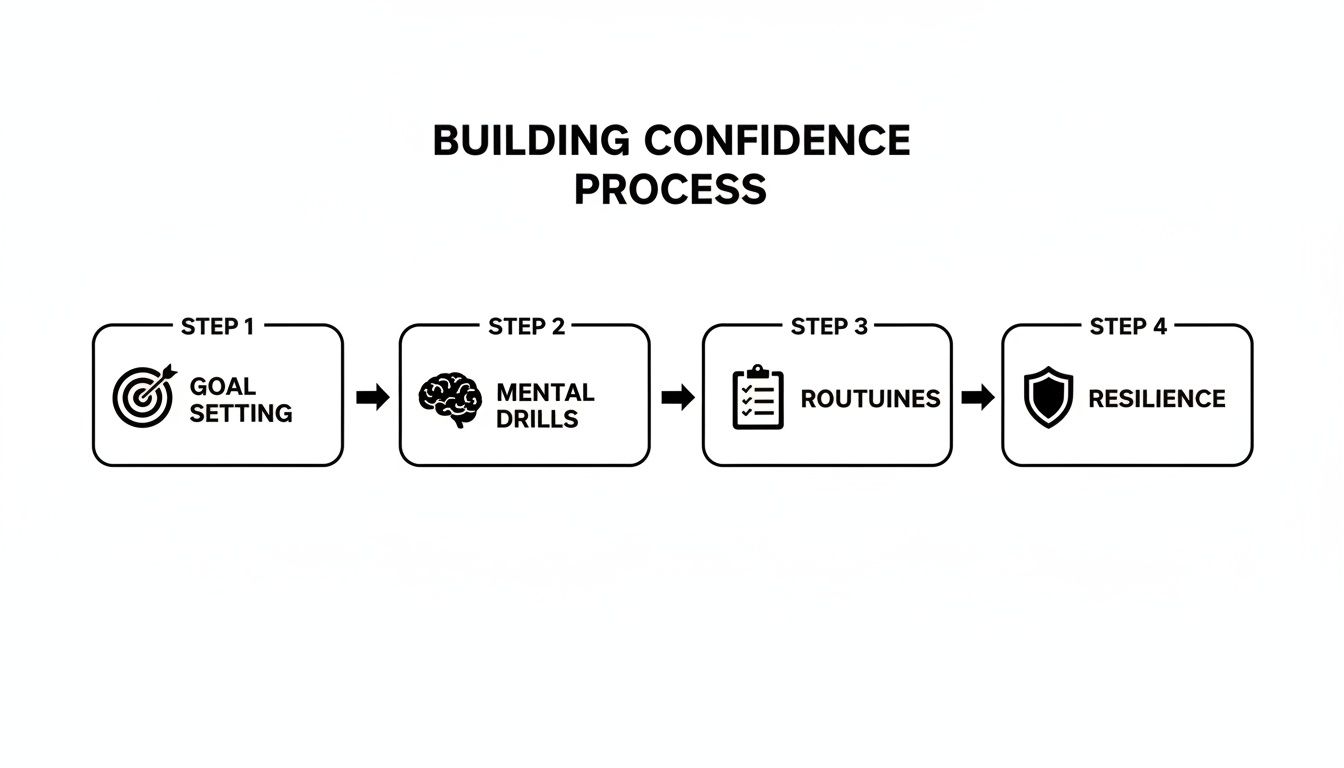
As you can see, each element feeds into the next, creating a powerful cycle that strengthens your mental game over time.
Your Quick-Start Confidence Building Toolkit
So, where do you start? You start by treating your mind like a muscle that needs consistent training. The table below outlines the essential tools you’ll need to build real, lasting mental toughness.
| Strategy Pillar | Key Action | Primary Benefit |
|---|---|---|
| Purposeful Goal Setting | Define specific, controllable process goals. | Shifts focus from outcomes to execution, building momentum. |
| Daily Mental Drills | Practice imagery and positive self-talk for 5-10 mins. | Rewires your brain for belief and reduces performance anxiety. |
| Bulletproof Routines | Create and stick to pre-performance and in-game rituals. | Provides a sense of control and familiarity under pressure. |
| Resilience Building | Reframe setbacks as feedback, not failure. | Turns losses into learning opportunities and fuel for growth. |
This toolkit provides a snapshot of the core strategies we’ll be diving into. It’s not about a single magic trick but about integrating these simple, powerful habits into your daily training. Let’s break down how to use each one.
Bringing Process Goals to Life
So, what does this actually look like on the court or the field? It’s all about deconstructing a complex skill into its smallest, most controllable parts. This strategy lets you stack small, undeniable wins—in practice and in competition—creating a powerful feeling of momentum and self-belief.
Let’s break it down with a few real-world examples:
- The Basketball Player: Instead of obsessing over making every single free throw (a performance goal), the process goal becomes “hold your follow-through for two seconds” on every shot. That tiny, controllable action directly cleans up your form and, over time, improves your percentage.
- The Swimmer: Rather than stressing about a specific split time (performance), the focus shifts to a perfect flip turn by “driving hard off the wall with both feet” every single time. Nail the process, and the time will take care of itself.
- The Tennis Player: A player struggling with a shaky serve can stop worrying about aces (outcome) and instead focus on a process goal like “tossing the ball to its peak height” consistently. This refines the mechanics and rebuilds trust in the motion, one toss at a time.
These small, specific actions are the bricks and mortar of confidence. Every single time you execute a process goal, you send a clear message to your brain: “I did exactly what I set out to do.”
You’re essentially building a library of evidence that proves you are competent, capable, and in control. A simple weekly goal plan ties it all together. Each week, pick one or two process goals to be your main focus in every single practice and game. This consistent effort is what turns focused actions into automatic habits, building the kind of unshakeable self-belief that fuels peak performance.
Creating Routines That Make Confidence Automatic
You’ve heard it before: under pressure, athletes don’t magically rise to the occasion. They fall back on their training. This is precisely why routines are your secret weapon for building unshakeable confidence. They inject a powerful sense of control and predictability into what can be a chaotic environment, effectively turning down the volume on that inner voice of doubt.
These aren’t superstitions or lucky socks. Routines are structured, deliberate sequences of actions that prime your mind and body for peak performance. When the pressure cooker gets turned up, a well-practiced routine is the anchor that keeps you grounded and locked in on the task at hand.
Building Your Pre-Performance Blueprint
A solid pre-game routine doesn’t start when you pull into the parking lot. It begins the night before. True preparation is about controlling every variable you can, which builds a deep, quiet belief that you’re ready for whatever comes your way.
This routine is intensely personal, but it should always cover your physical, mental, and tactical prep. The whole point is to create a sequence that feels familiar and puts you in the zone to compete.
Here’s an adaptable checklist you can use to start building your own powerful pre-performance routine:
- The Night Before:
- Gear Check: Get your bag packed with everything you’ll need. No last-minute panic. This simple act starts the mental prep process.
- Fuel Up: Eat a familiar, balanced meal. Game night is not the time to experiment with new foods that could throw your system off.
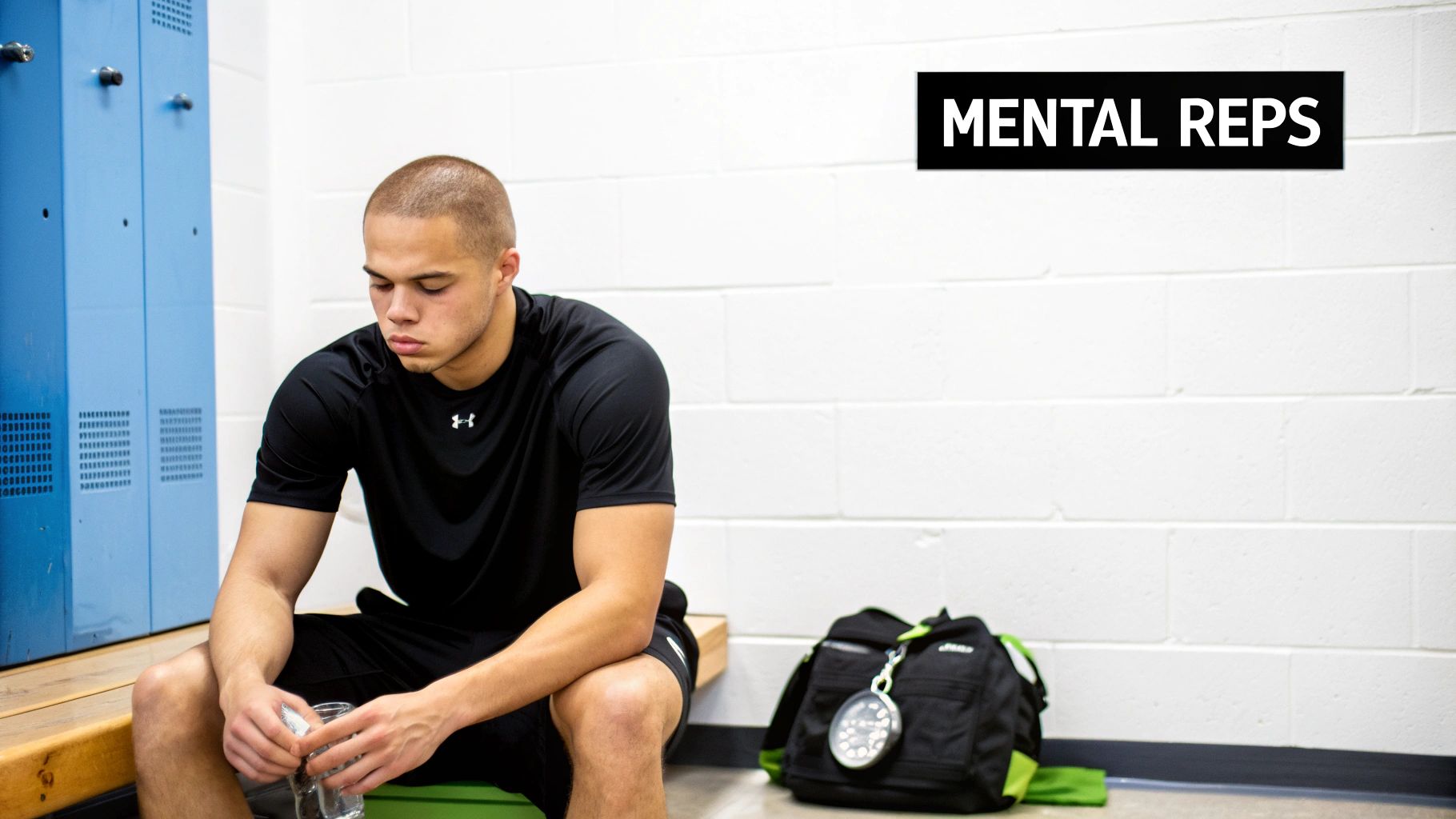
- Mental Reps: Spend 5-10 minutes visualizing success. See yourself executing your skills perfectly and feeling confident doing it.
- Sleep: Getting 7-9 hours of quality sleep is non-negotiable. It’s critical for both your mind and body to function at their best.
- Game Day Morning:
- Consistent Wake-Up: Try to get up around the same time, even for evening games. This keeps your body clock stable.
- Smart Breakfast: Eat the same kind of meal you’d have before a tough practice. Consistency is key.
- Light Movement: A short walk or some light stretching can do wonders to wake up your body.
- Arrival at the Venue:
- Set the Tone: Use a familiar playlist to manage your energy. Maybe you need pump-up music, or maybe something calming. You know what you need.
- Physical Warm-Up: Run through your standard dynamic warm-up. This should be the exact same, every single time.
- Final Mental Cues: Quickly review your key process goals. Recite a positive phrase to yourself, something like, “I trust my training.”
Building these habits also means staying healthy enough to compete. A big part of consistency is proactively preventing sports injuries so you can keep showing up.
Creating Your In-Game Reset Button
Confidence isn’t just about starting strong; it’s about staying strong, especially right after you make a mistake. One error can quickly snowball into a full-blown crisis if you don’t have a way to stop the negative momentum. This is where a quick “reset” routine is invaluable.
Your reset routine is your mental first-aid kit. It’s a simple, repeatable action that breaks the cycle of frustration, clears your mind, and snaps your focus back to the present moment.
This is a cornerstone of effective mental skills training for athletes and a tool pros in every sport rely on. It’s a short, practiced sequence that signals to your brain: that last play is over, we’re moving on.
The trick is to make it quick, physical, and consistent. A few examples from the field:
- The Golfer: After a bad shot, a golfer might walk back to their bag, meticulously wipe the club clean, take a deliberate sip of water, and then restart their pre-shot routine from scratch.
- The Tennis Player: A player who just double-faulted might turn their back to the court, fiddle with their racquet strings, and take one deep, controlled breath before stepping back up to the baseline.
- The Basketball Player: After bricking a free throw, a player could step off the line, clap their hands once, and repeat a simple cue word like “legs” or “finish” before getting the ball for the second shot.
Find what works for you. It could be adjusting your uniform, taking a deep breath while staring at a spot on the wall, or tapping your cleats three times. The key is to practice it relentlessly in training after every mistake, so it becomes an automatic reflex. This simple tool gives you the power to instantly regain composure and stop one error from sinking your entire performance.
Conduct an Objective Post-Performance Review
Emotions run high after a tough performance. It’s natural to zero in on everything that went wrong. But to build real resilience, you need a structured way to look at what happened objectively, separating the raw facts from your feelings. A post-performance review is the perfect tool for this.
The goal isn’t to beat yourself up. It’s to become a detective of your own performance, searching for clues that will help you improve. I have my clients use a simple framework to guide their thoughts:
- What Went Well? Always start here, no matter how small the win. Did you nail your pre-game routine? Execute a specific play correctly? You have to acknowledge your successes.
- What Could I Improve? Get specific and focus on the process. Ditch “I played terribly” for something like, “My footwork was slow on defense in the second half.”
- What Will I Do Differently Next Time? This is crucial. Turn your analysis into an actionable plan. For example: “This week in practice, I’m going to focus on defensive slide drills.”
This structured approach stops you from spiraling and immediately channels your energy toward productive solutions. For those looking to dive deeper into this, our guide on how to build mental resilience offers even more strategies.
Common Questions About Building Confidence in Sports
Working on the mental side of your sport can feel just as tough as any physical drill. As we wrap up this guide, you probably have some specific questions about how to put all this into practice. Let’s tackle some of the most common ones I hear from athletes, coaches, and parents.
This is where the rubber meets the road. We’ll clear up any confusion so you feel ready to start building a truly stronger mental game.
How Long Does It Take to Build Lasting Confidence?
I get this question all the time, and the honest answer is there’s no magic finish line. True confidence isn’t something you achieve once and then forget about; it’s a skill you have to maintain, just like physical conditioning. You wouldn’t get in shape and then just stop training, right? The mental game demands that same consistency.
That being said, with dedicated mental skills practice for just 10-15 minutes a day, most athletes I work with start to feel a real, noticeable shift in their self-belief within 3 to 4 weeks. Building that deep, resilient confidence—the kind that stands firm under the bright lights—is a longer game. That often takes a full season of focused work to truly lock in.
The key is consistency over intensity. Small, daily mental workouts beat occasional marathon sessions every single time.
What Is the Biggest Mistake Athletes Make?
Hands down, the single biggest trap is tying your self-worth directly to your last performance. It creates a brutal rollercoaster where you only feel confident after a win and completely deflated after a loss. Your entire mental state is at the mercy of the scoreboard.
Genuinely confident athletes build their belief on a much more stable foundation: their preparation, their effort, and their trust in the process. When your confidence is rooted in the quality of your training and the discipline of your routines, it becomes unshakable, no matter what the final score says.
To break this cycle, you have to become obsessed with what you can control. Your attitude at practice, the consistency of your pre-shot routine, the discipline of your self-talk—those are the real building blocks of durable confidence.
Can You Be Overconfident in Sports?
Absolutely. There’s a fine line between healthy confidence and arrogance, and it’s critical to know the difference. Overconfidence almost always leads to complacency, which is the absolute enemy of proper preparation. The arrogant athlete cuts corners in training, underestimates opponents, or tunes out coaching, which inevitably leads to a poor performance.
Healthy confidence, on the other hand, is rooted in evidence. It’s a realistic belief in your own ability that’s been earned through thousands of hours of hard work and successful reps in practice.
- The Confident Athlete believes they can succeed because they’ve done the work.
- The Overconfident Athlete simply expects to succeed, often without putting in the required effort.
How Can a Coach or Parent Help an Athlete Build Confidence?
As a coach or parent, your words carry immense weight. To build confidence without piling on pressure, the single most important thing you can do is shift the focus from outcomes to controllable actions and mindsets. It’s all about celebrating the process, not just the final result.
Here are a few practical ways to nail this:
- Praise Effort, Not Just Talent: Instead of a generic, “You’re the best player out there,” get specific. “I was so impressed with how you reset and refocused after that mistake.” This reinforces a behavior they can actually control.
- Promote a Growth Mindset: Frame losses and setbacks as learning opportunities, not failures. Ask questions like, “What did you learn from that game?” or “What’s one thing you want to focus on in practice this week?”
- Focus on the Process: Make a big deal about them sticking to their pre-shot routine or using positive self-talk, even if the play didn’t work out. Celebrate the things you want them to repeat.
This approach takes the pressure of “perfection” off their shoulders and helps them fall in love with the process of getting better. That’s how you help a young athlete build genuine, long-term confidence that will serve them well beyond the playing field.
For more information on mental performance coaching or psychological services, or to schedule a consultation, visit my Sports Psychology Services page.