
In a business world that feels more unpredictable by the day, great leadership isn't just a nice-to-have; it's the engine that powers the whole organization. This is where high-quality leadership development programs for executives come in. Think of them as a strategic investment, designed to forge leaders who can cut through complexity with vision, resilience, and genuine emotional intelligence.
These programs go beyond dusty textbooks and management theory. They build the mental fortitude needed for the high-stakes decisions leaders face every single day. An actionable first step for any organization is to survey its senior team: ask them to rank their confidence in areas like crisis communication, change management, and strategic foresight. The results will immediately highlight where development is most needed.
Why Effective Leadership Programs Are a Strategic Imperative
Companies are finally starting to see executive training for what it is. It's not an optional HR perk anymore. It’s a critical driver of growth, innovation, and long-term stability. The reason is simple: the quality of your leadership trickles down into every single corner of the organization.
The market data tells the same story. The global leadership development program market was recently valued at around $83.2 billion. Projections show it soaring to $218.9 billion by 2034. This isn't just a trend; it’s a clear signal that smart businesses worldwide are doubling down on their executive talent. You can dig into more details on this leadership development market growth at Global Insight Services.
Moving from Management to High-Performance Leadership
The best programs don’t just teach people how to manage projects; they cultivate a high-performance mindset.
Think of an elite athlete getting ready for a championship. They don’t just run drills. They go through intense mental conditioning to make sure they can perform under crushing pressure. Modern executive development borrows heavily from sports and business psychology, building mental toughness, clarity, and focus.
The real goal is to give leaders the cognitive and emotional tools to not just manage teams, but to truly inspire them. We're talking about developing leaders who stay calm and decisive in a crisis, who can rally people around a compelling vision, and who build a culture where resilience and innovation can thrive.
Tangible Business Outcomes of Executive Development
When you invest in your senior leaders, you create a powerful ripple effect. As they sharpen their skills, the benefits show up in real, measurable results. Well-trained executives are simply better at steering their teams toward goals, which boosts performance across the board. The returns show up in a few key areas:
- Improved Strategic Decision-Making: Leaders learn to analyze complex problems with more clarity, see market shifts coming, and make bold, well-informed choices. For example, a program might teach a framework like OODA (Observe, Orient, Decide, Act) to speed up and improve decision-making during a market disruption.
- Enhanced Team Engagement and Retention: Great leaders build environments where top talent wants to stick around. Companies that invest in training often see a major drop in employee turnover. A practical tip is to train leaders on how to conduct effective "stay interviews" to proactively address team concerns before they become exit reasons.
- Greater Organizational Agility: Developed leaders are far better at guiding their people through change, making the entire business more adaptable and ready to pivot when a new challenge or opportunity pops up. This includes practical skills like communicating a new vision in a way that reduces fear and builds buy-in.
Ultimately, leadership development is about future-proofing your organization. It builds a deep bench of capable, resilient, and forward-thinking leaders who can lock in your competitive advantage and drive bottom-line results for years to come.
The Building Blocks of a High-Impact Executive Program
Let’s be honest: not all leadership development programs are created equal. The real difference between a fleeting motivational speech and a genuine, lasting change in performance comes down to the program's design. The most effective programs aren't just one-off events; they're a thoughtfully constructed system of different elements, each building on the last.
Think of it like a symphony orchestra. Each section plays a unique role, but when they come together, the result is powerful and unified. This integrated approach creates a learning journey that is both intensely personal and incredibly practical, driving real behavioral shifts that stick around long after the final session.
Personalized Guidance Through Executive Coaching
Executive coaching is the heart of personalized development. It’s a completely confidential, one-on-one partnership where a leader can safely unpack their biggest challenges, sharpen their strategic thinking, and get unfiltered feedback from a seasoned expert. This isn’t about spoon-feeding answers. It’s about asking the tough, insightful questions that help leaders find their own solutions.
Practical Example: I worked with a senior VP who struggled with delegation. Through coaching, we identified the root cause: a fear of losing control. An actionable tip we developed was the "delegation scaffold." She started by delegating low-risk tasks with clear, written instructions and daily check-ins. As her team's confidence grew, she gradually removed the scaffolds, delegating larger projects with bi-weekly check-ins, freeing her up for high-level strategy.
Immersive Workshops and Simulations
While coaching is intensely personal, workshops offer a dynamic group setting where leaders can learn and practice together. These are a far cry from death-by-PowerPoint lectures. The best workshops throw executives into the fire with high-stakes business simulations, complex case studies, and interactive role-playing.
Practical Example: In a crisis management workshop, instead of a lecture, participants face a simulated PR disaster blowing up on a mock social media platform. They have 60 minutes to draft a public statement, prepare talking points for a press conference, and align on an internal communication plan—all while new information floods in. This builds muscle memory for performing under real-world pressure.
This approach is designed to help executives learn to navigate complexity, build genuine resilience, and cultivate the foresight needed to win in the long run.
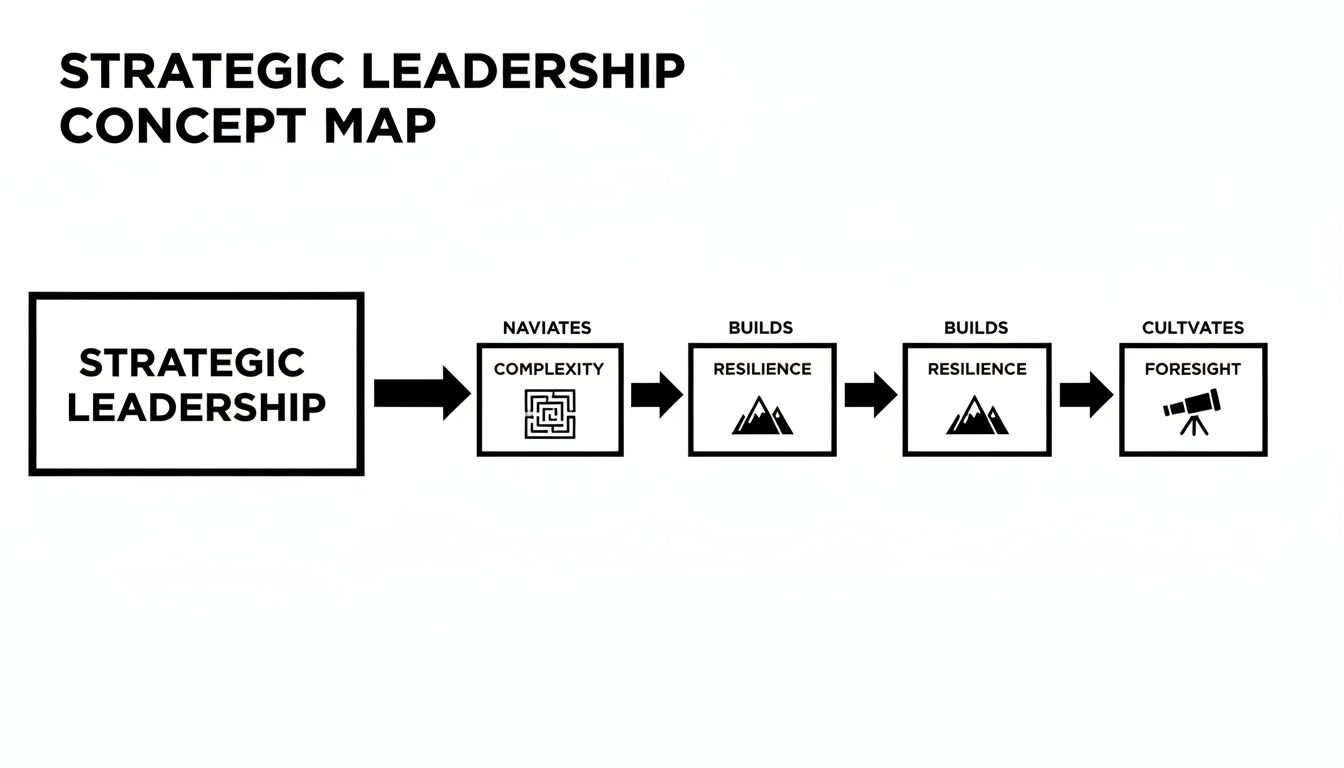
As the visual shows, mastering complexity is the foundation. That mastery allows resilience to develop, which ultimately unlocks true strategic foresight.
The Power of 360-Degree Feedback
To really grow, leaders need an honest look in the mirror. That's exactly what 360-degree feedback provides. This process gathers structured, anonymous input from an executive's direct reports, peers, boss, and sometimes even clients. The result is a well-rounded, unfiltered view of their strengths and—more importantly—their blind spots.
Actionable Tip: When reviewing 360-degree feedback, don't get defensive. Instead, look for themes. If multiple people say you don't listen in meetings, your action item isn't to argue the point; it's to practice active listening. A simple technique is to summarize what you've heard ("So, if I understand correctly, you're saying…") before offering your own opinion.
Getting this kind of feedback isn't always comfortable, but it is absolutely essential for self-awareness. It reveals what to work on, providing a clear focus for executive coaching and skill-building in the workshops.
Action Learning Projects That Drive Real Results
Knowledge without application is just trivia. Action learning projects are what connect the dots between the training room and the real world. Here, we task small groups of executives with tackling a genuine, high-priority business challenge the organization is facing right now.
This isn't a theoretical case study. The team has to do the research, build the strategy, and actually implement a solution, reporting their progress and results back to the C-suite. For example, a team might be tasked with developing a plan to reduce customer churn by 10% in the next quarter. This forces them to apply their new skills in a practical context while delivering tangible business value.
As you can see, each element serves a distinct purpose, yet they all work together to create a comprehensive development experience. The table below breaks down how these core pillars contribute to building a stronger leader.
Key Components of Executive Leadership Programs
| Component | Primary Focus | Desired Outcome |
|---|---|---|
| Executive Coaching | Personalized development, self-awareness, and overcoming individual barriers | A leader who understands their blind spots and has a clear, actionable plan for growth. |
| Workshops & Simulations | Building specific skills (e.g., communication, strategic thinking) in a hands-on environment | Enhanced capabilities and confidence to lead effectively in high-pressure situations. |
| 360-Degree Feedback | Gaining a holistic view of one's leadership impact from multiple perspectives | Increased self-awareness and a clear understanding of how one's behavior affects others. |
| Action Learning Projects | Applying newly learned skills to solve real, pressing business challenges | Practical skill mastery, proven ROI for the organization, and a demonstrated ability to drive results. |
By weaving these components together, leadership programs create a powerful learning cycle. Feedback sparks awareness, coaching provides a personalized roadmap, workshops build the necessary skills, and action projects prove that the learning has taken hold. This is what it takes to turn good managers into truly exceptional leaders.
Gaining a Competitive Edge with Mental Performance Training
In the high-stakes arena of executive leadership, the gap between a good decision and a game-changing one often comes down to mental clarity under fire. While traditional leadership programs focus on strategy and management, the most effective approaches now pull from the world of elite sports psychology to build a real competitive advantage.
This isn't about fuzzy "soft skills." It's about systematically training the brain to perform at its absolute peak when the pressure is on.
Think about the parallels between a top CEO and an elite quarterback. Both operate in environments where millions of dollars, countless jobs, and their professional reputations ride on every major call. A quarterback has seconds to execute the perfect play while facing immense physical and mental pressure. In the same way, a CEO has to steer a company through a market crisis with a steady hand and razor-sharp strategic focus. Their success isn't just about their playbook; it’s about their mental fortitude.
This evidence-based approach can actually rewire an executive's response to stress, turning pressure from a paralyzing threat into a trigger for peak performance.
Translating Athletic Mental Skills to the Boardroom
The very same mental conditioning that helps an athlete bring home a championship is directly applicable to the corporate world. It's about building specific, practical skills that sharpen focus, control anxiety, and supercharge resilience. By moving past theory and into actionable mental routines, leaders can make that state of controlled, confident performance a habit.
Here are a few powerful techniques borrowed directly from the sports psychology playbook:
-
Visualization and Mental Rehearsal: Actionable Tip: Before a high-stakes negotiation, spend 10 minutes visualizing the entire process. Picture yourself walking in confidently, clearly stating your opening position, calmly handling objections, and successfully reaching your desired outcome. This mental practice primes your brain for success.
-
Pre-Performance Routines: Actionable Tip: Develop a simple 3-minute routine before any major presentation. It could be: 1) one minute of box breathing (inhale for 4 seconds, hold for 4, exhale for 4, hold for 4), 2) one minute reviewing your three key takeaways, and 3) one minute visualizing a successful Q&A session. This ritual calms nerves and sharpens focus.
-
Cognitive Reframing: Actionable Tip: When you catch yourself thinking, "This project is impossible," actively reframe it to, "What's the first small step I can take to make progress?" This simple linguistic shift moves your brain from a state of overwhelm to a state of problem-solving. It's a trainable skill that separates effective leaders from those who freeze under pressure.
Building Resilience for the Long Game
At its core, mental performance training is about building resilience. The business world is a marathon, not a sprint, and it's filled with unexpected hurdles and relentless pressure. Leaders who are mentally tough can absorb setbacks, learn from them, and bounce back stronger without burning out.
By mastering their internal state, executives gain control over their external performance. This training equips them not just to survive high-pressure situations, but to actively thrive in them, making decisive, intelligent choices when others might falter.
Ultimately, weaving these mental skills into leadership development is the missing piece of the puzzle for many organizations. It turns capable managers into clutch performers who can consistently deliver when the stakes are highest, securing a powerful and lasting competitive edge for themselves and their company.
How to Design or Choose the Right Program for Your Team
Finding the right leadership development program isn't a simple procurement task; it's a strategic move. A generic, off-the-shelf program might check a box on an HR form, but it rarely delivers real, lasting change. You need to find or build a program that speaks directly to your organization’s toughest challenges and biggest ambitions.
That means you have to start by looking inward, long before you start vetting vendors. The most successful initiatives are always built on a crystal-clear understanding of where your leadership team is today and, more importantly, where you need them to be tomorrow.
Start with a Thorough Leadership Needs Analysis
Before you even think about a solution, you need to diagnose the problem with precision. A leadership needs analysis is your tool for pinpointing the exact skill and competency gaps holding your executive team back. This isn’t about pointing fingers. It's about finding the specific leverage points where development will have the greatest possible impact.
Here are some practical methods for your analysis:
- Stakeholder Interviews: Ask C-suite leaders this key question: "If our senior leaders could improve in one specific area over the next 12 months to accelerate our business strategy, what would it be?" This focuses the conversation on business impact.
- Performance Data Review: Don't just look at high-level KPIs. Dig into exit interview data. If you see a trend of talented employees leaving a specific department, it might point to a leadership development need within that team.
- Focus Groups: To get honest feedback, use an anonymous polling tool during the session. Ask questions like, "On a scale of 1-10, how clear is the strategic direction from senior leadership?" This provides psychological safety for candid answers.
- 360-Degree Assessments: Use these results to identify common themes across the entire leadership team. If 70% of leaders are rated low on "coaching and mentoring," you've found a clear priority for your program's curriculum.
Once you’ve done this work, you’ll have a blueprint of your team’s most pressing development needs. Now you’re ready to look for leadership development programs for executives that actually solve your problems, not someone else's.
Key Questions to Ask Potential Providers
With your needs analysis in hand, you're equipped to evaluate potential partners. This is where you look past the glossy brochures and start asking the tough questions that get to the heart of what they actually deliver. You're looking for a strategic partner, not just a vendor.
Here are the crucial questions to ask:
- How do you customize the curriculum to our specific business challenges? A good answer sounds like: "Based on your need to improve innovation, we would build an action learning project around launching a new product prototype and a workshop focused on psychological safety."
- What are the qualifications and backgrounds of your executive coaches? Look for coaches who have both certifications (e.g., ICF) and real-world leadership experience. Ask, "Can you share an example of a time a coach helped a leader overcome a challenge similar to ours?"
- How do you measure success and demonstrate ROI? A strong provider will suggest tracking pre- and post-program metrics, such as a 360-degree assessment to show behavioral change and monitoring a business KPI like employee retention for the participating leaders' teams.
- Can you provide case studies or references from past clients? When you speak to a reference, ask this specific question: "What was one unexpected challenge you faced during the program, and how did the provider help you resolve it?"
A provider's willingness to engage deeply on these questions is a strong indicator of their quality. If they offer generic answers or push a standard package, they are likely not the right fit for creating a targeted, high-impact experience.
Blueprint for an Internal Program Framework
For some companies, building a program in-house provides the ultimate level of customization and cultural fit. An effective internal program isn't a one-off event. It's a sustained learning journey spread over several months to ensure new skills are truly embedded. For expert guidance on building those abilities, check out our in-depth article on how to improve workplace communication.
Here is an actionable, phased blueprint:
- Phase 1 Foundation (Months 1-2): Kick off with 360-degree feedback followed by individual debrief sessions with a coach. Hold an intensive two-day workshop focused on your core needs (e.g., strategic thinking). The immediate action item for each leader is to create a Personal Development Plan with their coach.
- Phase 2 Application (Months 3-5): Launch action learning projects. Practical Tip: Ensure each project has an executive sponsor from the C-suite to provide guidance and ensure organizational relevance. Bi-weekly coaching sessions should focus specifically on overcoming project-related leadership challenges.
- Phase 3 Integration (Month 6): Teams present their project recommendations to the executive sponsor and C-suite. The final workshop focuses not on new content, but on creating a "sustainability plan" for each leader to continue their growth after the program ends.
This kind of structure ensures that learning is immediately applied, tested, and refined in the real world.
Measuring the ROI of Your Leadership Development Investment

So, you've made a significant investment in a leadership program. How do you actually prove it's paying off? In a world driven by data, a simple "they enjoyed it" survey just won't fly with the CFO.
To justify the expense and—more importantly—secure budgets for future initiatives, you have to show a clear, compelling return on investment (ROI). It’s all about moving past satisfaction scores and connecting the dots between training and real, tangible business results.
Establishing a Pre-Program Baseline
The most crucial step in measuring a program's impact happens before a single workshop even begins. You absolutely must establish a clear performance baseline. Without this starting point, any improvements you see later are just guesswork.
Actionable Tip: Select a control group of leaders who are not participating in the program. By comparing the business results (e.g., team engagement scores, productivity) of the participant group against the control group over 12 months, you can more accurately isolate the program's impact.
A Framework for Measuring Impact
The Kirkpatrick Model is a respected framework for measuring training effectiveness. It provides a four-level approach to build a complete picture of impact.
- Level 1 Reaction: Use specific survey questions. Instead of "Did you enjoy the training?" ask, "How confident are you that you can apply what you learned today?"
- Level 2 Learning: Assess knowledge with a pre- and post-training quiz. For skills, use a role-play scenario at the start and end of the program to observe improvement.
- Level 3 Behavior: This is key. Six months after the program, deploy a "pulse" 360-degree survey that asks direct reports and peers to rate participants only on the specific skills the program targeted.
- Level 4 Results: The holy grail. Connect the behavioral changes to bottom-line outcomes. For example, if the program focused on coaching, track whether the employee turnover rate decreases in the participants' departments.
By using a multi-level framework like this, you're not just reporting on training activities. You're telling a complete story that shows leaders learned new skills, are now using them, and are driving measurable improvements for the business as a result.
Linking Training to Key Performance Indicators
To truly prove ROI, you have to connect the program to your organization's most important metrics. The KPIs you choose should be things that effective leadership can directly influence. For a great deep dive, check out this guide on how to measure training effectiveness.
Practical KPIs to Monitor:
- Team Performance Metrics: Before the program, measure the average sales cycle length for teams led by participants. Measure it again six months after. A shorter cycle can be directly translated into financial gain.
- Employee Engagement & Retention: Track the quarterly employee Net Promoter Score (eNPS) for participants' teams. An increase in eNPS is a strong leading indicator of reduced turnover.
- Innovation and Agility: If a program goal is agility, track the "idea-to-implementation" cycle time for new initiatives led by participants. A reduction in this timeline demonstrates increased efficiency.
- Customer Satisfaction: Track the Net Promoter Score (NPS) for customers served by the participants' business units. Improved leadership often translates to a better customer experience.
Here’s the tough reality: a staggering 75% of organizations rate their own leadership programs as 'not very effective.' Yet, the companies that get it right—implementing comprehensive, multi-level leadership development programs for executives—often find themselves in the top 10% of their industry's financial performance. It shows just how powerful a well-executed and properly measured program can be.
The Future of Executive Leadership Development
The world of leadership is constantly churning, and development programs are racing to keep up. Gone are the days of the one-and-done leadership seminar. The future is all about continuous, tech-driven learning journeys that don't just teach skills but build genuine agility and foresight. It's a fundamental shift from preparing leaders for predictable problems to equipping them for perpetual change.
Technology is a huge piece of this puzzle. Practical Example: An AI-powered coaching bot can analyze a manager's emails (with permission) and provide real-time feedback like, "This phrase could be perceived as dismissive. Consider rephrasing to…" This provides immediate, contextual learning. We're also seeing Virtual Reality (VR) simulations that allow a leader to practice a difficult conversation with an underperforming employee avatar, receiving feedback on their tone and body language.
Integrating New Priorities and Methodologies
But it's not just about flashy tech. The very definition of what makes a great leader is getting a major update. Diversity, Equity, and Inclusion (DEI) is no longer a sidebar conversation; it's a non-negotiable competency that needs to be woven into the DNA of every leader. The best programs are now laser-focused on developing inclusive leaders who know how to build, retain, and truly motivate diverse teams.
How this training gets delivered is also changing fast. We've seen a 3.1-fold year-over-year jump in virtual leadership workshops in some areas, and the use of soft-skills simulations has climbed by 35%. This is all driven by a clear demand for leaders with stronger empathy and communication skills. As programs continue to evolve, innovative approaches like cohort-based learning are proving incredibly effective for building community and shared understanding. You can find more on these trends over at Future Market Insights.
Ultimately, the future of leadership development programs for executives is deeply personal and data-driven. The goal is to create agile learning journeys that are as responsive and adaptive as the leaders they aim to create.
In a world that only gets more complex, one thing is crystal clear: the foundational human skills matter more than ever. The most forward-thinking programs will always come back to strengthening the core mental assets—resilience, focus, and clarity. These are the timeless skills required to lead with unshakable confidence, no matter what the future throws at you.
Answering Your Questions About Executive Leadership Programs
When you're considering an investment in executive development, it’s natural to have questions. Let's tackle some of the most common ones I hear from clients to give you a clearer picture.
How Long Does a Typical Program Last?
There’s no one-size-fits-all answer here. A comprehensive program designed for deep, lasting behavioral change typically spans 6 to 12 months. This longer duration allows for the introduction of new skills in workshops, followed by essential real-world application through action learning projects and refinement via one-on-one coaching.
Shorter, high-intensity formats, like a 3-day bootcamp, can be effective for teaching a single, specific skill (like financial acumen for non-finance leaders). Actionable Tip: Match the program length to your goal. For a broad cultural shift, choose a longer journey. For a targeted skill gap, a shorter, focused program may suffice.
How Can We Justify the Program's Cost?
This is a big one. The key is to build a business case that ties the program's outcomes directly to financial metrics.
Forget focusing on the cost; focus on the return. Frame the investment by saying, "This program costs X, but by reducing senior-level turnover by just 5%, it will generate a net savings of Y." This shifts the conversation from expense to value creation.
Practical Tip: Calculate the cost of not training your leaders. What is the financial impact of poor strategic decisions, low team morale, and high employee turnover? Presenting this "cost of inaction" alongside the program's cost can be a powerful way to secure buy-in from stakeholders.
Are Great Leaders Born or Made?
This question has been debated for ages, but modern research and decades of practical experience have given us a clear answer: leadership is a skill that can be developed. While some people might have innate personality traits that give them a head start, the most critical leadership abilities—like strategic communication, emotional intelligence, and resilience—are absolutely trainable.
Think of these competencies like muscles. An individual may be naturally strong, but without structured training, proper technique, and consistent effort, they will never become an elite athlete. A great leadership development program for executives provides the gym, the personal trainer, and the workout plan needed to turn raw potential into reliable, high-impact performance.
At Dr. John F. Murray, we go a step further by integrating evidence-based mental performance training into our executive development. We give leaders the psychological tools to not just manage pressure, but to thrive under it.
Discover how our unique approach can build a resilient, high-performing leadership team for your organization. Visit us at https://www.johnfmurray.com to learn more.