

Mental skills training is the systematic practice of psychological strategies designed to sharpen your mind for better performance. It’s about building mental toughness as a trainable skill, not a mythic quality. The goal is to train your brain with the same focus you give your body, making your mind your greatest competitive asset. For example, a basketball player practicing free throws also needs to practice the mental routine of blocking out crowd noise and focusing only on the rim—that’s mental skills training in action.
Your Untapped Advantage: The Mental Game
Physical talent gets you in the game. Mental skill is what wins championships.
For far too long, athletes and even experienced coaches have bought into the idea that mental toughness is an innate trait—you either have it, or you don’t. This outdated myth is exactly what holds so many talented performers back. The truth is, mental skills are just like physical ones; you can systematically train, develop, and sharpen them with consistent practice.
Think about it this way: no one expects to get physically stronger without hitting the gym. Yet, countless athletes walk into high-stakes competitions without ever having trained their mind to handle the pressure, focus, and inevitable adversity. This is where mental skills training for athletes becomes a true game-changer. It shifts the approach from a reactive fix for problems to a proactive strategy for unlocking your peak potential.
Beyond Raw Talent
There’s a ceiling for raw talent. Sooner or later, everyone hits it. The real difference between a good athlete and a great one often boils down to what happens between the ears in a critical moment. Can you sink that free throw with the game on the line? Can you recover instantly from a mistake without letting it spiral?
Listen to any elite athlete, in any sport, and they’ll credit their success to mental fortitude. They get it. They understand that a strong mental game delivers tangible results on the field, court, or track. That’s why psychological skills training has finally started getting the attention it deserves as a vital tool. While old misconceptions saw these skills as innate, solid research has shown that systematic mental training boosts not just performance but also an athlete’s overall quality of life. You can dig into the science on pmc.ncbi.nlm.nih.gov.
Mental training isn’t about eliminating fear or doubt. It’s about performing your best despite them. It’s the ability to execute your skills, under pressure, on demand.
Investing in your mental game is the single most powerful way to elevate your physical abilities. It builds a foundation that lets your talent shine when it matters most, making sure your mind is your greatest asset, not an obstacle.
The Core Pillars of Mental Performance
Mental skills training is built on several key pillars that directly impact how you perform. These aren’t abstract theories; they’re practical tools you can learn and use right away.
- Visualization: This is mentally rehearsing a perfect performance. Actionable Tip: Before a game, a soccer player can close their eyes for 60 seconds and visualize the perfect penalty kick—the run-up, the solid contact, the ball hitting the top corner of the net.
- Self-Talk: This is mastering your inner dialogue. Actionable Tip: When a tennis player double faults, instead of thinking “I’m terrible,” they can use a pre-planned cue like “Legs and toss” to focus on the next serve’s mechanics.
- Focus & Arousal Control: This is learning to tune out noise and manage your energy. Actionable Tip: A golfer can use a slow, deep breath out as a physical trigger to quiet their mind and commit to a putt.
- Resilience: This is the art of the bounce-back after errors or losses. Actionable Tip: A baseball player who strikes out can have a “flush it” routine, like tapping their helmet twice, to mentally leave the at-bat behind before returning to the dugout. You might be interested in our guide on the connection between sports and mental health.
Conducting Your Personal Mental Skills Audit
Before you can build a stronger mental game, you have to know what you’re working with. A personal mental skills audit is your starting line—it’s how you move from just guessing what’s wrong to creating a clear, actionable plan for growth.
It’s all about taking an honest look at your own psychological tendencies to see where you’re solid and where you consistently trip yourself up.
This isn’t about judgment. It’s about awareness. A strength coach wouldn’t write you a program without first assessing your physical capabilities, right? The same logic applies here. This process is the critical first step in taking real ownership of your development and ensuring your mental skills training for athletes is targeted where it matters most.
Think of it as a diagnostic test for your mind. The insights you gather will shape every technique and drill that follows.
Starting With Self-Reflection
The simplest, yet most powerful, tool you have is guided self-reflection. But don’t just ask generic questions. You need to zero in on specific in-game scenarios that reveal your true mental habits under the gun.
Grab a journal and spend some quality time with these prompts. Be brutally honest.
- After a big mistake, what’s my immediate internal reaction? Am I my own worst critic, instantly thinking, “I can’t believe I did that,” or do I shift to something constructive like, “Okay, reset. Next play.”?
- When I feel pressure building, where do I feel it in my body? Do my shoulders tighten up? Does my breathing get shallow and quick? Pinpointing your physical cues is the first step to controlling them.
- What specific distractions throw me off my game? Is it the crowd, a cheap shot from an opponent, or my own nagging worries about the final score? Get specific.
This process gives you a baseline. It shows you the ingrained mental habits you’ve built up over years of competing, giving you clear targets to aim for.
Using a Mental Performance Checklist
For a more structured and quantitative look, a self-assessment checklist can be a game-changer. It forces you to rate yourself across different mental domains, making it painfully obvious where the imbalances are.
Give this simple checklist a try. This exercise will quickly highlight which skills need your immediate attention.
Mental Skills Self-Assessment Checklist
Use this checklist to rate your current abilities across key mental skills and identify areas for targeted training.
| Mental Skill Area | Key Questions to Ask Yourself | Your Rating (1-5) |
|---|---|---|
| Confidence | Do I trust my skills and training, even after a mistake or setback? | |
| Focus Control | Can I block out external and internal distractions during critical moments? | |
| Emotional Regulation | Am I able to manage my emotions (frustration, anxiety) without them hurting my performance? | |
| Resilience | How quickly do I bounce back mentally after a poor play or a loss? | |
| Positive Self-Talk | Is my inner dialogue generally supportive and constructive, or critical and negative? |
Rate yourself on a scale of 1 (Needs Significant Work) to 5 (A Consistent Strength). There’s no right or wrong answer—just honesty. This gives you a clear snapshot of your current mental toolkit.
Key Takeaway: An audit isn’t a one-and-done deal. Revisit this process every few months. As you train and improve, your weaknesses will become strengths, and new areas for growth will emerge. Your plan has to evolve with you.
A Coach’s Observational Toolkit
For coaches, your eyes are one of the most powerful assessment tools you have. You can spot mental skill gaps that an athlete is often too close to see themselves. Your observations during the heat of practice and competition are invaluable data points.
Look for specific, repeatable patterns of behavior. Pay close attention to these non-verbal red flags:
- Negative Body Language: Slumped shoulders, a dropped head, or frustrated gestures after an error are dead giveaways of poor emotional control and low resilience.
- Inability to “Reset”: Does one bad play snowball into the next three? This is a clear sign the athlete lacks a mental routine to refocus after mistakes.
- “Playing Not to Lose”: Watch for the athlete who suddenly becomes timid, hesitant, or overly cautious in high-stakes situations. They’re likely battling a lack of confidence or an overwhelming fear of failure.
When you combine an athlete’s own self-reflection with a coach’s objective observations, you get the full picture. This collaborative approach not only builds trust but ensures everyone is on the same page, working toward the same goals.
Building Your Mental Skills Toolkit
Once you’ve audited your mental game, it’s time to get to work. We’re moving from theory to action, building the practical, go-to tools that give you a real advantage when the pressure mounts. Think of these skills as the fundamental exercises in your mental gym—the core lifts for your mind.
Mastering these skills isn’t about some massive, complex overhaul. It’s about learning a few simple, repeatable techniques you can lean on in the heat of competition. This is the real essence of mental skills training for athletes: turning abstract concepts into concrete actions you can pull off on demand.
Harnessing the Power of Visualization
Visualization, or mental imagery, is way more than just daydreaming about winning. It’s a deliberate mental rehearsal that primes your brain and body for actual performance. Here’s the fascinating part: when you vividly imagine an action, you activate the same neural pathways you’d use if you were physically doing it.
It’s like getting in extra reps without the physical wear and tear. You’re literally building a mental blueprint for success.
I’ve worked with swimmers who, before a race, close their eyes and feel the cold water, hear the starting buzzer, and execute a perfect dive with powerful first strokes—all in their mind. This mental practice builds a deep sense of familiarity and confidence, taking the shock factor out of race day. The more vivid the rehearsal, the more powerful the effect.
Practical Visualization Scripts to Try
Don’t just vaguely “think about your game.” You need to get specific. Use structured scripts to guide your mental practice for the best results.
- Flawless Skill Execution: Take five minutes and visualize one specific skill. A basketball player might mentally rehearse their entire free-throw routine—the feel of the ball’s grip, the two dribbles, the soft bend in the knees, the perfect release, and the sound of the swish. Run through this imagery 10-15 times, locking in on every sensory detail.
- Pre-Game Routine Warm-up: Before you even leave for a competition, mentally walk through your arrival and warm-up. See yourself feeling calm, focused, and prepared as you step into the venue. This creates a powerful sense of control and predictability, which can settle your nerves before they even start.
- Navigating Tough Moments: This one is huge. Visualize a common challenge, like a tennis player falling behind a break in a set. But instead of picturing failure, rehearse a positive response—taking a deep breath, resetting your focus, and playing the very next point with clear, aggressive intention. This prepares you to handle adversity constructively instead of letting it spiral.
Mastering Your Inner Dialogue with Self-Talk
That running monologue inside your head? It’s one of the most powerful forces impacting your performance. If you let it run wild, it can become your harshest critic. But with intentional practice, you can turn it into your biggest ally. The goal is simple: catch, challenge, and replace negative thoughts with productive ones.
This isn’t about slapping on some fake, forced positivity. It’s about shifting your focus to what you can actually control and using language that empowers action, not language that dwells on mistakes. Effective sports psychology for performance almost always starts with this internal shift.
The most important conversation you have is the one you have with yourself. When you’re competing, that conversation needs to be strategic, supportive, and relentlessly focused on the next play.
The process is simpler than it sounds. I teach a three-step method you can practice anytime, anywhere.
- Catch It: First, you just need awareness. Notice when a negative thought pops up. A soccer player who just shanked an open shot might immediately think, “I can’t finish today.”
- Challenge It: Interrogate that thought. Is it really true? Is it helpful? Is it based on one single event? The answer is almost always no. It’s just an emotional reaction.
- Replace It: This is key. Swap the negative thought with a pre-planned, powerful cue word or phrase. Instead of dwelling on the miss, the player can immediately switch to a cue like “Next shot” or “Stay aggressive.” This short-circuits the negative spiral and yanks your focus back to the present moment.
As you focus on building your mental skills, an important component of your toolkit will be mastering effective goal-setting strategies.
Regulating Nerves with Arousal Control
Every athlete knows the feeling—the pre-game jitters, the adrenaline spike during a critical moment. Arousal control is the skill of managing your physiological and psychological activation levels to find your personal sweet spot for peak performance. It’s about learning to turn your internal dial up or down as needed.
Too much anxiety leads to tight muscles, tunnel vision, and poor decisions. Too little energy results in sluggishness and a lack of focus. The secret is learning techniques to consciously regulate your body’s response to pressure. One of the best and most discreet tools for this is simple, controlled breathing.
Actionable Arousal Control Techniques
- Box Breathing: This is a simple, powerful technique to calm your nervous system right down. Inhale slowly for a four-count, hold your breath for four, exhale slowly for four, and hold again for four. Repeat this cycle 5-10 times to lower your heart rate and clear your mind in minutes.
- Progressive Muscle Relaxation (PMR): This is a great one to do before bed or in a quiet space. Systematically tense and then completely release different muscle groups. Start with your feet, hold the tension for five seconds, then release for 15 seconds, really noticing the difference. Work your way up your entire body. This practice trains you to recognize and release physical tension you might not even know you’re holding.
Sharpening Your Focus and Concentration
In a world overflowing with distractions, the ability to direct your attention where you want, when you want, is a superpower. Focus is about locking onto the most important cues in a given moment, while concentration is the ability to sustain that focus over time. This skill is what allows you to filter out the noise—the crowd, the scoreboard, your own internal chatter—and just do your job.
A great drill I use with athletes is “attention shifting.” It trains your ability to consciously move your focus between different types of targets.
A quarterback, for instance, can practice shifting his focus from a broad view of the entire defensive formation (external-broad) to the specific feel of his grip on the football (internal-narrow), and then to his receiver’s route against a cornerback (external-narrow). Practicing this consciously in drills makes it an automatic, fluid skill during the chaos of a game.
And we know this stuff works. A notable study on collegiate athletes found that structured mental skills training programs were highly effective. The participants didn’t just enjoy the training; they retained key techniques like imagery and self-talk long after, which helped them better regulate their emotions and improve their overall psychological well-being.
Integrating Mental Drills into Your Training Routine
Knowing the exercises is one thing, but the real magic happens when you make them a non-negotiable part of your athletic life. The goal is to weave **mental skills training for athletes** into your schedule so seamlessly that it feels as automatic as your physical warm-up.
It’s all about consistency. That’s what turns these drills from items on a checklist into an ingrained habit. You’re creating small, repeatable moments throughout the week that reinforce your mental framework, making sure your mind is always as ready as your body.
Practical Templates for Your Weekly Schedule
You don’t need to carve out huge chunks of time for this. It’s about strategic, focused effort placed at the right moments in your training cycle. Feel free to adapt these templates to fit your own sport and schedule.
- The 10-Minute Pre-Practice Mental Warm-Up: Don’t just stretch your hamstrings; prime your mind. Before practice, dedicate ten minutes to a quick mental activation. Try three minutes of box breathing to settle your nervous system, then five minutes of visualizing the key skills you’ll be working on. Finish with two minutes to set a clear, process-based intention, like “My focus is on explosive starts.”
- The 30-Minute Weekly Deep Dive: Find one 30-minute block each week, maybe on a lighter day. This is your time for deeper work. You could review your performance journal, pinpoint negative self-talk patterns, or walk through a detailed visualization script for an upcoming competition.
- The 5-Minute Post-Competition Cooldown: After a game, fight the urge to immediately dissect the outcome. Take just five minutes for a mental cooldown. Practice gratitude for the chance to compete, acknowledge your effort, and do a brief body scan to release any lingering physical tension.
This kind of structured approach keeps you consistently engaged with your mental skills without feeling like another chore.
Periodizing Your Mental Training
Just like your physical conditioning ramps up and down through the season, your mental training should, too. This concept, known as periodization, aligns your mental focus with your competitive calendar. It’s all about building the right skills at the right time.
Syncing your mental and physical training ensures you arrive at your most important competitions with both your body and mind peaked for performance. It’s a systematic way to build unshakable confidence when it matters most.
Think of it as a flow where core skills like visualization, self-talk, and focus build on each other throughout your regimen.
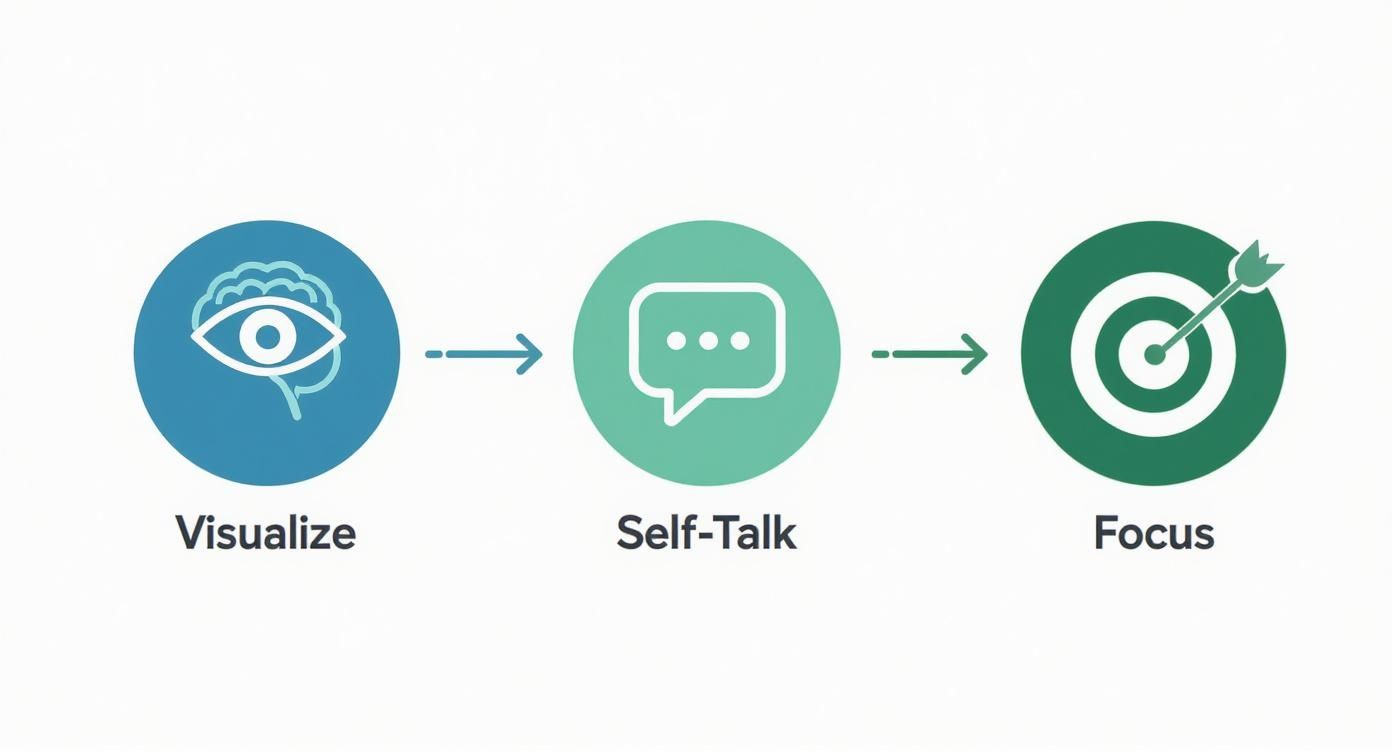
This process shows how an athlete first pictures success, reinforces it with positive internal dialogue, and then locks in their attention to execute.
- Off-Season (High Volume, Low Intensity): This is all about learning and acquiring skills. It’s the perfect time to build a strong foundation in a low-pressure setting. Spend more time mastering new techniques like progressive muscle relaxation or developing a library of positive self-talk cues.
- Pre-Season (Moderate Volume & Intensity): As you get closer to competition, you shift from learning to integrating. Start using your cue words during tough conditioning drills. Practice visualization right before scrimmages to make it feel more real.
- In-Season (Low Volume, High Intensity): During the competitive season, it’s about application and refinement. You’re not learning the skills anymore; you’re deploying them under pressure. This means quick pre-game visualization, in-the-moment cue words, and disciplined post-game reflection.
Beyond these specific drills, don’t forget the bigger picture. Integrating practices like optimizing sleep through sauna use can have a huge impact on an athlete’s mental resilience and cognitive function. This holistic view recognizes that mental recovery is every bit as vital as physical rest.
How to Track Your Mental Performance Gains

You track your reps in the gym and your splits on the track, so why would your mental training be any different? Tracking progress is what separates genuine skill development from just wishful thinking. The trick, though, is to look past the scoreboard and focus on the process—the small things that show real mental growth.
Wins and losses can be deceiving. You might execute your mental game plan to perfection and still come up short, or you could have a chaotic mindset and pull out a lucky win. True progress lives in the subtle shifts—how you handle your focus, manage emotions, and bounce back when things go wrong.
This is where a performance journal becomes an indispensable tool.
Using a Performance Journal to Measure What Matters
Think of your performance journal less as a diary and more as a data-gathering tool. Its real purpose is to connect the dots between your mental prep, what you do in the heat of the moment, and how you ultimately perform.
All it takes is ten minutes after a practice or competition to jot down a few specific, objective notes. You’re hunting for patterns. Over weeks and months, this data will clearly show which mental skills are becoming strengths and where you still have work to do. It turns vague feelings into concrete, actionable information.
Key Indicators to Track in Your Journal
To make your journal truly powerful, zero in on a few key performance indicators (KPIs) of your mental game:
- Pre-Game Confidence Level (1-10): How confident did you feel before the game even started? Can you connect that number to your visualization or self-talk routine that day?
- Cue Word Usage: Be specific. How many times did you actually use a cue word like “Reset” or “Next play” to pull your focus back after a mistake?
- Emotional State During Pressure: Think about a critical moment in the competition. Did you feel calm and in control, or was it more frantic and overwhelmed?
- Refocus Ability: After an error or a bad call from the ref, how long did it take you to get your head back in the game? A few seconds? Did it nag you for the next several plays?
Think of your mental skills plan as a living document, not a static rulebook. It’s designed to be reviewed, tweaked, and adapted as your skills, goals, and competitive environment change.
Reviewing Data to Fine-Tune Your Approach
A journal is only useful if you actually review it. Set aside time once a week to look back at your entries. Is your ability to refocus getting faster? Is your pre-game confidence trending up?
Imagine a basketball player who sees their confidence is consistently a 7/10, but their free-throw percentage tanks in the final two minutes. Their journal reveals they rarely remember to use their “smooth release” cue word during those high-pressure moments. That’s a huge, actionable insight. Now, they can go into practice and deliberately simulate late-game pressure to train that specific cue.
This is how you move from just hoping you’ll get better to a deliberate cycle of measure, analyze, and adjust.
Evolving Your Mental Skills Plan
As you grow as an athlete, your mental training has to grow with you. The challenges facing a high school athlete are a world away from those of a collegiate or pro competitor. A plan that works perfectly for a golfer might need significant tweaks for a hockey player.
This evolution is a great sign—it means you’re making progress. The fact that mental performance coaching is now seen as a key differentiator, especially in youth sports, shows just how vital this work is. Organizations that lean into science-backed mental training are seeing huge benefits, like better athlete retention and satisfaction. You can read more about how mindset training is transforming youth sports on youthsportsbusinessreport.com.
By constantly tracking your performance, you ensure your mental skills training stays sharp, relevant, and effective. It’s how you make sure your mind remains your single greatest competitive advantage.
Answering Your Top Questions About Mental Skills Training
Even with the best game plan, it’s natural to have questions when you first start digging into mental skills training. Let’s tackle some of the most common ones I hear from athletes and coaches so you can move forward with confidence.
How Long Does It Take to See Results?
This is the big one, and the answer isn’t all that different from physical conditioning. You might feel small wins almost immediately—maybe you use a breathing technique and feel a bit calmer before a big practice. That’s a great start.
But for significant, lasting changes, you’re looking at about 3 to 6 months of consistent work. The goal here isn’t a magic bullet; it’s about building mental habits that hold up under pressure. The first few weeks are for learning the tools. The months that follow are about making them second nature. Remember, consistency beats intensity every time. A focused 15 minutes a day will do far more for you than a long, sporadic session once a week.
Can I Do This Training on My Own?
Absolutely. You can make huge strides on your own. The self-assessment tools and practical drills in this guide are designed to give you a powerful foundation. Self-guided mental skills training for athletes is a fantastic way to build up your core skills in visualization, self-talk, and focus.
If you want to go even deeper, there’s a wealth of knowledge out there. Exploring a list of the best books on sports psychology is a great next step for anyone serious about mastering the mental game.
That said, working with a qualified sport psychology consultant can really accelerate your progress. A good coach brings an objective eye, gives you personalized feedback, and helps you break through those stubborn mental blocks you might not even see in yourself.
Is This Only for Struggling Athletes?
This is probably the biggest myth in sport psychology. While this training is incredibly effective for athletes hitting a rough patch with confidence or anxiety, its real power is in proactive performance enhancement. The most dominant athletes in the world don’t do this work because they’re broken; they do it because they’re relentless about finding an edge.
Think of mental training like strength training for your brain. You don’t lift weights only when you feel weak; you lift them to become stronger, more powerful, and more resilient. The same principle applies to your mind.
A top-tier quarterback still visualizes reading defenses. A world-class golfer still uses breathing routines to stay locked in over a crucial putt. Mental training is about turning a good mental game into a great one. It’s what makes sure your mind is your greatest asset, not a liability when the pressure is on. This is how good athletes become great, and great athletes become legends.
For more information on mental performance coaching or psychological services, or to schedule a consultation, visit my Sports Psychology Services page.