

When we talk about mental toughness in athletes, what are we really getting at? It’s the skill of delivering your best performance, consistently, no matter what the situation throws at you. This isn’t some vague concept; it’s a concrete skillset built on focus, emotional control, and unshakable confidence, especially when the game is on the line.
What Mental Toughness Really Means for Athletes
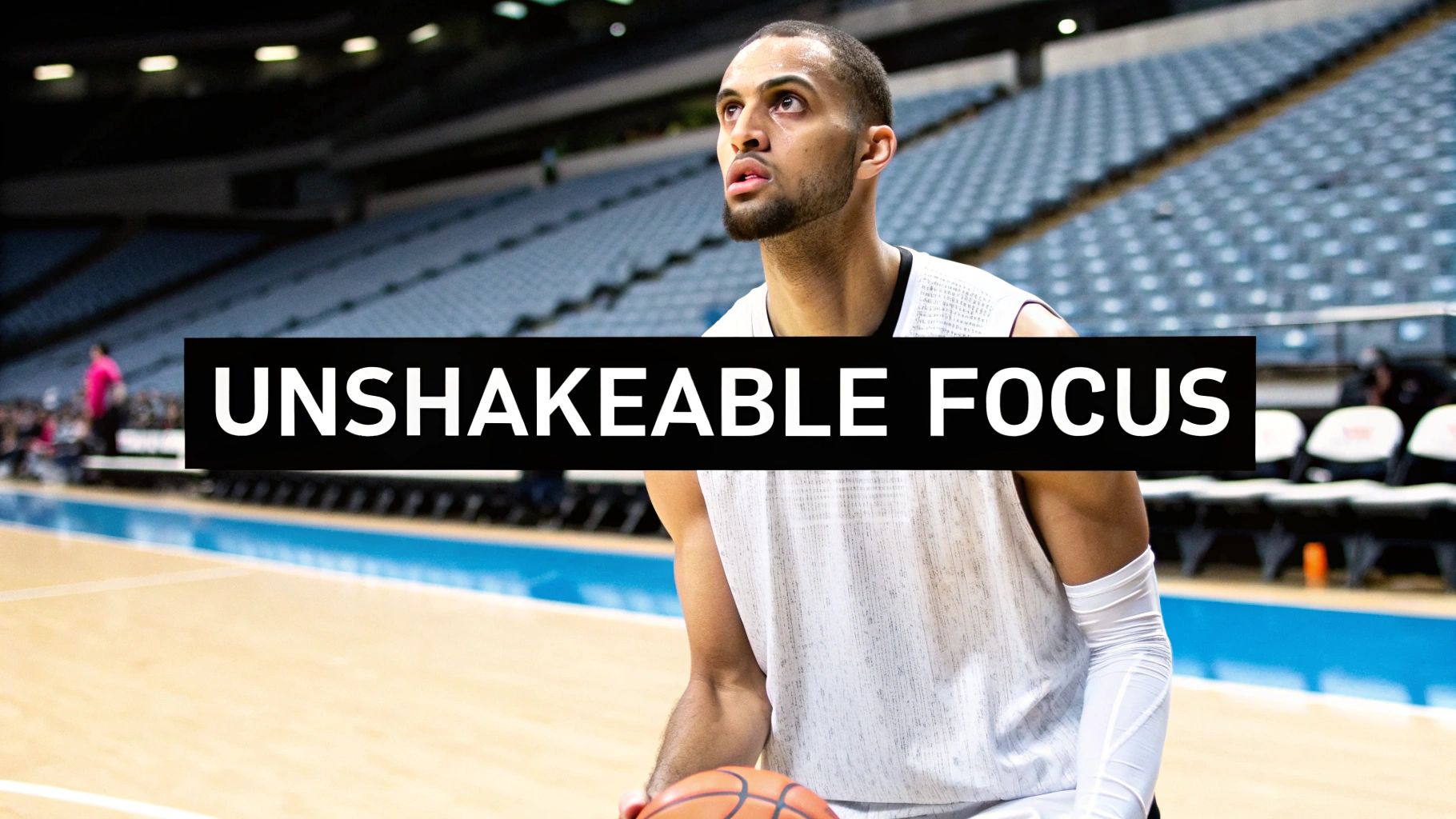
True mental toughness isn’t about being a robot or showing no emotion. It’s the opposite—it’s about actively managing your inner world to create the results you want on the outside.
Think about it. A golfer staring down a must-make putt on the 18th green. A swimmer on the blocks, seconds away from a championship final. The athletes who shine in those moments aren’t just physically primed; they are mentally dominant.
So many athletes fall into the trap of thinking this kind of grit is something you’re born with. That’s a myth. The reality is that mental toughness for athletes is a discipline that can be built through deliberate, consistent practice, just like any physical skill. You train your mind the same way you train your body.
Deconstructing Mental Strength into Trainable Skills
To really build mental toughness, you can’t just tell yourself to “be tougher.” That’s not a strategy. You have to break it down into specific skills you can actually practice and improve. Think of them as individual tools in your mental toolbox.
Let’s quickly look at the core pillars that make up true athletic mental toughness. Understanding these components is the first step toward mastering them.
Key Components of Athletic Mental Toughness
| Component | Definition | Example in Action |
|---|---|---|
| Unshakeable Confidence | A resilient belief in your abilities that doesn’t crumble after one bad performance. | A quarterback throws an interception but comes back on the next drive fully expecting to lead the team to a touchdown. |
| Laser Focus | The ability to tune out distractions (internal and external) and direct all your attention to the task at hand. | A tennis player ignores a noisy crowd during a crucial tie-break, focusing only on the ball and their opponent. |
| Emotional Control | Managing feelings like anxiety, frustration, and doubt so they don’t hijack your performance. | A basketball player misses a free throw but uses a breathing technique to calm down and sink the second one. |
| Resilience | Bouncing back quickly from mistakes, losses, and setbacks without getting mentally derailed. | A gymnast falls during a routine but immediately refocuses to perfectly execute the remaining elements. |
Each of these areas is a muscle. You have to work it to make it stronger.
Mental toughness isn’t about the absence of fear or doubt. It’s the ability to perform at a high level despite their presence. It’s about taking control of the only things you can ever truly control: your thoughts, your emotions, and your actions.
The Proven Link to Better Performance
The connection between mental fortitude and physical results isn’t just anecdotal—it’s backed by solid research.
A major meta-analysis looking at 76 different studies found a significant, positive link between mental toughness and athletic improvement. What does that mean in simple terms? Athletes with stronger mental skills don’t just win more often; they achieve bigger personal gains over time. You can dive into the full research about these athletic performance findings to see the data for yourself.
This guide will give you the practical, step-by-step techniques to build these skills. It’s time to stop letting pressure dictate your performance and start using your mindset as your ultimate competitive weapon.
Finding Your Mental Performance Baseline
Before you can build real mental strength, you have to know where you stand right now. It’s that simple.
Trying to improve your mental game without a clear starting point is like a strength coach handing you a workout plan without ever watching you lift. It just doesn’t work. This initial self-assessment is your personal scouting report—a deep dive into your own mind to pinpoint your natural strengths and, more importantly, the areas ripe for improvement.
This isn’t about slapping clinical labels on yourself. It’s about raw, honest reflection. The goal here is to create your own ‘Mental Performance Index’ by looking at how you actually respond when the pressure is on and things get tough.
How to Run Your Own Mental Self-Audit
You’ll need to set aside some quiet time for this. Think about your recent performances, both the good and the bad. Get specific. Zero in on key moments in practices and competitions. The most important rule? Be brutally honest with yourself. No one else ever has to see this.
Let’s break it down. Consider these core areas of mental performance and ask yourself the questions that follow. Don’t just give a “yes” or “no” answer. Jot down your thoughts and dig into the why behind them.
- Focus Under Pressure: When the crowd gets loud, a ref makes a terrible call, or pure exhaustion is setting in, can you stay locked in? Or does your mind start drifting to things you have absolutely no control over?
- Emotional Regulation: You just dropped a perfect pass or missed an easy shot. Do you spiral into frustration and let it ruin the next few plays? Or can you reset almost instantly? How long does one mistake stick with you?
- Confidence Stability: Is your self-belief rock-solid, or does it ride a rollercoaster with every success and failure? Do you walk into a big game feeling prepared and capable, even when you’re the underdog?
- Motivation and Drive: What gets you out of bed on the days you just don’t feel like training? Is your drive coming from within (a genuine love of the game, a desire for personal growth) or from the outside (praise from others, avoiding criticism)?
An honest self-assessment is the foundation of all effective mental training. It transforms a vague goal like “get mentally tougher” into a specific, actionable plan like “improve my focus after a turnover.”
Creating Your Personal Mental Performance Index
After you’ve done some reflecting, it’s time to pull your thoughts together into a simple, usable format. This isn’t some scientific, validated score. Think of it as a personal tool—a snapshot of your current mental game that will guide your training.
For each of the four areas we just covered (Focus, Emotional Regulation, Confidence, Motivation), give yourself a rating on a simple scale of 1 to 5. A 1 means it’s a significant area for improvement, while a 5 means it’s a consistent, reliable strength.
Example Scenario: A Soccer Player’s Index
Let’s see how this works in the real world.
- Focus Under Pressure: 2/5 “I completely lose my cool when the other team’s fans are yelling at me. I start thinking about what they’re saying instead of my positioning on the field.”
- Emotional Regulation: 4/5 “I’m pretty good at shaking off a bad pass. I have this little routine where I clap my hands and tell myself ‘next play,’ and it seems to work.”
- Confidence Stability: 2/5 “If I miss my first couple of shots, my confidence just tanks for the rest of the half. I start second-guessing every single decision.”
- Motivation and Drive: 5/5 “Honestly, I love the grind. I love practice and getting better. My drive to improve is always there, even after a tough loss.”
Rehearsing Success and Failure with Visualization
Visualization, or mental imagery, is so much more than daydreaming about winning. It’s a structured mental rehearsal that primes your brain and body for what’s to come. The most effective visualization is multi-sensory—it involves what you see, hear, feel, and even smell in the heat of competition.
But here’s a pro tip: elite athletes don’t just visualize perfect outcomes. A crucial, and often missed, part of mental toughness is rehearsing adversity. What will you do when you get a bad start, miss a crucial shot, or your opponent goes on a run?
- Visualize a Common Setback: Imagine something that often goes wrong. A swimmer, for instance, might visualize their goggles filling with water right off the blocks.
- Feel the Initial Frustration: Let yourself feel that jolt of panic or frustration. Don’t push it away. Acknowledge it.
- Visualize Your Ideal Response: Now, vividly rehearse your comeback. See yourself calmly fixing the goggles at the first turn, using your trigger word (“Focus”), and getting right back into your race rhythm without losing your cool.
This process builds resilience by creating a pre-planned response to chaos. When it actually happens in real life, your brain recognizes the situation and can execute the practiced solution instead of hitting the panic button.
Managing Anxiety with Breathing and Reframing
Anxiety is a physical reality in sports. Your heart pounds, your muscles get tight, and your breathing gets shallow. One of the quickest ways to down-regulate your nervous system is through simple, controlled breathing.
The box breathing technique is a powerful tool for your kit.
- Inhale slowly for a count of four.
- Hold your breath for a count of four.
- Exhale slowly for a count of four.
- Hold at the bottom for a count of four.
Actionable Tip: Integrate this into your routines. Practice box breathing during breaks in practice, while stretching, or in the locker room before a game. The more you do it when you’re calm, the more effective it will be when you’re under pressure.
Beyond the physical side, you have to reframe the mental story. Instead of interpreting a racing heart as “I’m scared,” teach yourself to reframe it as “I’m ready.” Those pre-game jitters aren’t a sign of weakness; they’re a signal that your body is primed and energized for battle. This simple cognitive shift turns what feels like a threat into a source of fuel.
Cultivating a Powerful Support System
No athlete ever makes it to the top on their own. The people around you—yourcoaches, family, teammates, and mentors—are an absolutely critical piece of your resilience. They’re the ones who give you perspective when you’ve lost it, encourage you when you’re in a slump, and celebrate your wins with real joy.
But a support system doesn’t just appear out of thin air. You have to actively build and maintain it.
- Be Vulnerable: Don’t be afraid to let your trusted circle know when you’re having a hard time. Talking about your frustrations isn’t a sign of weakness. It’s a crucial release valve that keeps the pressure from building to a breaking point.
- Identify Your Roles: Figure out who you can turn to for what. One coach might be your go-to for tactical adjustments, while a parent or a close friend is the right person for emotional support. It’s unrealistic to expect one person to be everything.
- Give Back: A real support system is a two-way street. Make sure you’re there for your teammates when they’re down. Supporting others not only builds a stronger team culture but also reminds you that you’re part of something bigger than just yourself.
Resilience is built in the spaces between competitions—in the honest conversations with a coach, the encouragement from a teammate, and the unconditional support from family. It’s the human connection that refuels the competitive fire.
Managing Your Stress Response
A huge piece of mental toughness is mastering your stress response. This means learning to tell the difference between ‘eustress,’ which is the good, energizing stress that comes from a challenge, and ‘distress,’ which is the negative, draining anxiety that torpedoes your performance.
The ability to notice when you’ve tipped from eustress into distress and pull yourself back is a hallmark of a resilient athlete. When you start to feel overwhelmed, that’s your cue that your stress levels are in the red zone.
Simple techniques like box breathing, using a trigger word, or even just taking a two-minute walk away from the action can reset your nervous system. When you learn how to manage stress in the moment, you stop it from piling up and turning into the chronic exhaustion that defines burnout. This is how you play the long game with your mind and body.
Integrating Mental Health Into Your Training Regimen
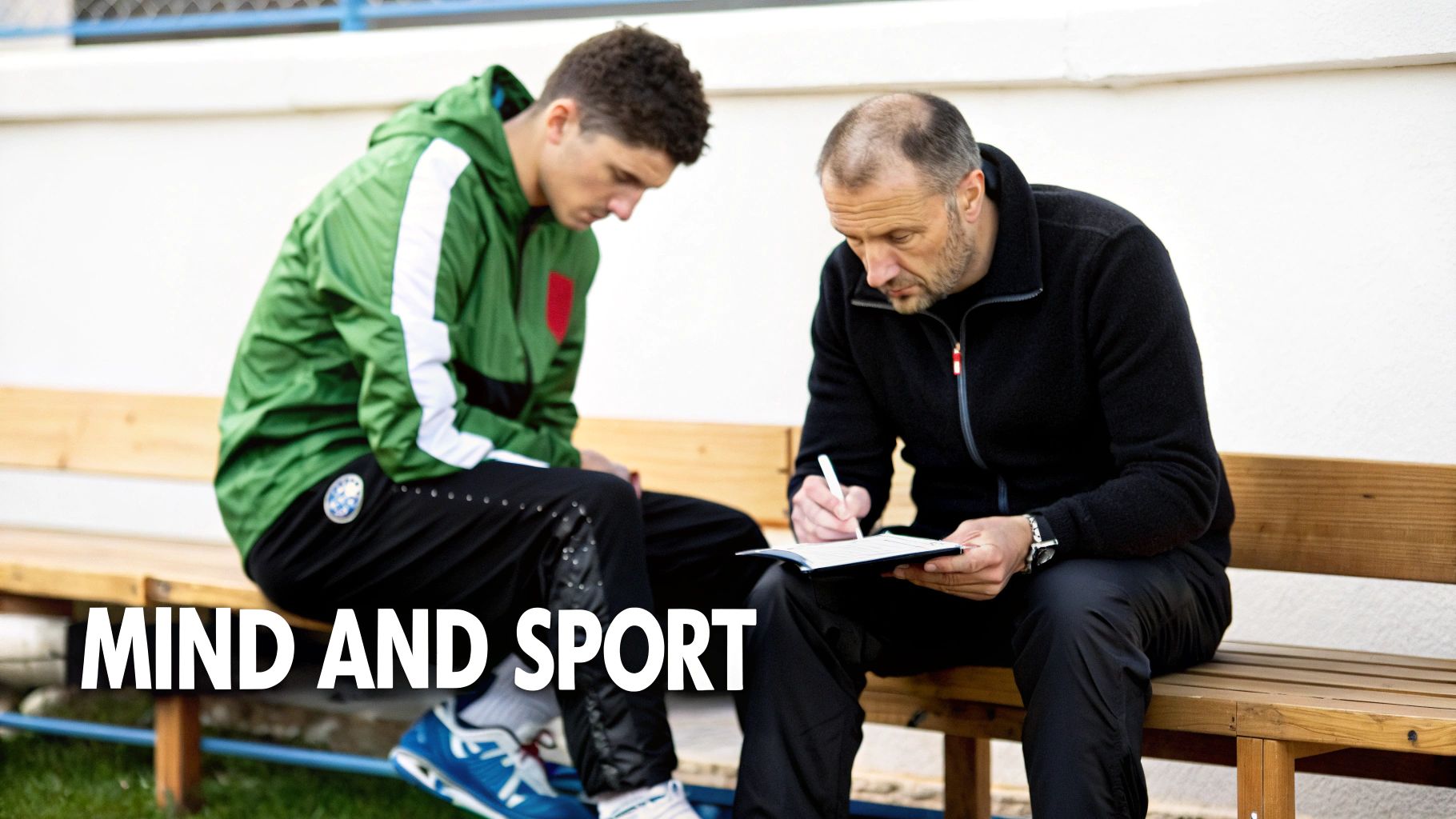
Let’s finally put one of the most dangerous myths in sports culture to bed: the idea that mental toughness is about gritting your teeth and ignoring any mental or emotional struggles. That’s not toughness; that’s a ticking time bomb.
The truth is, genuine, sustainable strength comes from acknowledging these challenges head-on. Peak performance and mental wellbeing aren’t two separate tracks—they are completely intertwined. An athlete’s mind is their single greatest asset, and like any muscle, it can get strained, fatigued, and injured. Ignoring the warning signs is like playing on a stress fracture. It’s only a matter of time before things get much, much worse.
The pressure to be stoic, to seem “unbreakable,” is precisely what stops many athletes from getting the help they need. This old-school mindset creates a culture of silence where anxiety, depression, or burnout are treated like personal failures instead of what they are: treatable conditions. A truly elite training environment prioritizes mental health with the same intensity as physical conditioning.
Recognizing the Signs of Mental Exhaustion
You can’t offer support if you don’t know what to look for. Mental exhaustion is sneaky; it often masquerades as a bad attitude or a simple performance slump.
Keep an eye out for these key indicators, either in yourself or a teammate:
- Changes in Behavior: Is a normally social teammate suddenly withdrawn and isolated?
- Increased Irritability: Are small frustrations triggering uncharacteristic emotional outbursts?
- Loss of Motivation: Have they lost their passion or joy for the sport, even for drills or games they once loved?
- Physical Symptoms: Are they complaining of constant fatigue, trouble sleeping, or nagging headaches and muscle aches?
True mental toughness for athletes isn’t about never struggling; it’s about having the awareness to recognize when you need support and the courage to ask for it. This is a skill that strengthens both performance and personal wellbeing.
The data backs this up with alarming clarity. A 2022 NCAA survey of nearly 10,000 student-athletes revealed that rates of mental exhaustion, anxiety, and depression are still 1.5 to 2 times higher than they were before the pandemic. These aren’t just numbers; they’re a call to action. To learn more, you can read about these important findings on athlete mental health.
Your Questions About Mental Toughness Training, Answered
Jumping into mental toughness training can feel like learning a new language. You’re bound to have questions. Getting these cleared up from the start removes any uncertainty and helps you commit to the process of strengthening your mind.
This isn’t about adding another huge time block to an already packed schedule. One of the first things athletes ask is how much time this all takes.
The key is integration, not addition. A good target is 10-15 minutes of focused mental work, three to five times a week. This could be a quick five-minute visualization before you go to sleep or doing some box breathing while you stretch. Consistency beats cramming every single time.
How Long Does This Take to Work?
Another big question is about the timeline. When do you actually feel the difference? Unlike lifting weights, where you might see physical changes in a few weeks, mental skills build more quietly. You’ll probably notice small things first—like resetting faster after a bad play or feeling less of that pre-game churn in your stomach.
You can expect to see significant, lasting changes within two to three months of consistent work. The real payoff comes when the pressure is on and you respond with composure. This isn’t about a quick fix; it’s about building mental habits that will serve you for a lifetime.
Mental training is a process of accumulation. Each small, consistent effort—every visualization, every controlled breath, every moment of positive self-talk—builds upon the last, creating a powerful foundation of resilience over time.
For more information on mental performance coaching or psychological services, or to schedule a consultation, visit my Sports Psychology Services page.