
Performance anxiety is that gut-wrenching fear of failing when the stakes are highest. It’s a vicious cycle where your mind and body betray your training, sabotaging the very skills you’ve spent countless hours honing. This is so much more than just pre-game jitters; it's a crippling pressure that makes your talents feel suddenly, frustratingly out of reach. For a tennis player, it's the arm that suddenly feels like lead on a match point serve. For a golfer, it's the simple three-foot putt that suddenly looks a mile long.
What Performance Anxiety Feels Like for an Athlete
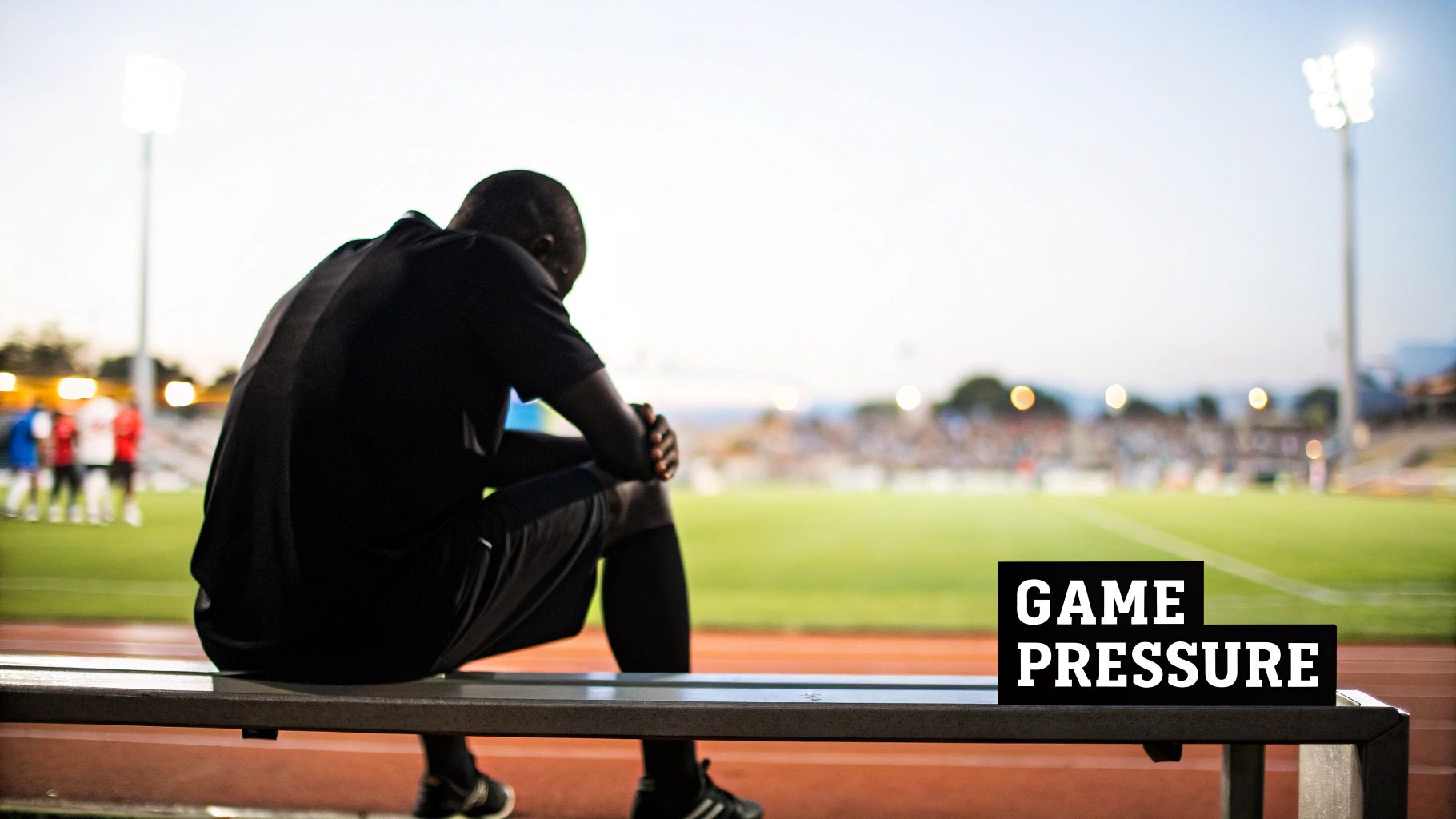
There's a massive difference between the relaxed rhythm of practice and the electric tension of a championship game. Every athlete feels this shift, but for many, it's not just a heightened sense of focus—it's a complete hijacking of their mind and body. The first step toward taking back control is understanding exactly what’s happening.
Think of it this way: in practice, your skills flow naturally, almost without thought. But under the bright lights of competition, performance anxiety can make those same skills feel foreign and clunky. The movements you’ve perfected suddenly feel awkward, and your once-fluid muscles are now stiff and unresponsive.
Jitters vs. Anxiety: A Crucial Distinction
It’s critical to separate the productive pre-game "jitters" from debilitating performance anxiety. One is your engine, the other is the emergency brake.
- Productive Jitters: This is your body gearing up for action. It’s a feeling of excitement, a sharpening of focus that can actually improve reaction time and boost energy. It's that slight buzz that says, "I'm ready." For example, a sprinter feels a surge of adrenaline in the blocks, helping them explode at the sound of the gun.
- Debilitating Anxiety: This is overwhelming and destructive. Instead of laser focus, you get mental fog. Instead of a surge of energy, you feel a draining dread that paralyzes your decision-making. For that same sprinter, anxiety might cause their muscles to tense up, leading to a false start or a slow, clumsy takeoff.
If you experience this, know that it isn't a sign of weakness. It's an incredibly common battle. In fact, research shows that a staggering 77% of athletes reported experiencing performance anxiety in the last year, with 55.4% facing it within the past month alone. For many, it's a huge barrier; 39.4% felt that anxiety directly held them back from reaching a higher level of competition. You can read the full research on these athletic mental health findings.
The cruel irony of performance anxiety is that it surfaces when you want to succeed the most. The very desire to perform well becomes the source of the pressure that prevents you from doing so.
This experience can feel incredibly isolating, but you are not alone. It’s a challenge that can be managed, and it all starts with acknowledging what's happening inside your mind and body. By having this conversation openly, athletes, coaches, and parents can build the mental resilience needed to unlock true potential when it matters most.
Why Your Brain Makes You Choke Under Pressure
Have you ever been in a big moment, completely prepared, only to watch your most practiced skills suddenly vanish? It’s a frustrating experience known as "choking," but it isn't a sign of weakness or poor training. It's a powerful biological and psychological response that’s hardwired into all of us.
At its core, performance anxiety in sports is your brain's survival instinct kicking into overdrive. When you’re staring down a game-winning penalty kick or a final serve, your brain sometimes can’t distinguish that pressure from a real, physical threat. This flips a switch in the amygdala—your brain's alarm system—and triggers the classic "fight or flight" response.
This ancient mechanism is great for escaping a predator, as it floods your body with adrenaline and cortisol. But when you need fine motor skills and a clear head to sink a putt? It’s the last thing you want.
The Physical Hijacking
When that fight-or-flight alarm sounds, the physical effects are immediate, noticeable, and devastating to athletic performance. These aren't just "feelings"; they are real-time physiological changes taking over your body.
- Racing Heart and Rapid Breathing: Your heart starts pounding to pump oxygen to your major muscles. Your breathing becomes short and shallow, which can leave you feeling dizzy and out of control. Practical Tip: To counteract this, practice "belly breathing"—placing a hand on your stomach and making it rise and fall with each deep, slow breath. This activates the calming part of your nervous system.
- Muscle Tension: Blood rushes to the large muscle groups needed for a fight, causing the smaller, more precise muscles to tighten up. This is exactly why a golfer's fluid swing can feel stiff and jerky over a simple, crucial putt.
- Tunnel Vision: Your pupils dilate to zero in on the threat, but this narrows your field of vision. Suddenly, it’s harder to read the court or spot an open teammate in your periphery.
Imagine your brain is a high-performance computer and your athletic skills are perfectly coded software. Performance anxiety acts like a nasty virus that crashes the whole system. It freezes your processing power, making it impossible to access the thousands of hours of muscle memory you’ve worked so hard to build.
We often call this state 'paralysis by analysis.' Instead of trusting your training and letting your body perform on autopilot, your conscious mind jumps in and starts overthinking every tiny movement. This micromanagement is what shatters the natural flow of your skills.
While this response can affect anyone, it's particularly common among elite athletes facing immense pressure. A comprehensive review in the British Journal of Sports Medicine found that up to 34% of elite athletes grapple with significant anxiety or depression. The burden is even heavier in individual sports, where 13% of athletes reported diagnosed anxiety, compared to just 7% in team sports. You can find more details on athlete mental health prevalence here.
Common Mental Traps That Fuel Anxiety
The physical response is only half the battle. Certain negative thought patterns act like gasoline on the fire, amplifying the anxiety and making it feel impossible to escape. The first step to disarming these traps is learning to recognize them.
One of the biggest culprits is catastrophizing—where your mind immediately leaps to the absolute worst-case scenario. A basketball player at the free-throw line isn't just thinking about missing the shot. They're picturing the entire game lost, the disappointment of their team, and the criticism from their coach.
Another is perfectionism. An intense, unrelenting need to be flawless creates crushing internal pressure. Every small mistake feels like a catastrophe, which only magnifies the fear of the next play. This is a heavy burden, and it makes it nearly impossible to perform freely and intuitively. Understanding that anxiety is often the root of performance problems is the critical first step toward building the mental strategies needed to break through.
By seeing these psychological and physiological triggers for what they are, you can start to view performance anxiety not as a personal failure, but as a predictable response you can learn to manage. The key is learning how to calm your nervous system and reframe your thoughts, allowing you to stay in command when it matters most.
How to Spot the Hidden Signs of Performance Anxiety
Performance anxiety is often a silent opponent. It rarely shows up like a scene from a movie with a dramatic public meltdown. Far more often, it’s a series of subtle red flags—small changes in an athlete's physical state, thought patterns, or behaviors that are easy to brush off if you don't know what you're looking for.
Recognizing these signs is the essential first step. It's about seeing what's really going on beneath the surface. These clues fall into three connected categories: physical, cognitive (what they're thinking), and behavioral (what they're doing). Think of it like a chain reaction: a negative thought can trigger physical muscle tension, which then leads to avoiding a certain play or drill. Learning to spot these patterns helps athletes, coaches, and parents intervene before anxiety gets a stranglehold on performance.
The Physical Manifestations
The physical symptoms are often the most obvious because they directly sabotage an athlete's skills. This isn't just about "feeling nervous." It’s a full-blown physical hijacking of the body by the mind.
Instead of just saying "muscle tension," picture a basketball player whose free throw is suddenly coming up short. The anxiety has made their shoulders so tight that they can't execute the smooth, fluid follow-through they've practiced thousands of times. Or think of a tennis player who starts shanking easy shots because their death grip on the racquet has robbed them of all feel and control.
Here are some common physical signs to watch for:
- Unexplained Muscle Soreness or Tightness: Muscles feel stiff, heavy, or fatigued without a clear physical reason, especially right before or during a big moment.
- Shallow or Rapid Breathing: The inability to take a deep, centering breath, which starves the muscles of oxygen and can lead to dizziness or a loss of stamina.
- Increased Heart Rate: A pounding heart that feels completely out of proportion to the actual physical exertion.
- Trembling or Shaking: Uncontrollable shaking in the hands, arms, or legs that makes fine motor skills (like sinking a putt) feel impossible.
- Nausea or "Butterflies": That sick feeling in the pit of your stomach that goes way beyond typical pre-game jitters.
The Cognitive and Behavioral Red Flags
What happens inside an athlete's head and how they act on it are just as important to watch. A cognitive sign isn't just "negative self-talk." It’s that specific, destructive voice inside a baseball player's head screaming, “Don’t strike out!” That single command forces the brain to focus on the one outcome they want to avoid, paradoxically making it more likely to happen. A mentally tough player is trained to think, “See the ball, hit the ball.”
Behavioral signs are the actions driven by this internal chaos. It might be the star gymnast who suddenly starts "getting lost" in the air on a tumbling pass she's landed perfectly hundreds of times in practice. Or the soccer player who always passes the ball when it’s their turn in a penalty shootout, ducking the responsibility and the pressure.
Identifying performance anxiety is like being a detective. You're not looking for a single piece of evidence, but a pattern of clues that, when pieced together, reveal the bigger picture of what the athlete is truly experiencing.
To help you connect these dots, let's break the signs down clearly. This table shows how these different symptoms manifest in real-world athletic situations.
Three Types of Performance Anxiety Symptoms
This table categorizes the common signs of sports performance anxiety into physical, cognitive, and behavioral symptoms, providing practical examples for each.
| Symptom Type | Description | In-Game Example |
|---|---|---|
| Physical | Bodily reactions triggered by the 'fight or flight' response that interfere with coordination and control. | A golfer's hands tremble over a simple putt, causing them to miss the shot. |
| Cognitive | Negative thought patterns, self-doubt, and mental distractions that disrupt focus and confidence. | A quarterback focuses more on the possibility of throwing an interception than on reading the defense. |
| Behavioral | Actions or inactions taken to avoid pressure, often manifesting as changes in routine or effort. | A star volleyball player becomes unusually quiet and withdrawn in the locker room before a championship match. |
Once you learn to recognize these patterns, you’re no longer guessing. You're equipped to understand the root cause of the performance issue and can begin taking targeted steps to fix it.
Actionable Strategies to Build Mental Toughness
Recognizing the signs of performance anxiety is the first step. Learning how to manage it is the real game-changer. Building mental toughness isn’t about trying to eliminate nerves entirely—it’s about developing a toolkit of skills you can rely on to control them when it matters most.
Think of these strategies not as quick fixes, but as trainable abilities. Just like a physical drill, you can strengthen your mental muscle for when the pressure is on.
Reframe Your Inner Monologue with CBT
One of the most powerful tools in sports psychology comes from Cognitive-Behavioral Therapy (CBT). The idea behind it is simple: your thoughts create your feelings, and your feelings drive your actions. If you can intercept and change a destructive thought, you can stop the anxiety spiral before it ever takes hold.
I teach athletes a simple, three-step process they can practice daily:
- Catch the Thought: The second you feel that jolt of anxiety, stop and ask yourself: "What was I just thinking?" It's usually a negative automatic thought, something like, "I'm going to mess this up."
- Challenge the Thought: Now, put that thought on trial. Is it 100% true? Have you ever succeeded in a similar spot before? What's a more realistic, process-focused alternative?
- Change the Thought: Swap the negative assumption for a productive command. Instead of, "Don't strike out," you reframe it to, "See the ball, swing through the ball." This immediately pulls your focus from a feared outcome to the immediate, controllable action.
This mental reframing rewires how your brain responds to pressure, shifting your focus to process instead of outcomes—a true hallmark of elite performers.
Master In-the-Moment Calming Techniques
When anxiety hits hard and fast, you need tools that work right now to calm your nervous system. These techniques are designed to interrupt the "fight or flight" response and pull your body and mind back into the present moment.
A simple yet incredibly powerful method is box breathing. Just inhale for four seconds, hold for four, exhale for four, and hold again for four. This pattern forces a slower, more deliberate breathing rhythm, which lowers your heart rate and sends a direct signal to your brain that you're safe and in control. Practical Tip: Practice this during breaks in practice or games, like between points in tennis or before a free throw.
Another fantastic strategy is the 5-4-3-2-1 grounding technique. It yanks you out of your anxious mind by forcing you to engage with your immediate environment:
- Name 5 things you can see.
- Name 4 things you can feel (e.g., your feet in your shoes, the grip on your racquet).
- Name 3 things you can hear.
- Name 2 things you can smell.
- Name 1 thing you can taste.
It's nearly impossible for your brain to ruminate on future fears when it's busy cataloging sensory details from the here and now.
The image below breaks down the three core areas where anxiety shows up. The techniques we're discussing directly address these symptoms.

By targeting the physical, cognitive, and behavioral symptoms with specific strategies, an athlete can reclaim control over their performance state.
Harness the Power of Visualization
Here's a fascinating thing about your brain: it often has trouble telling the difference between a vividly imagined experience and a real one. This is exactly why visualization is a cornerstone of managing performance anxiety in sports. When you repeatedly rehearse success in your mind, you build the neural pathways that make that success feel more familiar and achievable under pressure.
To make this work, you have to engage all your senses. Don't just see yourself making the perfect shot; feel the texture of the ball in your hands, hear the roar of the crowd, and smell the grass on the field. This sensory detail is what makes the mental rehearsal so potent. Many elite athletes excel at harnessing the power of visualization to prepare for tough moments and build unwavering confidence.
"Visualization is not just about picturing success. It's about mentally rehearsing the process—the footwork, the breathing, the focus—so that when the moment arrives, your body already knows what to do. It’s a blueprint for execution."
By creating these detailed mental blueprints, you reduce the uncertainty that fuels so much anxiety. For those who want to take this further, I offer more insights into how you can apply visualization techniques in your own sport.
Build an Unshakeable Pre-Performance Routine
A consistent pre-performance routine is your psychological anchor. It’s a sequence of simple, familiar actions that signal to your brain and body that it's time to compete. In an otherwise chaotic environment, this predictability is incredibly calming.
Your routine doesn't need to be complex or superstitious. It could be as simple as:
- Listening to the same warm-up playlist.
- Going through a specific sequence of dynamic stretches.
- Taking five deep, centering breaths while setting your intention for the game.
The key here is consistency. This ritual creates a "bubble of familiarity," turning an intimidating competitive arena into your controlled workspace. It’s a powerful way to tell your mind, "I've been here before, and I know exactly what to do." By practicing these skills, you are actively building the mental resilience required to perform at your best, no matter what the stakes are.
Building a Resilient Lifestyle Off the Field

Mental toughness isn't something that just shows up on game day. It's built brick by brick through the daily habits you keep long before you ever step into the arena. This off-field training—what you do when no one is watching—creates the foundation for resilience and makes you far less vulnerable to competitive pressure.
The core pillars of this lifestyle are nutrition, sleep, and a balanced identity outside of your sport. When you get these right, you create an internal stability that helps you manage performance anxiety in sports from the inside out.
Fuel Your Mind for Stability
What you eat has a direct and powerful impact on your mood, energy levels, and mental clarity. Think of nutrition as a tool for regulating your nervous system. Loading up on sugary foods or too much caffeine can trigger energy spikes and crashes that feel almost identical to the physical symptoms of anxiety, making you much more likely to spiral.
On the flip side, a balanced diet filled with complex carbs, lean proteins, and healthy fats delivers a steady, reliable stream of fuel. This keeps your blood sugar stable and your mood even, which is exactly what you need to stay grounded.
Here are a few practical nutritional strategies I teach my clients:
- Avoid Caffeine Spikes: That pre-game coffee might feel necessary, but too much can send your heart rate soaring and leave you feeling jittery. Test your limits in practice, not minutes before a championship.
- Hydrate Relentlessly: Dehydration is a huge culprit behind brain fog and fatigue, both of which crank up anxiety. Don't just chug water during training; sip it consistently all day long.
- Prioritize Complex Carbs: Foods like oatmeal and whole grains are your friend. They provide sustained energy, helping you avoid the crashes that leave you feeling mentally and physically spent.
The Power of Restorative Sleep
Sleep is perhaps the single most potent—and most overlooked—weapon against anxiety. When you're in deep sleep, your brain is hard at work processing emotions and consolidating memories. It's like a nightly reset for your mental state. Skimp on quality sleep, and this critical process gets short-circuited, leaving your brain's emotional centers on high alert.
The research is clear: sleep deprivation massively lowers your anxiety threshold. For an athlete, that means small stressors can suddenly feel like mountains after one bad night of sleep.
A consistent sleep routine isn’t a luxury; it’s a non-negotiable part of mental training. It calms the nervous system, enhances reaction time, and builds the mental fortitude needed to perform under pressure.
To lock in your sleep hygiene, try a simple pre-sleep checklist:
- Set a Consistent Bedtime: Go to bed and wake up around the same time every day, even on weekends, to regulate your body's internal clock.
- Create a Dark, Cool Environment: Your bedroom should be a sanctuary dedicated to rest, not scrolling or work.
- Power Down Devices: Blue light from screens messes with melatonin production. Put your phone and tablet away at least an hour before you plan to sleep.
Cultivate an Identity Beyond the Game
When your entire self-worth is wrapped up in your last performance, every single competition becomes an unbearable test of your identity. This creates an intense, unsustainable pressure cooker that's bound to crack. The most effective way to diffuse this is to build a life outside of your sport.
This doesn't mean you're any less committed; it just means you're more balanced. Hobbies, friendships, and academic or professional goals provide other avenues for building confidence and finding fulfillment. This well-rounded identity acts as a psychological safety net, reminding you that one performance—good or bad—does not define who you are. Exploring the surprising link between exercise and anxiety can also broaden your understanding of how physical activity supports overall mental wellness.
When your sport becomes something you do rather than everything you are, the fear of failure loses its power over you.
When You Need to Call in a Professional
The mental skills and self-help strategies we've covered are incredibly effective for most athletes. But sometimes, a mental block is just too stubborn to tackle on your own. Recognizing when you need a professional in your corner isn’t a sign of weakness—it’s a sign of strength. It's a strategic move to invest in your mental game, just as you’d hire a top physical coach.
So, how do you know when it’s time to make that call? The line is often crossed when the anxiety stops being just about the game. If the stress from your sport starts to bleed into other parts of your life—damaging relationships, wrecking your sleep, or stealing your overall happiness—that’s a clear signal to get expert help.
Red Flags That Signal It's Time for Help
While self-management tools are powerful, certain signs indicate that performance anxiety in sports has grown into something bigger. Be honest with yourself and watch for these specific red flags. They suggest a deeper issue that will benefit from professional guidance.
- Panic Attacks: You’re experiencing sudden, overwhelming episodes of intense fear, complete with physical symptoms like a racing heart, chest pain, and shortness of breath.
- Persistent Hopelessness: A constant feeling of dread or sadness follows you around and doesn't lift, even after a great performance or during the off-season.
- Complete Avoidance: You find yourself skipping practices, faking injuries, or making any excuse to get out of competitive situations you once loved.
- Significant Performance Drop: Your skills have tanked for a prolonged period, and nothing you try seems to pull you out of the slump.
If any of these sound familiar, a professional can provide the structured, expert support needed to get you back in control.
Think of a sports psychologist as a strength and conditioning coach for your mind. They provide a specific training plan, identify your mental weak spots, and give you the expert guidance needed to build true psychological resilience.
What to Expect from Working with a Sports Psychologist
Working with a professional is a proactive process designed to give you a true mental edge. It isn't just about talking through problems; it's active training for your brain.
The journey starts with a thorough assessment to pinpoint your unique triggers and challenges. From there, we'll work together to set clear, achievable goals for your mental performance. The real work involves learning and practicing mental skills tailored specifically to you—developing personalized strategies to manage pressure, reframe negative thoughts, and build unshakeable confidence. You can learn more about what a real sports psychologist does and see how this specialized coaching elevates an athlete’s game. An expert provides the framework and accountability you need to finally break through stubborn mental blocks and unlock the full potential you know you have.
Frequently Asked Questions About Sports Anxiety
Even after covering the basics, I find that athletes, parents, and coaches still have some very specific questions. Let's tackle some of the most common ones I hear in my practice to help you connect these ideas to the real world.
Nerves or Anxiety How Do I Tell the Difference
This is one of the most important distinctions an athlete can learn to make. I like to use a simple analogy: think of it as a volume knob on a stereo.
Productive pre-game nerves are like turning up your favorite song to the perfect level. It gets you hyped, sharpens your focus, and floods your body with the energy you need to compete. It’s that feeling of excitement and readiness that usually melts away once the whistle blows.
Performance anxiety, however, is when that volume knob is cranked so high the speakers are blown. It’s just painful, distorted noise. Instead of sharpening your focus, it creates a mental fog. Instead of energizing you, it leaves you feeling drained and full of dread. If that feeling consistently sabotages your skills or makes you want to run from the competition, you’ve crossed the line from helpful nerves to harmful anxiety.
What Can Parents Do Without Adding Pressure
The single most powerful thing you can do as a parent is to intentionally shift your focus from the final score to the effort and the experience. Believe me, your child is already putting a mountain of pressure on themselves. Your job is to be their safe harbor, not another evaluator with a clipboard.
Here are a few ways to do that:
- Change your first question. Instead of leading with, "Did you win?" try asking, "Did you have fun out there?" or saying, "I just loved watching you play today."
- Praise the process, not just the outcome. Acknowledge the hard work they put in all week at practice, their sportsmanship, or how they bounced back from a mistake. This teaches them their value isn't tied to the scoreboard.
- Master your own sideline emotions. Your body language says more than your words ever will. When you stay calm and supportive—win or lose—you provide a steady anchor. That quiet presence is infinitely more valuable than any frantic coaching you could shout from the stands.
A parent's greatest gift is unconditional support. The message must always be, loud and clear: "My love for you has absolutely nothing to do with how you perform." This simple truth is the antidote to the fear of letting you down, a massive driver of anxiety in young athletes.
Is Mental Training Only for Anxious Athletes
Not at all. Thinking that mental skills coaching is only for struggling athletes is like saying only weak players should go to the weight room. It's a fundamental misunderstanding of what this work is about.
Mental training is about performance optimization for everyone. It gives all athletes the toolkit they need to sharpen focus, build resilience, manage their energy, and execute more consistently when it matters most.
An athlete who isn’t struggling with anxiety can still use visualization to hardwire a new technique or use breathing exercises to stay grounded during a championship point. Mental training is proactive. It’s what takes a good performer and makes them a great one.
At Dr. John F. Murray, we specialize in building these exact mental skills to help athletes at all levels overcome challenges and reach their peak potential. To learn how personalized sports psychology coaching can elevate your game, visit https://www.johnfmurray.com.