

I conducted my doctoral dissertation at the University of Florida on The psychology of sport injury. It is all about what happens in an athlete’s head after their body takes a hit. It’s the recognition that the unseen wound—the shock, the grief, the sudden loss of identity—can be just as painful and debilitating as any torn ligament or broken bone. Getting a handle on this psychological fallout isn’t just helpful; it’s the first real step toward a full, lasting recovery. This guide offers actionable insights to help you navigate that journey.
The Unseen Injury: An Athlete’s First Mental Hit

When an athlete goes down, everyone rushes to assess the physical damage. But the first and often hardest blow is entirely psychological. A mental shockwave hits long before the true extent of the physical pain even registers, triggering an immediate and overwhelming sense of loss.
For a dedicated athlete, this isn’t just a temporary inconvenience; it can feel like an existential crisis. Their entire identity is woven into their physical abilities, their punishing daily routines, and their place within a team. An injury rips all of that away in an instant, leaving a massive void where purpose and passion used to be.
When Your Identity Is Grounded
Imagine a top fighter pilot who lives for the sky. Their whole sense of self is tied to the cockpit, the G-forces, the mastery of their machine. Then, one day, they’re grounded. Indefinitely. They’re still a pilot, sure, but they can’t do the one thing that defines who they are. That’s exactly what a serious injury feels like for an athlete.
The structured world of practice schedules, team meetings, and the electric buzz of competition simply vanishes. This abrupt stop can trigger a profound loss of identity, a feeling that a core piece of you has been stolen. It’s a huge reason why the psychology of sport injury is so critical—the recovery isn’t just about rebuilding a body part, it’s about rebuilding a sense of self.
Actionable Tip: Immediately after an injury, write down three things you are besides an athlete (e.g., a student, a friend, a musician). This simple act helps broaden your identity and reminds you that your value isn’t solely tied to your performance.
“The inability to continue in the sport can generate high levels of stress and anxiety in athletes, which can sometimes lead to depressive states. Rehabilitation can distance athletes from their sporting and social environment, which can lead them to feel isolated.”
The First Wave of Emotions
In the immediate aftermath, athletes are hit with a tidal wave of emotions. It’s crucial to understand that these aren’t signs of weakness; they are a completely normal response to trauma and loss. Here’s a look at what that often looks like.
| Psychological Response | What It Looks Like for an Athlete | Practical Tip to Manage It |
|---|---|---|
| Denial & Disbelief | “It’s not that bad.” “I’ll just walk it off.” “I’ll be back in a week.” | Get a clear diagnosis from a medical professional. Facts and a concrete timeline, even if it’s long, help ground you in reality. |
| Anger & Frustration | Lashing out at coaches, teammates, or even themselves. Blaming the equipment or the field. | Channel that energy productively. Squeeze a stress ball, write an angry journal entry, or talk it out with a trusted friend. Don’t let it fester. |
| Bargaining | “If I just do twice the rehab, I’ll be back sooner.” “I promise I’ll never skip a warm-up again.” | Redirect this desire for control into your rehab plan. Focus on executing your physical therapy perfectly, one rep at a time. |
Recognizing and validating these feelings is the starting point. They are the first stages of a grieving process for the season, the career, or the identity that was just lost.
The mental comeback is every bit as important as the physical one. It sets the tone for the entire recovery journey ahead. Exploring resources on sports mental health can offer powerful insights into building the resilience required to navigate this gut-wrenching experience. Until this emotional foundation is addressed, no amount of physical therapy can lead to a truly complete return.
Navigating the Emotional Rollercoaster of Rehab
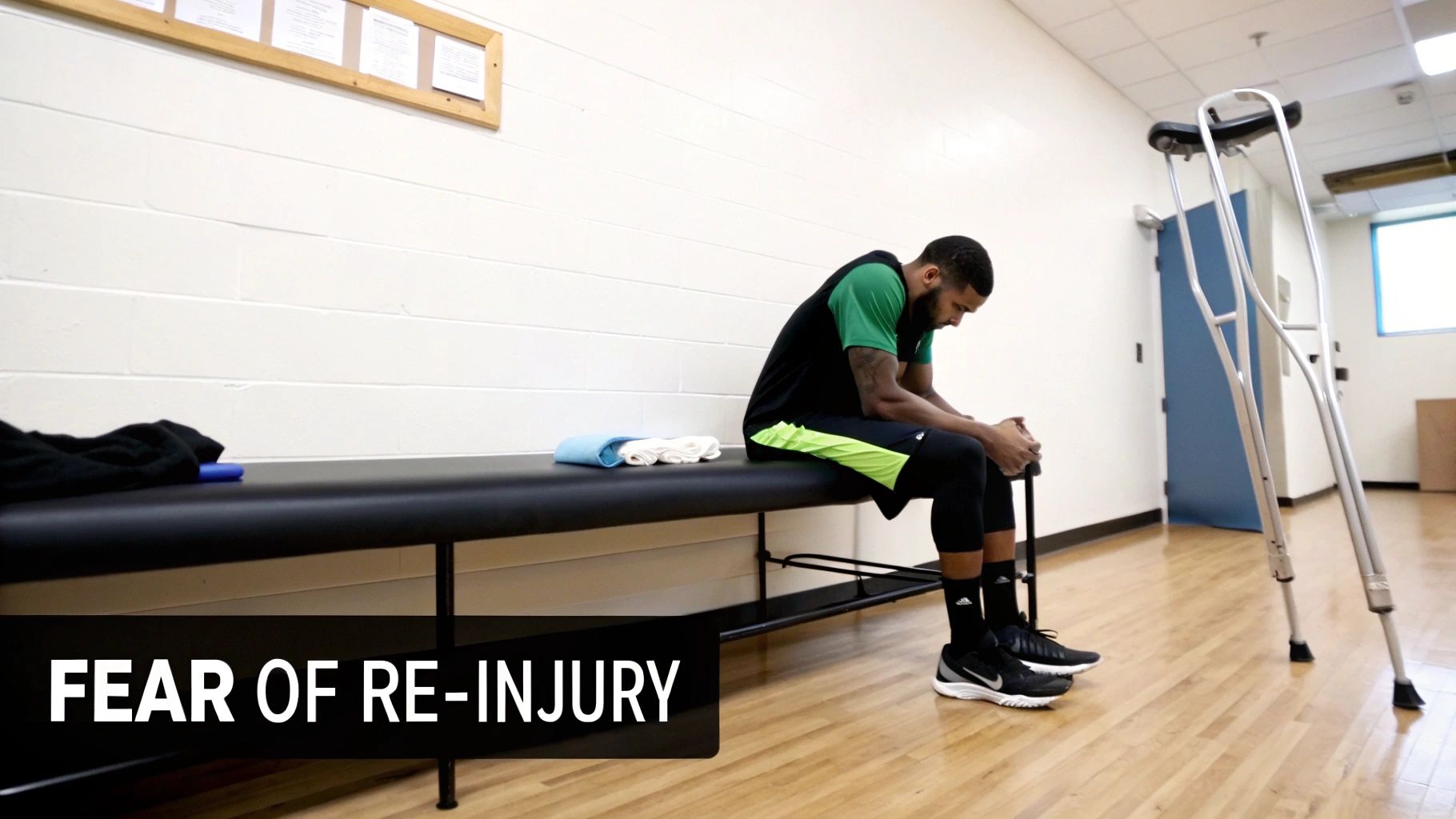
After the initial shock of an injury wears off, the reality of the long, grueling road of rehabilitation sets in. This isn’t just a physical grind; it’s an emotional marathon, full of unpredictable highs and soul-crushing lows. An athlete’s world, once defined by the structured rhythm of daily practice and the energy of the team, is suddenly replaced by a solitary, monotonous, and often painful routine.
This abrupt shift can be a perfect storm for mental health struggles. The isolation from teammates, the complete disruption of a familiar schedule, and the nagging uncertainty about the future can easily breed anxiety and depression. Each day becomes a battle, not just against physical pain, but against the immense psychological weight of the comeback journey.
The psychology of sport injury during this phase is incredibly complex. One day, a tiny bit of progress—a little more range of motion—feels like winning a championship. The next day, a flash of pain or a moment of stiffness can feel like a devastating failure, unleashing a flood of negative thoughts and fears about ever getting back to your best.
The Specter of Re-Injury
Hanging over the entire rehab process is a powerful psychological roadblock: the fear of re-injury. This fear, known in clinical terms as kinesiophobia, is more than just being cautious. It’s a deep-seated anxiety that can completely paralyze an athlete’s progress. It’s that little voice in your head that makes you hesitate during a drill or pull back from contact, even long after the tissue has healed.
This mental hurdle is not just common; it’s potent. Consider this: while about 90% of athletes are physically cleared to return to play after an ACL reconstruction, studies show that only around 55-65% ever get back to their pre-injury performance levels. What explains that huge gap? It’s often psychological factors like kinesiophobia, showing a stark disconnect between physical healing and mental readiness.
The fear of re-injury can become a self-filling prophecy. An athlete who moves with hesitation is compromising their mechanics, which ironically makes them more susceptible to getting hurt again. Tackling this fear isn’t just a good idea—it’s a non-negotiable part of a truly successful recovery.
For a powerful real-world example, just look at former NFL quarterback Alex Smith. His physical comeback from a catastrophic leg injury that nearly required amputation was nothing short of miraculous. But Smith has been very open about the intense mental battle he fought to trust his body again, stressing that overcoming the fear was just as demanding as the 17 surgeries he endured.
Actionable Strategies for Managing Rehab’s Mental Demands
You can’t just grit your teeth and hope to get through this emotional rollercoaster. Just as you have a detailed plan for physical therapy, you need a mental recovery plan. The real goal is to build resilience and regain a sense of control over your own psychological state.
Understanding your physical regimen is a great first step. Looking into the variety of rehabilitation exercises you’ll be doing can give you practical insight into the journey ahead, helping you set realistic expectations and feel more in command.
Here are a few practical tips to help you stay on track:
- Start a Rehab Journal: Grab a notebook and dedicate it to your recovery. Don’t just log reps and sets; write down how you feel. Document the small wins, the moments of frustration, and the fears that pop up. This helps you process your emotions and, more importantly, see your progress over time—which is a lifesaver on the tough days.
- Build Your “Rehab Team”: You might be cut off from your sport, but you don’t have to go through this alone. Identify your core support system—a trusted coach, a family member, a teammate, or a sports psychologist. Make it a point to schedule regular check-ins where you can talk about anything but your injury.
- Differentiate Fear from Pain: You have to learn to listen to your body intelligently. Work closely with your physical therapist to understand the difference between “good pain” (the burn of a muscle working) and “bad pain” (a genuine warning sign). This knowledge is power. It empowers you to push forward with confidence instead of letting generalized fear hold you back.
Actionable Mental Skills for a Stronger Comeback
Knowing about the emotional rollercoaster of an injury is one thing, but actually managing it is a whole different ballgame. This is where we put theory into practice. Taking a proactive approach to your mental state can shift the entire rehab experience from a frustrating waiting game into a journey you actually control. By developing a few key mental skills, you gain the tools to not just get through recovery, but to truly own it.
Think of your mind as another muscle that needs its own dedicated rehab plan. Just like physical therapy rebuilds a joint, mental skills training strengthens your focus, resilience, and confidence. This kind of focused effort is a massive part of the psychology of sport injury, helping you move from feeling helpless to becoming an active participant in your comeback.
Strategic Goal Setting for Daily Wins
The ultimate goal—getting back in the game—can feel miles away, which is a recipe for frustration. The key is to break that huge goal down into small, daily wins that build momentum. Instead of staring at the finish line, just focus on winning today’s rehab session.
This simple shift changes your focus from an outcome you can’t really control (how fast your body heals) to the daily processes you absolutely can. One of the most powerful skills you can learn is simply making exercise a lasting habit, which keeps you locked into your recovery plan day in and day out.
For a swimmer with a shoulder injury, it might look like this:
- Long-Term Goal: Get back to competing in six months.
- Monthly Goal: Get my full, pain-free range of motion back.
- Weekly Goal: Nail every single PT session without cutting corners on reps.
- Daily Goal: Hit 10 pain-free reps on my external rotation exercise.
This kind of structure gives you a constant stream of small successes, which is incredibly motivating and provides hard proof that you’re moving forward.
This screenshot from my website shows the wide range of clients I work with, from top athletes to business leaders. It really underscores a universal truth: mastering your mental game is non-negotiable for high performance, especially when you’re facing something as tough as an injury.
Visualization and Imagery Rehearsal
Even when you’re stuck on the sidelines, your mind can still be on the field training. Visualization is the powerful practice of mentally rehearsing your sport with perfect form. This technique keeps the neural pathways that control your muscle memory firing and sharp, even while your body is on the mend. It’s like running a perfect simulation in your head to prime your brain for your return.
Imagine a soccer player recovering from an ankle injury. They could run through a script like this:
- Find a quiet spot, close your eyes, and take a few deep breaths.
- Picture yourself on your home field. Feel the turf under your cleats.
- See a pass coming your way and imagine controlling it perfectly with your good foot.
- Mentally rehearse a crisp, accurate pass. Feel the clean contact and watch the ball go exactly where you want it.
- Now, the big one: Imagine planting on that injured ankle with total confidence, making a sharp, explosive cut with zero pain or hesitation.
Actionable Tip: To make visualization more powerful, engage all your senses. Don’t just see the play; hear the crowd, smell the cut grass, and feel the impact of the ball. The more vivid the mental rehearsal, the more effective it is.
Cognitive Reframing to Conquer Destructive Thoughts
An injury can unleash a vicious inner critic. Thoughts like, “I’m falling behind for good,” or “I’ll never be the same player again,” can completely derail your recovery. Cognitive reframing, a tool pulled from Cognitive Behavioral Therapy (CBT), is all about learning to spot, challenge, and replace those negative thoughts with something more productive.
This isn’t about pretending everything is fine. It’s about questioning the destructive stories you tell yourself. When you challenge a negative thought, you take away its power and start writing a new, more helpful script.
Here’s a simple three-step way to practice it:
- Catch the Thought: The second you feel that wave of frustration, pinpoint the thought driving it. (e.g., “This rehab is pointless; I’m not getting any better.”)
- Challenge the Thought: Interrogate it. Look for evidence that proves it wrong. (e.g., “Is that 100% true? Last week I couldn’t even do this exercise. Today I did five reps.”)
- Change the Thought: Swap the negative thought for a more realistic, balanced one. (e.g., “Progress isn’t a straight line, but I am definitely getting stronger.”)
Building an Unbreakable Support System
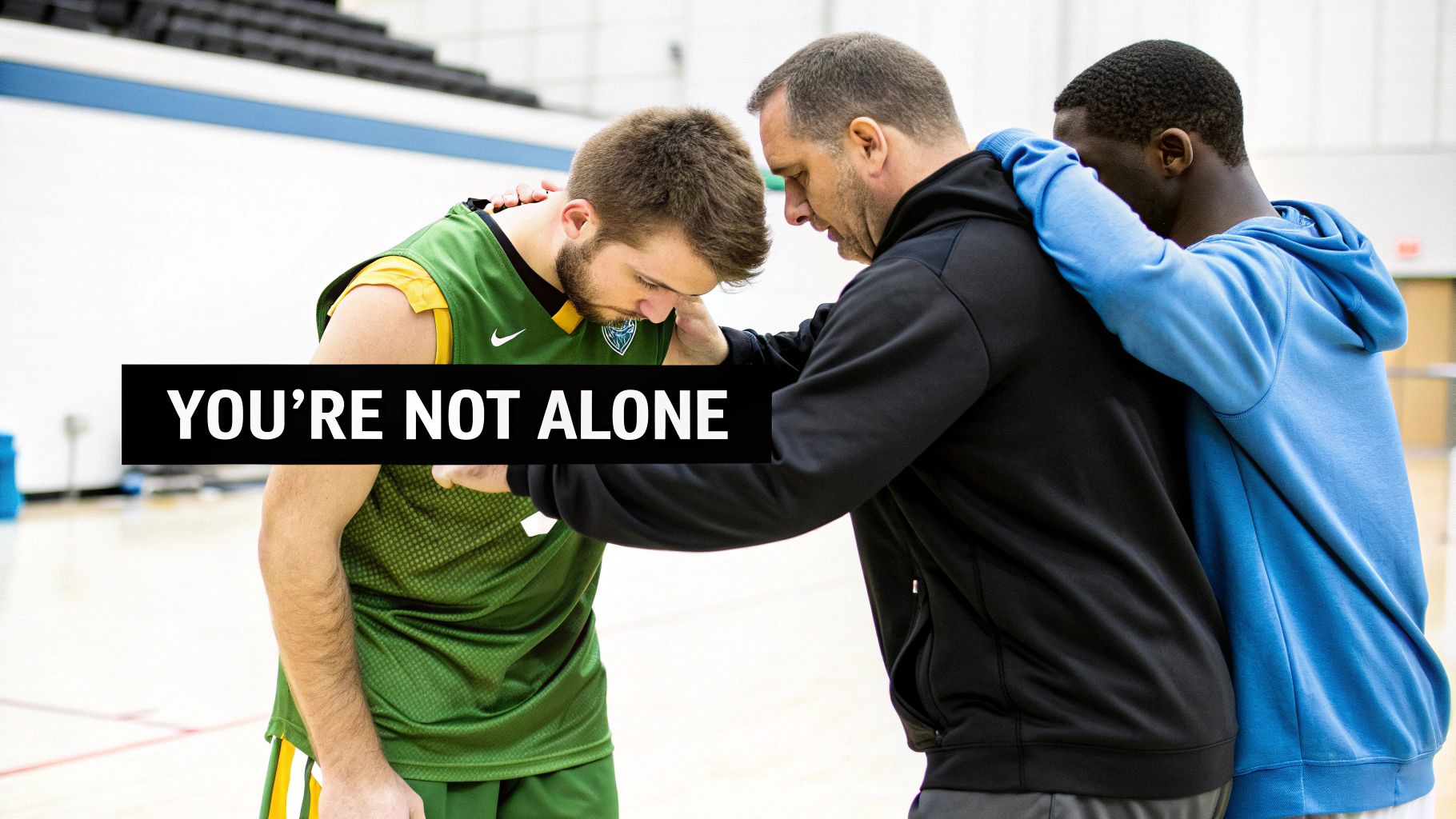
No athlete recovers in a vacuum. The mental journey back from injury can be intensely lonely, but it should never be traveled alone. The single most powerful catalyst for both psychological and physical healing is a strong, informed, and compassionate support system made up of coaches, family, and teammates.
When this network is in sync, it becomes a powerful antidote to the isolation that so often sabotages an athlete’s recovery. Research has shown time and again that athletes with solid social support report lower stress levels and stay more motivated during rehab. This isn’t just about cheering them on; it’s about meaningful, targeted engagement that reminds an athlete of their value beyond their ability to perform right now.
The psychology of sport injury is deeply connected to an athlete’s sense of belonging. By understanding and embracing their specific roles, this support network can turn a solitary struggle into a unified team effort.
A Playbook for Parents and Coaches
The best way to protect young athletes, both physically and mentally, is to build a healthier youth sports culture around them. That means shifting the entire focus from chasing short-term wins to fostering long-term athletic and personal development.
Here’s a practical playbook for creating that supportive atmosphere:
- Champion Multi-Sport Participation: Actively encourage kids, especially before age 14, to play a variety of sports. This builds a wider range of motor skills, dramatically reduces the risk of overuse injuries, and helps prevent the psychological burnout that comes from monotonous, year-round training.
- Prioritize Rest as a Skill: Stop treating rest and recovery as a sign of weakness. Frame it as what it is: a critical component of any elite training plan. Enforce real off-seasons and make sure there are days off each week where sports are completely off the table.
- Celebrate Effort Over Outcome: Praise hard work, resilience, and good sportsmanship far more than you praise wins or stats. This helps kids build an identity based on their character and work ethic, not just their athletic performance.
- Recognize the Warning Signs: Stay vigilant for the subtle changes that can signal psychological distress. Look for things like unusual irritability, withdrawing from friends, changes in sleep, or a sudden loss of interest in a sport they once loved. When you see these signs, open a conversation focused on their well-being, not their return-to-play timeline.
Winning the Mental Game of Returning to Play
Getting the physical “all-clear” from a doctor is a huge milestone, but it’s not the finish line. Not by a long shot. The final, and often toughest, hurdle in recovery is achieving true psychological readiness to get back in the game and compete.
Physical healing and mental confidence are two separate benchmarks. An athlete is only truly ready to return when both are fully aligned. This final stage of the psychology of sport injury is where all the mental skills training really comes to a head.
You have to learn to trust your body again, manage the inevitable nerves that come with game day, and keep your focus squarely on performance—not on the ghost of the old injury. It’s a massive shift in mindset, moving from being a patient in rehab to being a competitor in the arena.
The mental fallout from an injury can be staggering. Concussions, for instance, aren’t just a physical blow; they can shatter an athlete’s mental world, accounting for 10% of all sports injuries and impacting 1.6-3.8 million people annually in the US alone.
Psychologically, post-concussion syndrome can trigger anxiety, depression, and a persistent cognitive fog in 15-30% of athletes. It’s no surprise that return-to-play success rates can dip below 80% in severe cases. You can explore more about these sports injury statistics and find detailed data on how they affect athletes of all ages.
Are You Mentally Ready to Compete?
So, how do you know if you’re mentally formidable or just physically cleared? True readiness goes way beyond just completing rehab exercises.
It’s about restoring that automatic, unthinking confidence that elite performance demands. It means being able to execute movements without that split-second hesitation that screams “I’m still afraid.”
This is where self-awareness becomes your most critical tool. Athletes, working closely with their coaches and support staff, have to be brutally honest about where they stand on the mental playing field before ever stepping back onto the physical one. This evaluation is crucial for protecting against premature returns that can lead to performance slumps or, even worse, re-injury.
This decision tree offers a simple but effective framework for parents and coaches to check in on a young athlete’s well-being. It looks for signs of both physical overuse and mental distress.
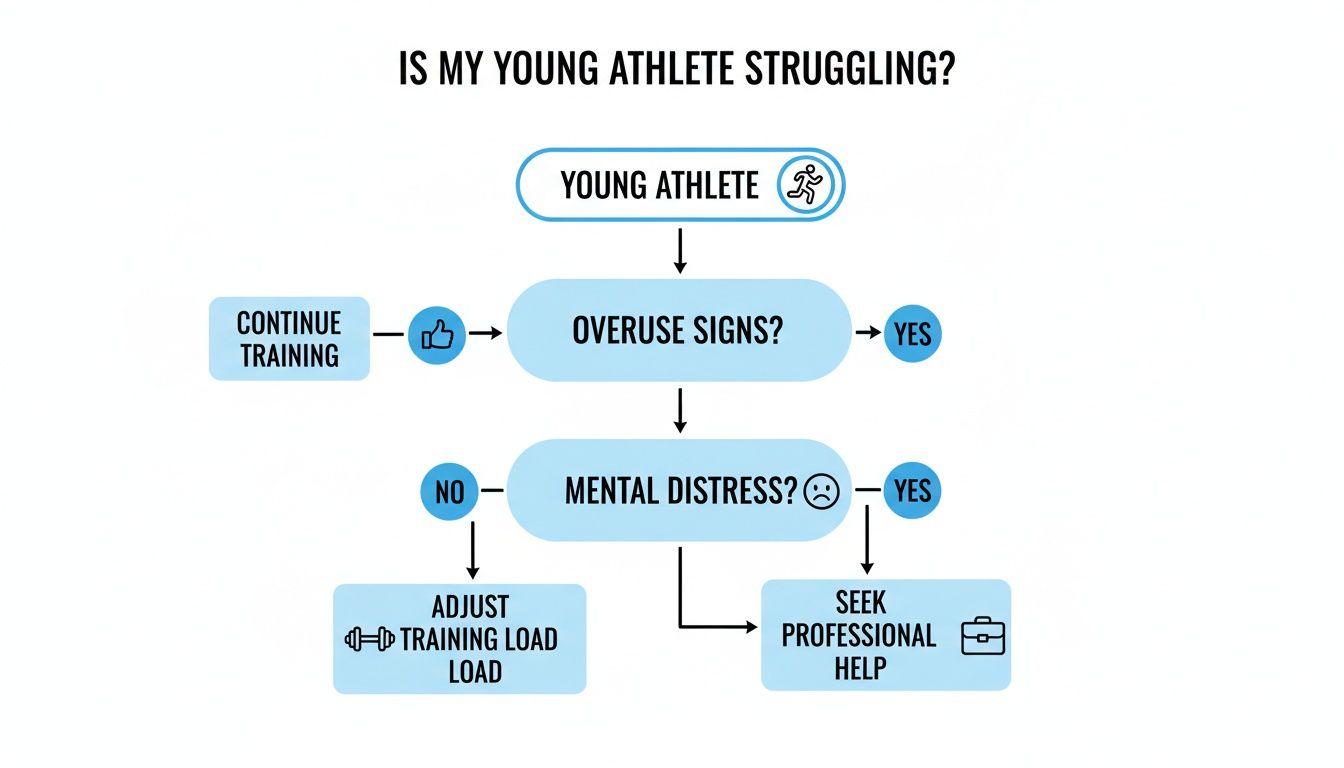
As the flowchart shows, physical symptoms and psychological struggles are often two sides of the same coin. It’s a great guide for looking at the athlete’s holistic health before deciding what to do next.
A Practical Readiness Checklist
To make this assessment more concrete, athletes and coaches can use a practical checklist. Think of it not as a test with a pass/fail grade, but as a conversation starter to pinpoint and address any lingering mental hurdles.
The goal is to return to the sport not just healed, but hardened and mentally prepared for the intense demands of competition.
A physically healed athlete who is mentally hesitant is an athlete at risk. True recovery is when the mind gives the body permission to perform at its peak without fear holding it back.
Here are a few key questions to work through before that first game back:
- Trust in the Injured Body Part:
- Can you perform key sport-specific movements—like cutting, jumping, or throwing—at full speed without hesitating?
- During practice, is your focus on executing the play or on protecting the injured area?
- Realistic Performance Goals:
- Have you set process-based goals for your return (e.g., “play three clean shifts”) instead of outcome-based ones (e.g., “score a goal”)?
- Are you mentally prepared for your performance to be a bit rusty as you readjust to the speed of the game?
- Managing Game-Day Nerves:
- Do you have a pre-game mental routine to manage anxiety and lock in your focus?
- Can you tell the difference between normal pre-game jitters and a debilitating fear of getting hurt again?
Answering these questions honestly gives a clear snapshot of an athlete’s mental state. If hesitation and fear are still running the show, it’s a clear sign that more work is needed on the psychological side of recovery, perhaps with a sports psychologist. This ensures that when you do return, you’re not just physically present but mentally formidable—ready to win the game from the inside out.
Common Questions About the Psychology of Sport Injury
When you’re sidelined, the mental side of recovery can feel just as daunting as the physical. Understanding the core challenges of sport injury psychology is the first real step toward building a tougher, more resilient mindset. I get a lot of questions from athletes, parents, and coaches, and here are my answers to some of the most common ones.
How Long Does Psychological Recovery Really Take?
There’s no magic number here. Every athlete’s journey back is unique, and a fixed timeline just doesn’t exist. So many things play a role: the injury’s severity, your natural coping skills, the strength of your support system, and even your past experiences.
For some athletes, confidence simply returns as their physical strength comes back. But for many others, the psychological healing can lag weeks or even months behind the physical all-clear. The key is to work on your mental skills right alongside your physical therapy, giving them the same priority and focus.
What Are the First Steps to Mentally Cope with an Injury?
The moments right after an injury are a whirlwind of emotion, but taking a few deliberate actions can set a much more positive tone for the entire recovery process.
- Feel What You Feel: First, just allow yourself to feel it—the anger, the sadness, the frustration. These are completely normal reactions to a significant loss. Don’t judge them, just acknowledge them.
- Zero in on What You Control: Next, immediately pivot your focus to what you can control. This could be your dedication to rehab exercises, what you eat, or how much you sleep. It’s about regaining a sense of agency.
- Stay in the Game: Finally, find ways to stay connected to your team. You can still be a valuable part of the group. Offer to help your coach break down film or take a younger player under your wing. This is crucial for maintaining your identity as an athlete.
When Is It Time to See a Sports Psychologist?
While a strong support system of family, coaches, and teammates is invaluable, sometimes professional help is what truly tips the scales. Think of it as a proactive move toward a stronger comeback, not a sign of weakness.
It might be time to reach out if you’re experiencing any of these:
- Anxiety or depression that just won’t lift and is getting in the way of your rehab or daily life.
- An intense and constant fear of getting hurt again (known as kinesiophobia).
- A complete loss of motivation to even show up for your recovery work.
- Major changes in your appetite or ability to sleep.
- Pulling away from your friends, family, and teammates.
A sports psychologist has a specialized, evidence-based toolkit designed to help you navigate these roadblocks and build the mental resilience you need not just to return, but to thrive.
For more information on mental performance coaching or psychological services, or to schedule a consultation, visit my Sports Psychology Services page.