

There’s a direct and powerful line connecting sports psychology to an athlete’s performance on the field. When a mind is trained, it consistently unlocks the body’s full physical potential.
Think of mental skills not as a repair kit you pull out when something’s broken, but as a proactive, daily training regimen for your brain. This is the mental conditioning that builds the resilience and sharpens the focus needed to execute under pressure. It’s what separates a good day from a great career.
The Unseen Advantage in Sports Psychology and Performance
Every serious athlete knows the grind. We log relentless hours of physical practice to build strength, speed, and technical skill. We track metrics, obsessively refine our movements, and push our bodies to their absolute limits.
But there’s another training ground, one that’s often overlooked, that separates the good from the truly great: the mind. The entire field of sports psychology and performance is dedicated to systematically training this internal operating system.
It’s a huge misconception that sports psychology is only for athletes stuck in a slump or crippled by anxiety. The reality? It’s a fundamental piece of peak performance training for everyone. Just like you strengthen your core to support every physical move you make, you have to strengthen your mind to support every single competitive action. This isn’t a quick fix; it’s a continuous process of building mental muscle.
Moving Beyond Physical Talent
Raw physical talent will only get you so far. When you’re up against competitors who are just as skilled and conditioned as you are, the winner is almost always the one with the superior mental game. It’s here that a structured approach to mental performance gives you a real, tangible edge.
Mental training makes a direct impact in a few key areas:
- Consistency: Developing pre-game routines and focus strategies helps you deliver your best, not just on the days you feel great, but every single day.
- Resilience: Learning to reframe a bad play and manage your emotions allows you to bounce back instantly from mistakes instead of letting them derail your whole performance.
- Pressure Management: Techniques like controlled breathing and visualization keep you calm and centered when the stakes are sky-high, allowing for clear, sharp decision-making.
Think of it this way: a world-class race car with a distracted driver will never win. Your body is the car, but your mind is the driver. Sports psychology ensures that your driver is focused, confident, and in complete control.
Take a basketball player, for example. They can practice thousands of free throws. But the player who also visualizes the ball sinking, uses focused breathing to manage the roar of the crowd, and reinforces their confidence with positive self-talk before the shot? That’s the player far more likely to drain it in the final seconds of a championship game.
This proactive mental preparation is the unseen advantage that turns all that practice into victory. It’s about building a mental toolkit that ensures you’re just as prepared mentally as you are physically.
Before we dive deeper, let’s break down the core skills that form the bedrock of mental performance. These are the fundamental pillars that sports psychologists help athletes build to create a solid and resilient mindset.
Core Pillars of Mental Performance in Sports
| Mental Skill | Description | Practical Example |
|---|---|---|
| Focus & Concentration | The ability to direct and maintain attention on relevant cues in the environment and ignore distractions. | A golfer concentrating solely on the ball and the target, blocking out spectator noise and internal doubts during a crucial putt. |
| Confidence | An athlete’s belief in their ability to execute a specific task or achieve a particular goal. | A soccer player stepping up to take a penalty kick, fully believing they will score, despite the pressure from the opposing goalie and fans. |
| Motivation | The internal and external factors that drive an athlete to train, compete, and strive for excellence. | A marathon runner pushing through the pain in the final miles, driven by the personal goal of setting a new personal best. |
| Emotional Regulation | The capacity to manage and control one’s emotional state, especially under pressure, to maintain optimal performance. | A tennis player remaining calm and resetting their mindset after losing a set, preventing frustration from affecting the next one. |
| Resilience | The ability to bounce back from setbacks, mistakes, or failures and maintain a positive and determined outlook. | A quarterback throwing an interception but coming back onto the field for the next drive with renewed focus and determination. |
Mastering these skills isn’t about eliminating pressure or preventing mistakes—that’s impossible. It’s about building a mental framework so strong that you can thrive no matter what the competition throws at you.
Building Your Mental Toolkit with Key Skills
Think of a master carpenter. They don’t just have a hammer; they have a whole toolbox filled with specialized tools for every possible job. A mentally tough athlete is no different. Their toolbox is filled with proven mental skills, not just vague ideas. These are practical, trainable techniques that give them an edge when it matters most.
The whole point is to stop reacting to pressure and start proactively managing it. Mastering just a few of these mental exercises builds a psychological foundation as solid as your physical one. This is the essence of mental training for peak performance—it puts you in the driver’s seat when the stakes are highest.
This is all about the interplay between your mind and your results.
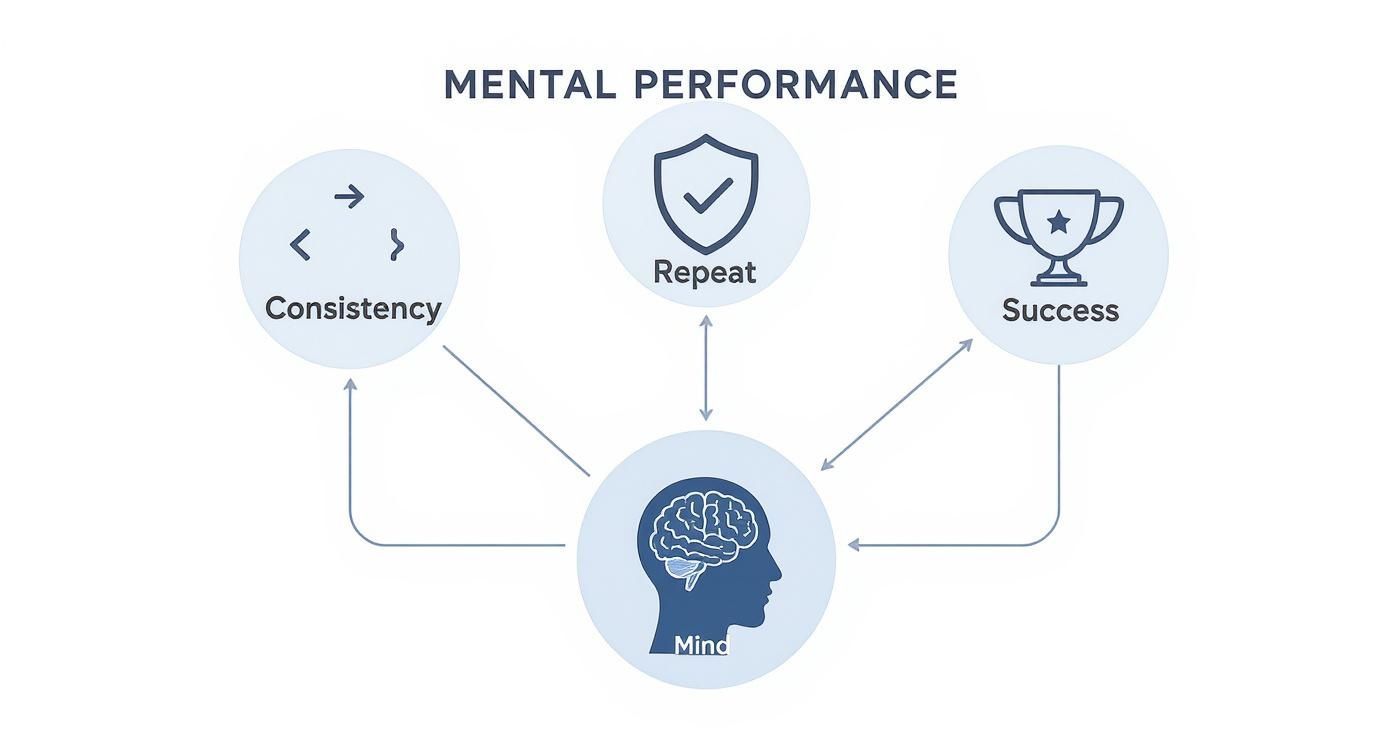
As you can see, a well-trained mind is the engine that powers everything else: consistency, resilience, and, ultimately, success.
Strategic Goal Setting The Right Way
Almost every athlete sets goals, but the elite performers do it differently—strategically. A huge mistake I see all the time is focusing only on the final prize, like winning a championship. That’s an outcome goal, and while it’s great for motivation, you don’t actually have full control over it.
A much smarter approach is to break your goals down into layers you can control:
- Performance Goals: These are about hitting your own personal bests, completely separate from what your opponent does. A swimmer might aim to slash half a second off their personal record. It’s tough, but it’s entirely up to them.
- Process Goals: This is where the magic happens. These are the specific, tiny actions you have to nail to hit your performance goals. For our swimmer, it could be obsessing over a perfect flip-turn or sticking to a precise stroke count on every single lap.
When you lock in on the process, the performance goals tend to take care of themselves. And when that happens, you give yourself the absolute best shot at achieving that big outcome you’ve been dreaming of. It keeps you focused on the here and now, not lost in what-ifs.
Using Visualization to Rehearse Success
Here’s a fascinating thing about your brain: it often can’t tell the difference between a real event and one you’ve imagined in vivid detail. That’s the science behind visualization, and it’s a game-changer. This isn’t just daydreaming; it’s a structured, deliberate mental rehearsal.
Practicing techniques like visualization in sports is a cornerstone of any robust mental toolkit, giving athletes the power to rehearse success before they even step onto the field. It’s about creating an experience so real you can feel it.
A golfer lining up a critical putt shouldn’t just see the ball drop. They need to feel the texture of the grip, hear the clean click of the clubface hitting the ball, and imagine that perfect, satisfying rattle as it falls into the cup.
This kind of detailed mental run-through actually builds and strengthens the neural pathways in your brain, making the real-life action feel second nature. It’s like getting in hundreds of extra reps without wearing out your body.
Mastering Your Inner Dialogue with Self-Talk
Every athlete has a voice in their head. The real question is, is that voice a supportive coach or your harshest critic? When that voice turns negative—”Don’t choke,” “I can’t do this”—it triggers a physical stress response. Your muscles tighten, your focus narrows, and your judgment gets cloudy.
Constructive self-talk is all about consciously flipping the script on those negative thoughts, turning them into productive cues. This isn’t about lying to yourself with blind positivity; it’s about strategic thinking. The research backs this up, too. A meta-analysis covering 30 studies found that mental skills training had a clear positive effect on performance, while things like anxiety had a damaging one.
Think of a cyclist grinding up a brutal hill. Their legs are screaming, and the first thought is, “I’m toast, I have to stop.”
They can reframe this with specific, actionable thoughts:
- Instructional: “Keep my cadence smooth. Deep breath in, long breath out. Drive through the pedal.”
- Motivational: “I trained for this exact climb. My legs are strong. I am powerful.”
That simple shift in the internal conversation can be the deciding factor between giving in and finding another gear to push through. It turns your mind from your biggest obstacle into your most powerful weapon.
Mastering Pressure and Achieving Clutch Performance
Pressure is the ultimate test in sports. It’s that invisible opponent that can turn a simple, everyday play into an impossible task. It’s also what separates the good athletes from the truly great ones—the clutch performers who shine when the lights are brightest. To conquer pressure, you first have to understand what it’s doing to your mind and body.
When the stakes get high, our ancient survival wiring—the ‘fight or flight’ response—takes over. This physiological alarm system floods your body with adrenaline and cortisol, preparing you for what it perceives as a threat. While great for escaping a predator, this response can completely sabotage athletic performance. It leads to tight muscles, shallow breathing, and a narrowed focus often called “tunnel vision.”
In this state of over-arousal, fine motor skills go out the window and clear-headed decision-making becomes nearly impossible. Suddenly, that free throw you’ve shot a thousand times in practice feels like the hardest thing in the world. The secret isn’t to get rid of the pressure. It’s to learn how to manage your body’s reaction to it and channel that nervous energy into a powerful advantage.

Regulating Your Arousal Level
Think of your arousal level like the RPM gauge on a race car. If it’s too low, you’ll be sluggish and unfocused, lagging behind the competition. But if it’s too high, you’re redlining—anxious, tense, and spinning out of control. The goal is to find that sweet spot, your optimal performance zone. Thankfully, there are proven techniques to dial it in.
When you need to bring your heart rate down and clear your head, controlled breathing is your best friend.
- Box Breathing: This simple but incredibly powerful technique can instantly slow things down. Just inhale for a count of four, hold your breath for four, exhale for four, and hold again for four. A few cycles can recenter your mind and bring your entire nervous system back into balance.
On the flip side, sometimes you need to fire yourself up and get the engine revving.
- Psych-Up Techniques: Using motivational self-talk (“Let’s go!”, “I own this!”), blasting some high-energy music, or even doing some quick, dynamic movements like jumping jacks can get your heart rate up and prime your body for explosive action.
Having both sets of skills in your back pocket gives you a thermostat for your internal state, making sure you’re perfectly primed for whatever the competition throws at you. For younger athletes, developing these tools early on is a game-changer. Getting the right support, like exploring psychological counseling for teen athletes, can give them a foundation of mental resilience that will last a lifetime.
Building an Unshakeable Pre-Performance Routine
Consistency under pressure isn’t an accident; it’s a product of routine. The best athletes in the world don’t just hope they feel good on game day—they build their ideal mental state with a deliberate pre-performance routine. This is a specific sequence of thoughts and actions you run through before every competition to get locked in.
This routine becomes your anchor. It gives you a feeling of control and familiarity, no matter how wild the environment around you gets. It’s a powerful signal to your brain that it’s go-time.
Your routine is your personal launch sequence. It tells your mind and body that all systems are go, and you are ready for liftoff. It eliminates the guesswork and lets you step into the moment with complete confidence.
A rock-solid routine weaves together both physical and mental elements:
- Physical Warm-Up: This isn’t just about stretching; it’s about sport-specific movements that get your body ready for the exact demands of the game.
- Mental Rehearsal: Use visualization to mentally walk through your performance, seeing yourself succeed flawlessly.
- Arousal Regulation: This is where you use your breathing or psych-up techniques to get into that optimal zone.
- Focus Cue: Have a simple word or phrase—like “sharp,” “explode,” or “calm”—that you use to lock in your focus right before the action starts.
Picture a soccer player stepping up to take a penalty kick that will decide the championship. The crowd is a wall of noise, and the pressure is immense. Instead of panicking, she executes her routine: place the ball, take three deep breaths, visualize it hitting the back of the net, and repeat her focus cue—”smooth”—just before she begins her approach.
That sequence pushes aside all the external noise and internal chatter, allowing her years of muscle memory to take over. That’s the power of sports psychology in action—turning a moment of crushing pressure into a stage for perfection.
The Rise of Mental Performance Technology
For decades, the mental side of sports was an art form, guided by intuition and gut feelings. Today, it’s rapidly becoming a hard science, powered by objective data and incredible new tools. The intersection of sports psychology and performance isn’t just about locker-room talks and visualization anymore; it’s about quantifiable metrics and data-driven plans.
This evolution is opening up a whole new frontier in athlete development, where mental conditioning is finally as measurable as a 40-yard dash. Coaches and athletes can now peek “under the hood” of the mental game, moving from guessing about an athlete’s mental state to knowing with a high degree of confidence.
From Subjective to Objective Measurement
One of the biggest leaps forward is our newfound ability to objectively measure an athlete’s physiological response to stress and recovery. Wearables and biometric trackers are giving us a continuous stream of data, offering a clear window into the autonomic nervous system.
A cornerstone metric here is Heart Rate Variability (HRV), which measures the tiny variations in time between each heartbeat. Think of it this way: a higher HRV usually means you have a well-rested, recovered, and resilient nervous system. A lower HRV, on the other hand, can be a red flag for fatigue, stress, or the need for a day off. As the tech improves, tools like Heart Rate Variability (HRV) training give athletes real-time, data-backed insights into their readiness and stress, helping them make smarter calls about their training and overall well-being.
This data allows for smarter, more agile coaching. If an athlete’s HRV is consistently low, a coach might dial back the intensity or build in more recovery and mental relaxation, heading off burnout before it even starts.
Immersive Training with Virtual Reality
Pressure is notoriously hard to replicate in practice. How do you simulate the deafening roar of 80,000 fans or the final, nail-biting seconds of a championship game? Virtual Reality (VR) is emerging as a powerful answer. VR can create stunningly realistic, high-pressure scenarios, letting athletes sharpen their mental skills in a controlled yet stressful environment.
A quarterback can use VR to face a blitz from an elite defense hundreds of times, training their brain to spot patterns and make split-second decisions—all without the physical toll. It’s essentially digital visualization on steroids, building the same neural pathways as real-world experience.
These tools aren’t just for practice; they’re for forging resilience.
- Repetition: Athletes can face clutch moments again and again, desensitizing them to the anxiety that comes with it.
- Controlled Stress: Scenarios can be tweaked to ramp up or dial down the pressure, allowing for a progressive mental workout.
- Immediate Feedback: Performance inside the simulation can be analyzed to pinpoint exactly where decision-making breaks down under duress.
The market for these technologies is exploding, which tells you just how vital they’ve become in elite sports. The sports psychology tech market is projected to grow at a CAGR of 22.5% from 2025 through 2033. Data-driven coaching platforms are enabling personalized strategies like never before, and with 80% of coaches in a recent report already using AI, the shift from reactive to proactive training is well underway.
The Future is AI-Driven and Personalized
Looking ahead, Artificial Intelligence (AI) is poised to play an even bigger role. AI-powered platforms can crunch massive datasets—combining biometrics, performance stats, and even video—to spot subtle patterns a human coach could easily miss.
AI can act as a co-pilot for coaches, flagging potential performance slumps before they happen. By detecting tiny changes in an athlete’s mechanics or recovery metrics, these systems can provide predictive insights, allowing for proactive intervention.
This means mental training can become deeply personal. An AI might recommend specific breathing exercises for one athlete based on their in-game heart rate spikes, while suggesting different visualization techniques for another who battles pre-game jitters. This data-informed future ensures that mental skills training is no longer one-size-fits-all, but is instead tailored to each athlete’s unique psychological and physiological fingerprint.
Creating a Winning Environment with Coaches and Parents
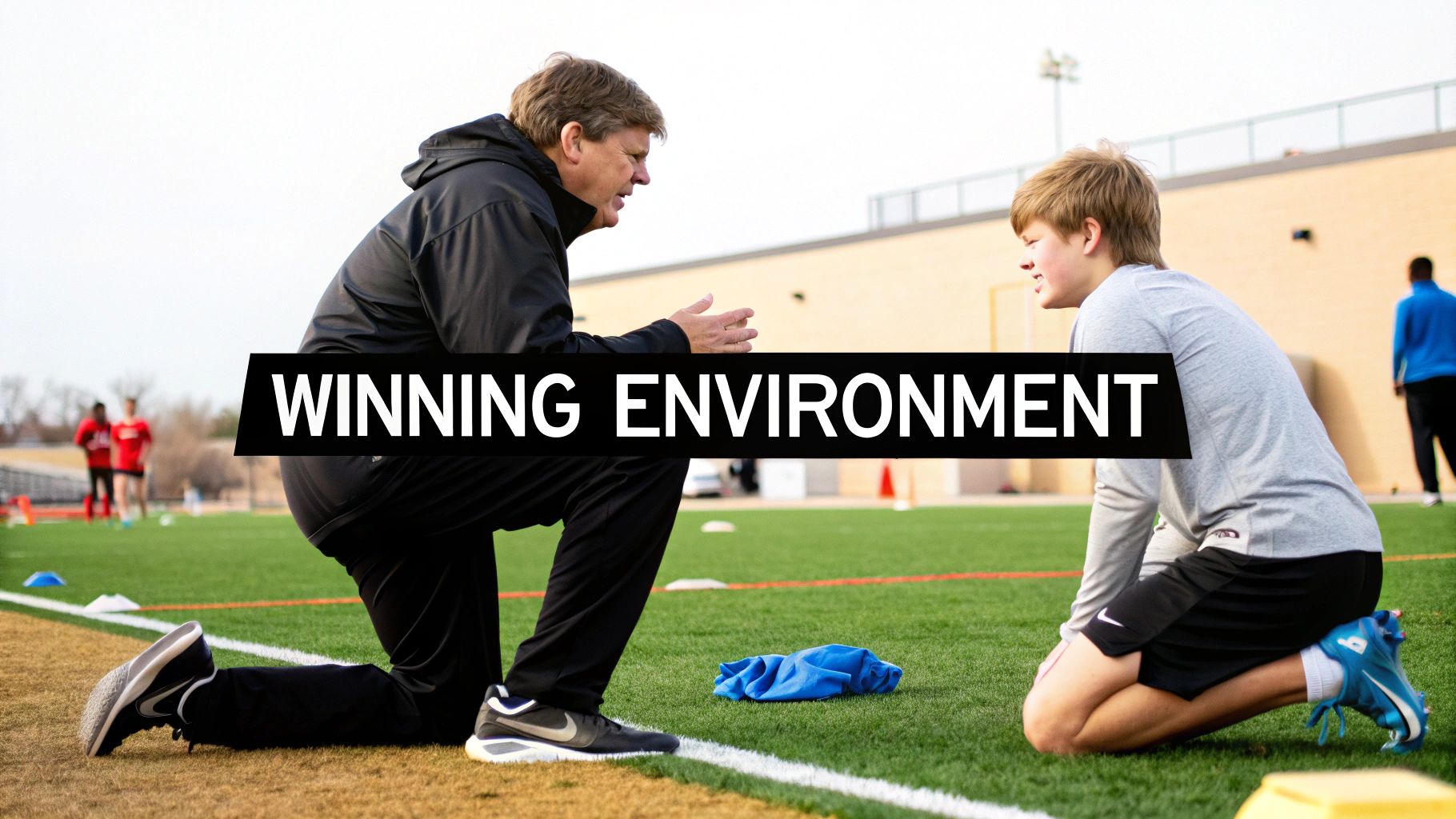
An athlete doesn’t develop in a vacuum. The people they lean on most—their coaches and parents—profoundly shape their mental fortitude, resilience, and confidence. Crafting a supportive environment is one of the most critical factors in the entire sports psychology and performance puzzle.
This support system is the very framework upon which an athlete builds their mental game. When coaches and parents are aligned in creating a positive, growth-oriented atmosphere, athletes feel free to take risks, learn from failure, and ultimately reach their highest potential.
Actionable Strategies for Coaches
Coaches are the architects of an athlete’s daily training world. Your words and actions carry immense weight, directly impacting confidence and motivation. The hallmark of elite coaching is moving beyond just the X’s and O’s to intentionally build mental skills.
One of the most powerful shifts a coach can make is to consistently praise effort over outcome. When an athlete makes a mistake while attempting the right play, the feedback needs to target the sound decision and hustle, not the error itself. This simple change encourages aggressive, confident play instead of timid, fear-based performance.
“I love that you went for that shot. Your form was perfect; next time it drops.” This type of feedback builds a player who isn’t afraid to fail—an absolutely essential ingredient for growth.
Here are a few practical ways you can start weaving mental skills into every practice:
- Pressure Drills: Intentionally create high-stakes scenarios in practice, like a timed shooting drill where the whole team has to run if a target isn’t met. This helps normalize the feeling of pressure so it’s familiar on game day.
- Mistake Rituals: Teach athletes a quick physical or verbal cue—like a fist clench and release or saying “reset”—to use immediately after a mistake. This trains them to let go and refocus in an instant.
- Goal Setting Sessions: Before practice, dedicate five minutes to discussing one specific process goal for the day, such as communication on defense or footwork on drills.
For coaches looking to take a deeper dive, exploring professional development like specialized sports psychology workshops can provide structured tools and expert guidance to truly elevate your team’s mental game.
Essential Guidelines for Parents
Parents provide the emotional bedrock for a young athlete. Your role isn’t to be a second coach; it’s to be their number one source of unconditional support. That distinction is crucial for fostering a long-term love for the sport and building unshakeable resilience.
Managing your own emotions on the sideline is paramount. Your anxiety, frustration, or excitement is incredibly contagious. When your child sees you remaining calm and supportive regardless of the score, it gives them the emotional freedom to perform without the added weight of your expectations.
The car ride home after a tough loss is a critical moment. Resist the urge to immediately dissect what went wrong. Instead, lead with empathy and support.
Do’s and Don’ts for Post-Game Conversations
| Do Say This | Don’t Say This |
|---|---|
| “I love watching you play.” | “Why did your coach take you out?” |
| “What was your favorite part of the game?” | “You should have shot more.” |
| “You looked like you were having fun.” | “We’ll work on your mistakes tomorrow.” |
| “I’m so proud of your effort today.” | “You need to be more aggressive.” |
Your primary job is to reinforce your love and support, completely separate from their athletic performance. This creates a safe emotional space where they can process wins and losses in a healthy way. By focusing on the person, not just the player, you help develop a well-rounded and mentally tough individual prepared for challenges in sports and in life.
Your Questions on Sports Psychology Answered
Diving into the world of sports psychology can spark a lot of questions. It’s a fascinating field. Maybe you’re an athlete hunting for that extra edge, a coach trying to unlock your team’s potential, or a parent navigating the journey with a young competitor. Getting straight answers is always the best place to start. Let’s tackle some of the most common questions I hear.
When Is the Right Time for an Athlete to Start Sports Psychology Training?
The short answer? Yesterday. But today is a close second. The best mental training is proactive, not something you scramble for when things go wrong. Think of it like strength and conditioning—you build it from the ground up, not just when you feel weak.
Waiting until you’re in a slump or dealing with an injury is like trying to learn to swim during a flood. You’re already behind. By weaving simple mental skills like goal setting and visualization into an athlete’s routine early on, you forge a foundation of resilience that will last a lifetime. Working with a sports psychologist is valuable at any point, but starting before a crisis hits is what truly creates lasting, sustainable success.
How Is Sports Psychology Different from Clinical Psychology?
This is a huge one, and the distinction is critical. While they both come from the world of psychology, they play entirely different roles. I like to use the analogy of a personal trainer versus a physical therapist.
- Clinical Psychology is a healthcare field. It’s focused on diagnosing and treating mental health conditions like depression, anxiety disorders, or trauma. The goal is to help people manage or overcome mental illness to improve their overall life.
- Sports Psychology, on the other hand, is all about performance enhancement. We work with mentally healthy athletes who want to be better at what they do. I teach skills to sharpen focus, manage pressure, and build unshakable confidence.
A well-trained sports psychologist knows how to spot signs of clinical issues, and treat them too. Dr. John F. Murray can do this, while most cannnot because Murray is both a clinical and sports psychologist. His job is to provide both the mental toolkit for peak sports psychology and performance, and to treat mental illness if needed.
What Are Some Simple Mental Exercises an Athlete Can Do Daily?
Building mental muscle is just like building physical muscle: consistency is everything. You don’t need to spend hours a day on it. A few focused minutes can make a world of difference, creating powerful habits that show up when the pressure is on.
Here are three simple but incredibly effective exercises to work into a daily routine:
- Five-Minute Visualization: Every morning or night, close your eyes and vividly imagine yourself performing flawlessly. Don’t just watch it like a movie—feel it. Feel the smooth, powerful motion of a perfect golf swing, hear the crisp sound of a perfect pass, and experience the surge of success. This mental rehearsal literally strengthens the neural pathways for that action.
- One-Minute Centering Breath: Before practice, take just 60 seconds to focus only on your breath. Breathe in slowly through your nose, then out slowly through your mouth. This simple act of mindfulness trains your focus and gives you a go-to tool for calming your nerves when the stakes are high.
- Constructive Performance Reflection: After every training session, take two minutes. Identify one thing that went well and one specific thing you want to improve tomorrow. This builds a growth mindset, stopping you from dwelling on mistakes and shifting your focus to steady, incremental progress.
How Can I Find a Qualified Sports Psychology Professional?
Call Dr. John F. Murray at 561-596-9898
For more information on mental performance coaching or psychological services, or to schedule a consultation, visit my Sports Psychology Services page.