
As a coach, you're already an expert in the X's and O's. But what if I told you the biggest competitive advantage isn't on the whiteboard? It's between your athletes' ears.
Sports psychology is simply about integrating mental skills training with physical conditioning. It's about turning your role from just a tactician into a mental skills architect, building your players' confidence, focus, and resilience from the ground up. This guide gives you actionable insights and practical examples you can use on the field tomorrow.
Winning the Mental Game Before the Whistle Blows
The best coaches have always known it, but now it's becoming mainstream: elite coaching has moved beyond physical drills and deep into the minds of athletes. Sports psychology is no longer some fringe idea; it's a core part of any winning playbook. I’ve seen it time and again—the real difference between a good athlete and a great one is mental fortitude.
This isn't about getting a Ph.D. in psychology. It's about proactive mental training. You already see the raw potential in your players; this is the key to finally unlocking it. The idea is simple: mental skills like staying focused under pressure, holding onto confidence after a mistake, and bouncing back from a bad play are what translate directly to better performance on the field.
The Shift to a Mentality-First Approach
One of the most critical skills a modern coach can develop is learning to spot the difference between mental burnout and physical fatigue. An athlete who is physically tired might slow down a step. But one who is mentally drained? They'll make uncharacteristic errors, lose their drive, or seem completely checked out. An athlete's mindset can absolutely make or break their execution when it counts.
This mentality-first approach is catching on, and fast. The global sports psychology market is on track to hit $4.0 billion by 2033. Even more telling, mental training programs are seeing a projected growth rate of a massive 47% through 2026. This isn't just a trend; it's a fundamental shift. Coaches are sharpening their team's competitive edge with practical techniques like stress management and focus training.
"I need them to be mentally tough." I hear this from coaches constantly. It’s a universal truth in sports: physical talent alone doesn't win championships. The ability to manage your head and stay locked in is what separates the best from the rest.
To get you started, here's a quick look at the core mental skills and what they actually mean for your team on game day.
The Coach's Mental Skills Toolkit At a Glance
This table breaks down the key mental skills, what they look like in action, and the direct impact they have on performance. Think of these as the foundational tools you'll be helping your athletes build.
| Mental Skill | What It Looks Like in Practice | Direct Performance Benefit |
|---|---|---|
| Confidence | An athlete who takes the big shot, even after a miss. They carry themselves with self-assurance. | Increased assertiveness, better decision-making under pressure, and reduced hesitation. |
| Focus | A player who can tune out a hostile crowd to sink a crucial free throw or make the right read. | Fewer unforced errors, improved reaction time, and consistent execution of fundamentals. |
| Resilience | A quarterback who throws an interception but immediately leads a scoring drive on the next possession. | Prevents one mistake from spiraling into a string of bad plays. Maintains team morale. |
| Visualization | A diver mentally rehearsing every twist and turn of a perfect dive before even stepping on the board. | Improved motor skills, heightened confidence, and reduced pre-performance anxiety. |
These are the pillars of peak mental performance. They aren't abstract concepts; they are trainable skills, just like a perfect free throw or a solid tackle.
- Confidence: It's that unshakeable belief in their ability to succeed, even when things go wrong.
- Focus: It’s the skill of locking into the present moment, blocking out everything from the roaring crowd to their own internal doubts.
- Resilience: This is the ability to bounce back instantly from mistakes or losses without letting failure derail them.
- Visualization: It’s the powerful practice of mentally rehearsing a successful outcome before it ever happens. Many top athletes use this to build a blueprint for success. You can learn more about visualization in sports to see just how effective this technique is.
Diagnosing Your Team’s Mental Strengths and Weaknesses
Before you can start building mental toughness, you need a clear picture of where your team stands right now. Going on gut feelings alone won’t cut it. You need a deliberate plan to assess the mental skills of both the team as a whole and each individual athlete. This isn’t about playing armchair psychologist; it’s about gathering real, practical data to build a mental training plan that actually solves problems.
The whole point is to establish a solid baseline. Maybe your athletes are laser-focused but shatter at the first sign of adversity. Or perhaps they communicate well in drills but fall apart under scoreboard pressure. Answering these questions honestly is the first real step toward making sports psychology work for you and get you tangible results on the field.
Moving From Observation to Insight
Believe it or not, your daily practices are a goldmine of psychological data—you just need to know what to look for. Start watching for the behaviors around the physical execution. How an athlete bounces back from a mistake often tells you more about their mental state than the mistake itself.
Practical Tip: Next practice, watch a single player for five minutes. Don't look at their technique. Instead, notice their body language after a success versus a failure. Do they celebrate a good play with teammates? Do they hang their head after an error? This micro-observation gives you a window into their mindset.
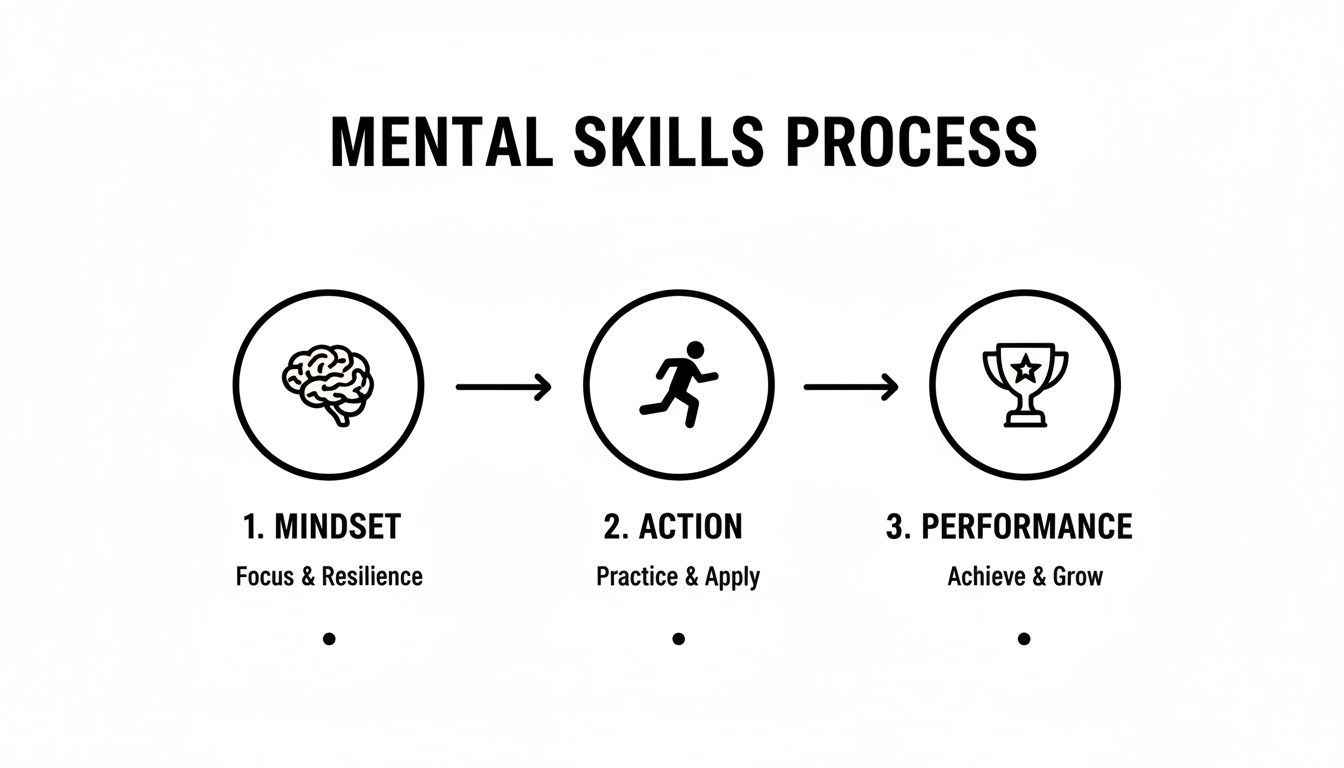
As the graphic shows, a solid mindset is the foundation. It directly fuels the quality of an athlete's actions, which is what determines whether they win or lose.
Practical Tools for Your Diagnostic Toolkit
You don't need a PhD or complicated psychological assessments to gather this information. Simple, consistent tools woven right into your coaching routine can give you profound insights. The key is to use a mix of methods to get a complete picture.
Here are three actionable tools you can put into play this week:
- Observation Checklists: During practice, keep a simple checklist. Jot down instances of positive self-talk versus negative body language. Who responds well to feedback? Who communicates clearly when the pressure is on? After a week, you'll start to see clear patterns.
- Targeted Debrief Questions: After a game or a tough practice, dig deeper than "What went wrong?" Ask questions that reveal what’s going on inside their heads. Try things like, "What was going through your mind before that penalty kick?" or "When did you feel most focused today, and what was happening at that moment?"
- Anonymous Surveys: A simple, anonymous survey can uncover things athletes might never say to your face. Use a 1-5 scale for questions on confidence levels, pre-game anxiety, and team chemistry. This gives you hard data to back up what you're observing.
A coach's greatest diagnostic tool is curiosity. Instead of assuming you know why an athlete is struggling, ask questions that help you understand their internal experience. The answer is often surprising and always informative.
When you combine these methods, you get a 360-degree view of your team's mental landscape.
Interpreting the Feedback to Build a Plan
Once you have the data, it's time to turn it into a game plan. Look for the recurring themes. Are multiple surveys showing a dip in confidence after a loss? Does your checklist reveal that focus tanks in the last 10 minutes of every practice? These are your starting points.
Actionable Tip: If your data shows a team-wide dip in confidence, run a "highlight reel" session. Have each player write down one thing they did well in the last game and one thing a teammate did well. Read them aloud. This simple drill actively shifts focus from deficits to strengths and builds both individual and collective confidence.
This data-driven approach ensures you’re fixing the team’s actual needs, not just what you think their weaknesses are. This is how sports psychology for coaches becomes a precise and powerful tool for building a mentally unbreakable team.
Integrating Mental Toughness Drills into Daily Practice
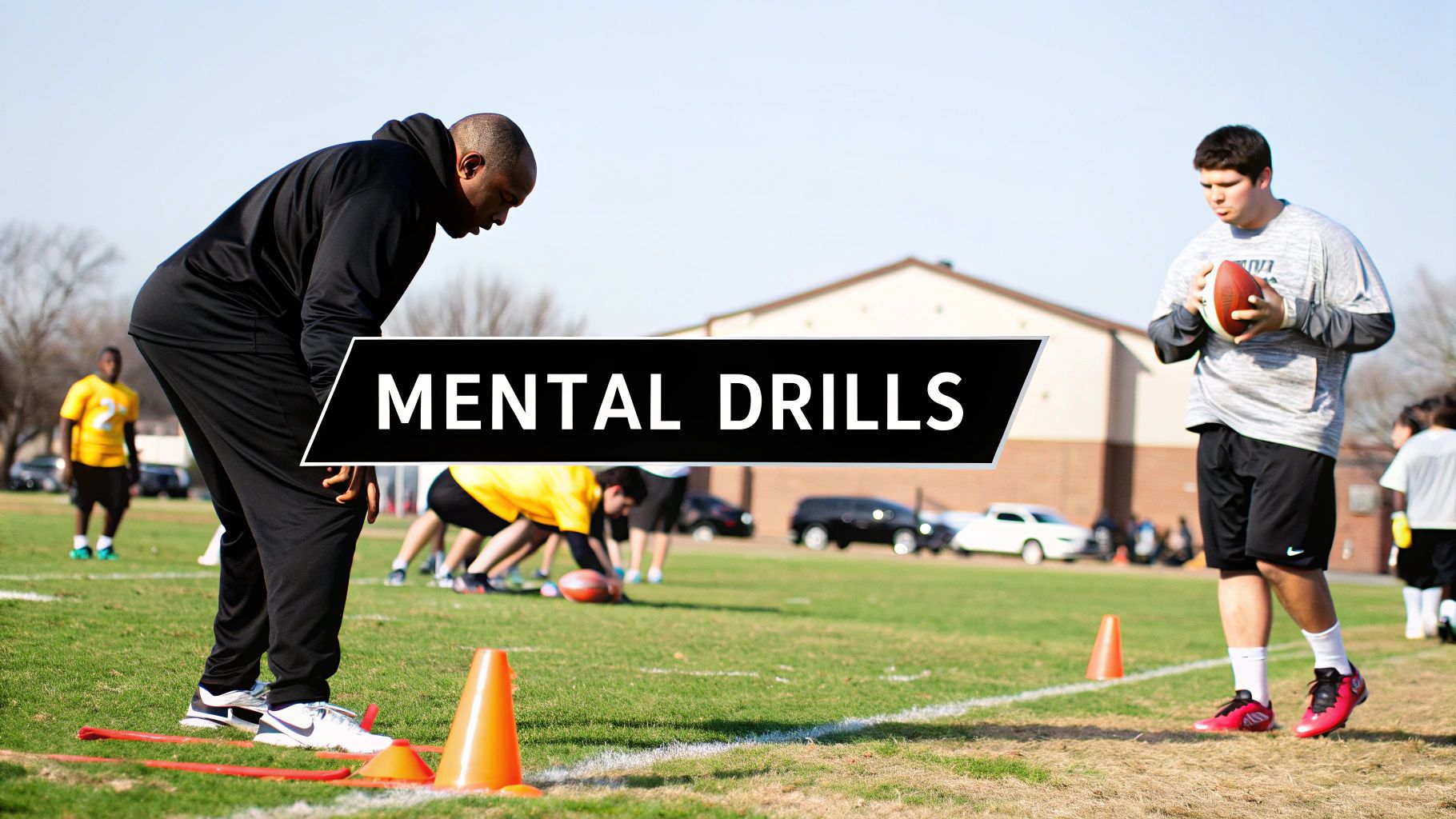
Mental toughness isn't built in a classroom or a one-off workshop. It’s forged on the field, through sweat and deliberate repetition, just like a perfect free throw or a powerful swing. If you want to build a mentally resilient team, you have to stop treating the mental game as an afterthought and start weaving it into the very fabric of your daily practices.
Think of it like making small, consistent deposits into your team's mental bank account. Those deposits might not seem like much on any given Tuesday, but they compound over time and pay massive dividends when the pressure is on.
The industry is catching on. The sports training market, a massive $27.8 billion industry in 2023, is projected to hit $50.7 billion by 2035. Why the boom? Because coaches and organizations are finally realizing what the research has shown for years: evidence-based mental strategies work. In fact, things like mindfulness and performance anxiety counseling have been shown to cut performance slumps by up to 40%. You can read the full research about these sports training market trends to see the hard data behind this shift.
Creating Pressure in a Controlled Environment
One of the most effective things you can do is bring game-day pressure into your practices. I call this pressure simulation. The idea is simple: replicate the stress of a critical moment in a controlled environment. You’re essentially inoculating your players against anxiety, so when the real moment arrives, they've been there before.
This doesn't require a complete overhaul of your practice plan. Just add a consequence or a reward to a drill you already run. When you raise the stakes, you force athletes to execute with the same focus they’ll need in a championship game.
Here are a few practical examples:
- For Basketball: End practice with a single player at the free-throw line for two shots. Make both, and practice is over. Miss, and the entire team runs. You'll see a level of focus you've never seen before.
- For Soccer: In the last five minutes of a scrimmage, put one team a man down. This "power play" scenario forces them to tighten their communication, manage fatigue, and dig deep under immense tactical pressure.
- For Baseball: Put a runner on third with one out. The batter's job isn't to get a monster hit; it's simply to get the run home. This drill trains them to shift their focus from a perfect outcome to simply executing their specific job.
The point of pressure drills isn't to punish anyone. It's to teach focus. Frame these moments as a chance to practice their mental skills. When they face that same situation in a game, it will feel familiar, not terrifying.
Sharpening Focus with Reset Routines
Mistakes are going to happen. It's sports. But a single mistake should never be allowed to spiral into a complete meltdown. The best athletes have an almost instant ability to reset their focus, and you can coach this skill directly.
The tool for this is a "keyword reset" routine. It’s a simple, personal sequence of actions that tells the brain, "That play is over. Move on." It needs to be quick, automatic, and practiced relentlessly until it’s second nature.
A great reset routine has three parts:
- A Physical Action: A quick, tangible movement like clapping their hands, adjusting their helmet, or wiping their shoe.
- A Keyword or Phrase: A short, powerful phrase they say to themselves. "Next play." "So what?" "Reset."
- A Conscious Breath: One single, deep breath to slow the heart rate and calm the nervous system.
Actionable Tip: Dedicate the first five minutes of practice to having athletes design and practice their personal reset routines. Call out "Mistake!" and have everyone perform their sequence. It makes the training active and turns an abstract idea into muscle memory. To dive deeper into this, you can explore more strategies in our guide on developing mental toughness for athletes.
Structuring Drills for Confidence and Process
You can't talk an athlete into being confident. Confidence is earned, and it's built on a foundation of repeated, successful experiences. As a coach, you have the power to strategically design drills that manufacture that success.
When introducing a new skill, start with a simplified version where success is almost guaranteed. This creates a positive feedback loop from the very first rep. If you're teaching a volleyball team a new defensive set, don't start with a player blasting spikes at them. Start with a coach gently tossing the ball. Let them feel success first.
You can also design drills to pull their focus away from the outcome and onto the process.
- Volleyball Example: Run a "perfect pass" drill where the only thing you evaluate is the passer's technique. Did they move their feet? Was their platform stable? The outcome of the set or hit is irrelevant.
- Golf Example: A player on the driving range isn't trying to hit the ball 300 yards. Their goal is to execute their complete pre-shot routine for 10 consecutive balls.
This teaches athletes to anchor themselves in what they can control: their effort and their execution. That, right there, is the bedrock of real, unshakable confidence. By folding these small mental exercises into every practice, you're not just running drills—you're building competitors.
Coaching Through Pressure Cooker Moments and Performance Slumps
How you handle the crucible moments—the championship game, a season-derailing slump, a star player's injury—is what truly defines your legacy as a coach. This is where the rubber meets the road, where physical talent collides with mental grit. Your ability to apply real sports psychology here can be the difference-maker.
Let's be clear: pressure and slumps are part of the game. They're going to happen. The goal isn't to create a team that never feels stress, but to build a team that knows exactly what to do when adversity hits. It's about changing their relationship with pressure, not pretending it doesn't exist.
The Playbook for High-Stakes Situations
Pressure itself isn't the problem; an out-of-control reaction to it is. The most practical way to arm your athletes for these moments is to give them simple, repeatable routines that ground them in the present. When the mind starts spinning out of control, these anchors bring them back to what they can actually influence.
One of the most battle-tested tools is the Pre-Performance Routine (PPR). This is a quick, automatic sequence an athlete runs through right before they act—think a free throw, a penalty kick, or stepping up to the plate.
A simple, effective PPR could be:
- Physical Cue: The player bounces the ball three times.
- Mental Cue: They repeat a single keyword in their head, like "target" or "fluid."
- Action: A final, centering breath, and then they go.
This little sequence short-circuits the panic response. It shifts their focus from the enormous, scary outcome ("We lose if I miss!") to a small, manageable process.
Mastering the Breath Between Plays
Here's another tool you can teach in five minutes that pays dividends forever: tactical breathing. When an athlete comes to the bench or has a break in play, their heart rate is often through the roof. That leads to shallow breathing, which clouds judgment. Box breathing can flip that switch in just a few seconds.
Teach them this simple pattern:
- Inhale slowly through the nose for a 4-count.
- Hold the breath for a 4-count.
- Exhale slowly through the mouth for a 4-count.
- Hold at the bottom for a 4-count.
Actionable Tip: Don't just explain this; practice it. During a timeout in a high-intensity scrimmage, have the entire team run two cycles of box breathing together before you give any tactical instruction. They'll be more receptive and focused.
Coaching an Athlete Through a Slump
A slump feels like quicksand. The more an athlete struggles, the deeper they sink. Your job as a coach is to be the lifeline that pulls them out by changing their entire focus from results back to the process. An athlete in a slump has lost their confidence because their entire sense of self-worth has become tangled up in outcomes they can't seem to produce.
The key is to redefine "winning" for them, right now, in practice. Stop talking about making shots; start celebrating perfect form. Forget about strikeouts; praise a perfectly executed pre-pitch routine. You're building their confidence back one brick at a time with small, controllable wins.
A slump is often just a crisis of confidence disguised as a technical problem. By focusing on process and effort—things the athlete fully controls—you give them a pathway back to feeling successful, which is the first step out of the slump.
Both slumps and high-pressure moments demand specific coaching strategies. While they might seem similar, your approach needs to be tailored to the unique mental state of the athlete. One requires rebuilding from the ground up; the other involves sharpening a tool that's already there.
Slump-Busting vs Pressure-Proofing Strategies
| Challenge | Primary Goal | Key Coaching Actions | Communication Focus |
|---|---|---|---|
| Performance Slump | Rebuild confidence and restore a positive process focus. | Simplify tasks, focus on small technical wins, review past successes, and reduce outcome-based feedback. | "Let's focus on your footwork today. That's the only win we need." |
| High-Pressure Moment | Maintain composure and execute a well-practiced skill under stress. | Rehearse pre-performance routines, practice tactical breathing, and use visualization for high-stakes scenarios. | "Trust your routine. You've done this a thousand times. Just breathe and execute." |
Understanding this distinction ensures you're giving the right mental medicine for the specific ailment, helping your athletes get back on track faster and perform when it counts the most.
The Psychology of Injury Recovery
For an athlete, a serious injury can be psychologically devastating. They're cut off from their teammates, their identity feels threatened, and they've lost all control over their athletic life. How you communicate and act during this period is absolutely critical.
Don't let them drift away. Keep injured players woven into the fabric of the team.
- Practical Tip: Give them a specific "coaching" role. Ask your injured point guard to chart turnovers during practice or have your injured pitcher track pitch counts. This keeps them mentally engaged and reinforces their value to the team beyond their physical ability.
Also, introduce them to visualization as a powerful rehab tool. Have them spend 10 minutes a day vividly imagining themselves performing their skills flawlessly. This isn't just daydreaming; it keeps the neural pathways firing and can genuinely speed up their physical return to action.
Technology is amplifying these methods. The sport psychology tech market is booming, growing at an incredible 22.5% CAGR between 2024 and 2032. In North America especially, tools like VR simulations are helping athletes rehearse high-pressure scenarios. In baseball, for instance, some teams have seen up to a 25% improvement in player decision-making after adopting mental training tech. If you're a coach, staying on top of these trends is no longer optional.
Building a Culture of Mental Resilience and Accountability
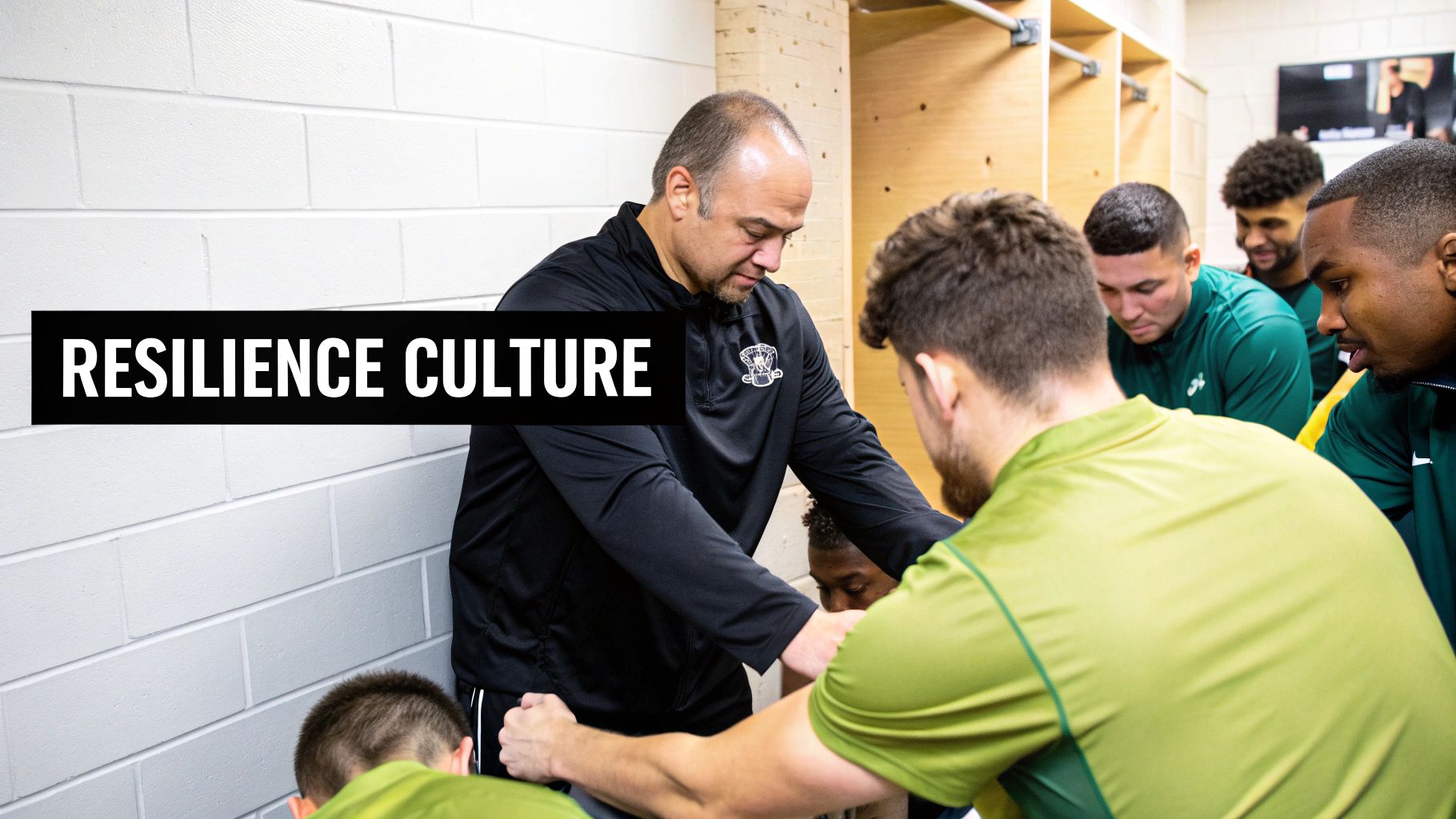
All the mental drills and pressure-proofing in the world won't stick if they're just one-off events. The real game-changer is weaving these principles into the very fabric of your team. This is how you create a culture where resilience and accountability aren't just taught; they're expected. It's simply "how we do things here."
When you make this shift, mental training stops being a temporary patch and becomes a lasting competitive edge. It creates a system where everyone—from coaches to captains to the last player on the bench—shares ownership of the team's mental performance.
Tracking Progress Beyond the Scoreboard
You have to measure mental skills to make them a priority. After all, what gets measured gets managed. This applies just as much to mindset as it does to free-throw percentages. While you can’t exactly assign a number to "grit," you absolutely can track the behaviors that define it.
The key is to blend your qualitative eye-test with some hard data. Start by noticing the small things that reveal an athlete’s inner game.
- Body Language Audits: What's a player's first move after a mistake? Do their shoulders slump, or do they immediately get their head up and communicate with a teammate? Make a mental note of these reactions. Better yet, jot it down.
- Clutch Performance Stats: Start tracking stats specifically in high-stakes moments. Think of a basketball team's field goal percentage in the final two minutes of a tight game, or a hitter's average with runners in scoring position.
- Post-Practice "Mental Reps" Check-in: Keep it simple. End every practice with a quick one-minute self-rating. Ask your athletes to score their focus, resilience, and communication that day on a 1-5 scale. This daily habit forces them to stay conscious of their mental game.
When you track these indicators, your feedback becomes concrete and powerful. You can move from a generic "be tougher" to "I saw you didn't let that turnover affect you—your body language was strong, and you sprinted back on defense. That's the resilience we're building."
Modeling the Behavior You Want to See
Make no mistake, your athletes are watching your every move. A culture of mental toughness starts and ends with the coaching staff. If you blow up on the sideline, you're giving them a green light to do the same. If you're still complaining about a bad call five minutes later, you're teaching them to make excuses.
You are the primary architect of your team's mental environment. Your actions, words, and reactions set the tone for how your athletes will respond to adversity. Lead with the composure and resilience you want them to emulate.
Actionable Tip: The next time a referee makes a questionable call against your team, make a conscious effort to immediately turn to your players and say, "Control what we can control. Next play." Your composure in that moment is a more powerful lesson than any lecture.
Empowering Athletes to Lead the Culture
For any culture to truly take hold, the players have to drive it. Your team captains and leaders must become extensions of your mental coaching. Give them the language and the responsibility to hold everyone to the team's mental standards.
- Captain-Led Focus Huddles: Before a tough drill, let your captain lead a quick huddle to set a mental goal, like "One play at a time, clear communication on every rep."
- Peer Accountability: Create an environment where players hold each other to that "next play" mindset. When a player is getting down on themselves, a teammate should be the first one there to reinforce the reset routine.
- Celebrate Mental Wins: When you're reviewing film, highlight moments of exceptional mental toughness with the same energy you'd bring to a game-winning shot. Point out the player who calmed a teammate down or the one who executed their reset routine perfectly after a tough mistake.
This creates a self-policing, self-sustaining system. For more on this, my guide on how to build team culture offers deeper strategies. By prioritizing both mind and body, you lay the foundation for success that lasts.
Frequently Asked Questions From Coaches
Even with the best playbook, bringing mental skills training to your team is going to raise some questions. I get it. Here are the most common things coaches ask me, with clear, practical answers to help you start making an impact right away.
How Do I Get Buy-In From Skeptical Athletes
The quickest way to win over a skeptic is to show them how mental training translates to winning. That’s the language they understand.
Forget the clinical jargon. Instead of "cognitive restructuring," call it "how to reset after a mistake so you can dominate the next play." Frame everything in terms of competitive advantage.
Actionable Tip: Start with your most respected team leader. Work with them one-on-one on a single mental skill, like a pre-shot routine. When other players see them using it and having success, they'll want to know what they're doing. Peer influence is far more powerful than a coach's directive.
What Can I Do for Free if I Have No Budget
Some of the most powerful mental performance tools cost nothing more than your time and consistency. In fact, building daily habits is far more valuable than a one-off, expensive workshop.
You can weave these free strategies into your practices starting tomorrow:
- Mindful Moments: Kick off every warm-up with just 60 seconds of focused breathing. It’s a simple way to get every player centered and present.
- Verbal Cues: Create a team-wide reset phrase like "Next Play!" or "So What?" to use after a mistake. It’s a powerful, instant tool to shift focus forward.
- Mental Film Review: Spend five minutes in film study focused only on decision-making, reading the game, and mental errors, not just physical mechanics.
- Goal Journals: A simple notebook is all they need. Encourage athletes to jot down their process goals for the week—things they can control, like effort in drills or communication.
Your biggest investment here isn't money. It's making mental skills a non-negotiable part of how your team prepares.
Remember, your role is to teach mental skills for performance enhancement. You're a coach, not a clinician. Knowing the difference is crucial for both your effectiveness and your athletes' well-being.
When Does an Athlete Need a Professional
As a coach, your world is performance. You’re there to help athletes build focus, sharpen confidence, and become more resilient on the field. But you have to know where your job ends and a licensed professional's begins. Your responsibility is to see the red flags and refer them to someone who can truly help.
Look for signs that go beyond a typical slump:
- Persistent Mood Changes: Are they suddenly withdrawing from teammates, unusually irritable, or losing interest in everything, not just the sport?
- Disordered Eating: Any concerning patterns or comments about food, weight, or body image need to be taken seriously.
- Expressions of Hopelessness: Any talk about feeling worthless or that things will never get better is an immediate red flag.
- Pervasive Anxiety: Watch for anxiety or depression that bleeds into their daily life, affecting school, sleep, and relationships far beyond the game.
Your job isn't to diagnose. It's to observe, care, and connect your athletes to the right resources. The best thing you can do is build a culture where asking for help is seen as a sign of strength, not weakness.
Building a mentally tough team is a marathon, not a sprint. By making these strategies part of your culture, you give your athletes tools for success that will last long after their playing days are over. If you're ready to build that ultimate competitive edge, Dr. John F. Murray offers expert sports psychology consulting and workshops to get you there. Learn more and book a consultation at johnfmurray.com.