

True team cohesion isn't built on physical drills alone; it's forged in the shared psychological space where communication, trust, and resilience are honed. While most teams focus exclusively on physical practice, elite programs understand that winning championships requires mastering the mental game. This article moves beyond generic trust falls and icebreakers to provide a curated list of ten powerful, evidence-informed team building activities for sports teams.
Each activity is designed not just to foster camaraderie, but to systematically build the critical mental skills that separate good teams from great ones. You will find actionable strategies, grounded in sports psychology and used by professionals, that you can implement immediately to give your team a decisive competitive edge. We break down each exercise with clear objectives, step-by-step instructions, and guidance on timing and group size.
This guide is structured to be a practical playbook for coaches, captains, and athletes. You'll learn not just 'what' to do, but 'how' to facilitate each activity and, most importantly, 'why' it works to build a mentally tougher, more cohesive unit. We provide specific debriefing questions to help your team connect the experience back to in-game scenarios, ensuring these lessons translate directly to improved performance. From visualization sessions that sharpen focus to workshops that develop authentic leadership, these exercises will equip your team with the mental fortitude needed to thrive under pressure and achieve its highest potential.
1. Visualization and Mental Imagery Sessions
Visualization is a powerful psychological technique where athletes mentally rehearse performance scenarios with vivid, sensory-rich detail. Rather than just daydreaming, this structured practice involves creating detailed mental blueprints of successful execution, from a flawless free throw to a game-winning play. It's a core component of many elite training programs because it prepares the brain for competition just as physical practice prepares the body, strengthening neural pathways and building automaticity.
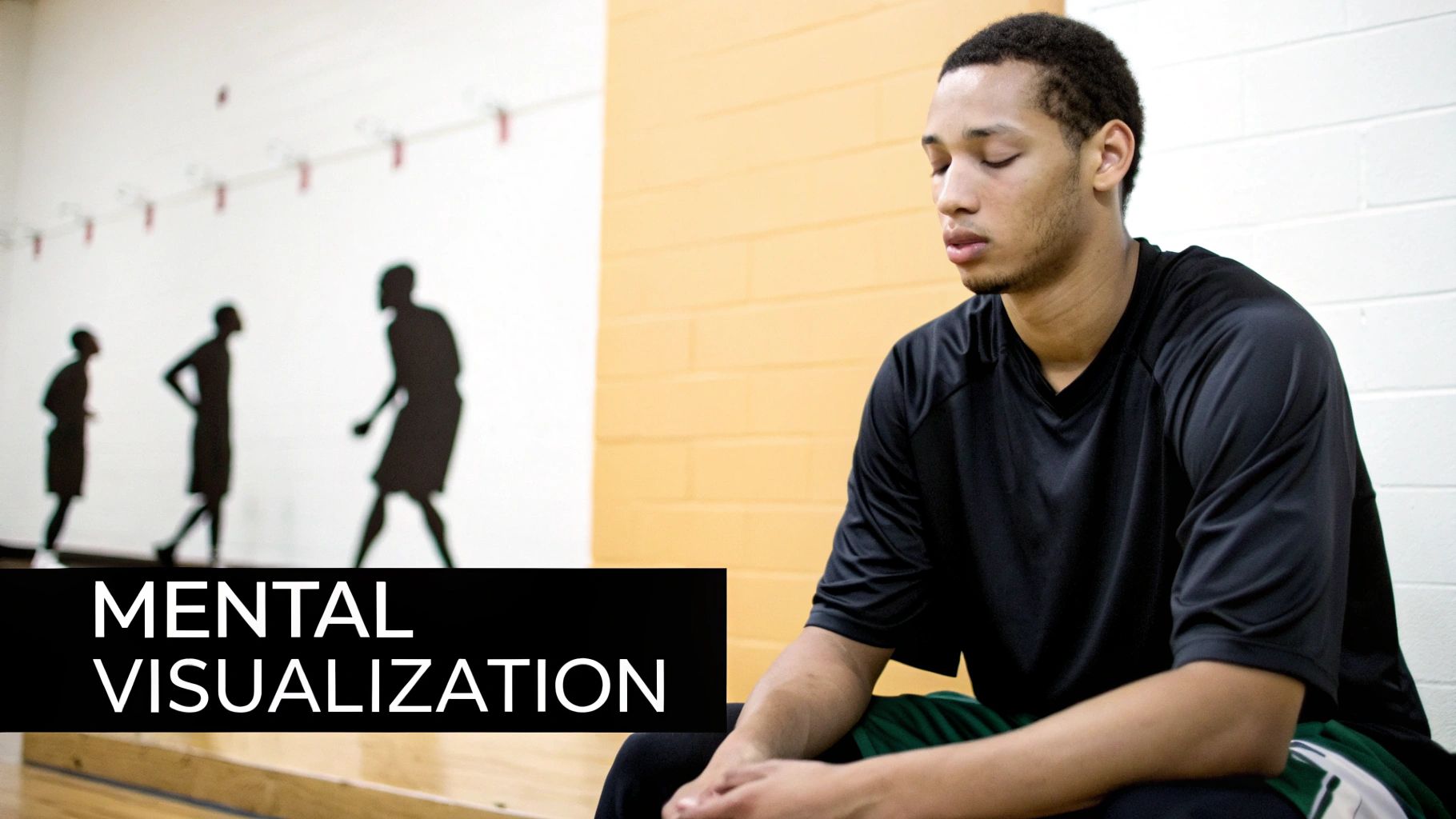
When an entire team visualizes together, it aligns their collective focus and reinforces shared goals. This mental synchronization fosters a deep sense of preparedness and mutual trust, making it one of the most effective team building activities for sports teams looking to gain a psychological edge.
How to Implement Visualization Sessions
To get started, guide your team through a focused session in a quiet, distraction-free environment. Have athletes sit or lie comfortably and close their eyes. Begin with a few deep, calming breaths to quiet the mind.
Next, lead them through a scripted scenario specific to your sport. Use evocative language to engage all senses: what do they see (the ball, teammates, opponents), hear (the crowd, their own breathing), and feel (the grip on the ball, the explosive power in their legs)? Walk them through a successful sequence from start to finish, emphasizing positive emotions and perfect execution. A practical example for a soccer team would be visualizing the final two minutes of a tied game, starting from a defensive stop, transitioning to a counter-attack, and ending with the game-winning goal.
Practical Tips for Success
- Be Specific and Sensory: Instead of "imagine making the shot," say, "Feel the texture of the ball in your hands, see the net ripple as the ball swishes through, and hear the celebratory roar from your teammates."
- Practice Consistency: Short, daily sessions (5-10 minutes) are more effective than infrequent, long ones. Integrate them into pre-practice warm-ups or post-practice cool-downs.
- Visualize Adversity: Don’t just rehearse success. Guide athletes through visualizing a mistake—like a missed pass—and then successfully recovering from it by immediately refocusing and winning the ball back. This builds resilience and emotional control.
- Record Scripts: Create audio recordings of guided visualizations so athletes can practice independently, reinforcing the team’s mental game plan on their own time.
For a deeper dive into the science and application, you can explore the extensive work on visualization in sports from experts like Dr. John F. Murray. By making mental imagery a regular part of your training, you build not just individual confidence but a shared belief in the team’s ability to perform under pressure.
2. Focus and Attention Training Drills
Focus and attention training drills are structured exercises designed to strengthen an athlete's ability to maintain concentration, filter out distractions, and direct mental resources toward task-relevant cues. Rather than simply telling players to "pay attention," these cognitive drills train the brain to sustain focus under pressure, much like weightlifting strengthens a muscle. This systematic practice builds the mental discipline required for elite performance, helping athletes process information quickly and accurately amidst the chaos of competition.
When a team engages in these drills together, they develop a shared understanding of what "being focused" looks like in action. This collective training improves on-field communication and anticipation, as teammates learn to operate on the same mental wavelength. By making attention a trainable skill, these exercises become powerful team building activities for sports teams aiming to improve their collective execution and resilience.
How to Implement Focus and Attention Drills
Begin by creating drills that simulate the specific attentional demands of your sport. For example, a basketball team can practice free throws while teammates and coaches create controlled auditory distractions, training players to block out crowd noise. A soccer team might use a drill where players must track multiple balls simultaneously, improving their divided attention and field awareness.
Start with a low level of distraction and gradually increase the intensity as the team's focus improves. The goal is not to create an impossible task but to progressively challenge and expand the team’s collective attentional capacity. Debrief after each drill to discuss what worked and what mental strategies players used to stay locked in. For example, ask, "What did you say to yourself to block out the noise and refocus?"
Practical Tips for Success
- Identify Key Focus Cues: For a baseball batter, define the key cues as "see the spin" and "hips first." For a tennis player, it might be "split step" and "watch the ball hit the strings." This simplifies focus under pressure.
- Use Cue Words for Resetting: Teach athletes a simple, personal cue word (like "focus," "clear," or "next play") to mentally reset their attention after a mistake or distraction.
- Practice Under Fatigue: Incorporate focus drills at the end of practice when players are physically tired. This simulates late-game conditions and trains them to maintain mental sharpness when it matters most.
- Track Focus Metrics: Use simple metrics, like the number of successful free throws made under distracting conditions, to provide objective feedback and show progress over time.
By integrating these drills, you help athletes develop robust attentional control. This practice is heavily supported by applied sports psychology literature and is a staple in many NCAA and professional sports programs.
3. Stress and Anxiety Management Workshops
Stress and anxiety are natural components of high-stakes competition, but unmanaged, they can derail individual and team performance. Stress and Anxiety Management Workshops are structured training sessions designed to equip athletes with evidence-based psychological tools to control their physiological and cognitive responses to pressure. These workshops go beyond simple relaxation, teaching cognitive-behavioral strategies and breathing techniques to reframe stress as manageable energy rather than a debilitating threat.
When a team learns these skills together, they develop a shared language and a collective toolkit for navigating high-pressure situations. This mutual understanding and support system transforms individual coping mechanisms into a powerful team resilience, making these workshops one of the most impactful team building activities for sports teams focused on developing mental toughness.
How to Implement Stress and Anxiety Management Workshops
The most effective workshops are facilitated by a qualified sport psychologist or mental performance consultant. The facilitator will typically introduce core concepts like the body’s "fight or flight" response and then guide the team through practical, interactive exercises.
A session might begin with psychoeducation on how stress impacts motor skills and decision-making. It could then transition into hands-on practice of techniques like diaphragmatic breathing (belly breathing) to lower heart rate or cognitive reframing to turn anxious thoughts like "I can't miss this shot" into productive ones like "I've practiced this shot a thousand times; trust my training." The goal is to build a proactive, rather than reactive, approach to competitive pressure.
Practical Tips for Success
- Start Early: Introduce these workshops early in the season to give athletes ample time to practice and integrate the skills into their routines before championship games.
- Make it Sport-Specific: Frame exercises in the context of their sport. For example, a basketball team can practice a calming breath routine specifically for the free-throw line. A golfer can develop a routine for resetting after a bad hole.
- Provide Take-Home Resources: Offer handouts, audio recordings, or video demonstrations of the techniques so athletes can practice them independently and consistently.
- Establish Accountability: Create a buddy system where teammates check in with each other to reinforce the use of stress-management skills during practices and games.
- Conduct Booster Sessions: Schedule shorter follow-up sessions before key competitions to refresh skills and address any new sources of pressure the team is facing.
By investing in mental skills training, you empower your team to not just withstand pressure but to thrive in it. For a deeper understanding of the clinical expertise behind these methods, explore the work of sport psychologists like Dr. John F. Murray, whose work integrates clinical psychology with elite performance.
4. Team Communication and Leadership Development Sessions
Effective on-field performance is often a direct reflection of off-field dynamics. Team communication and leadership development sessions are structured interventions designed to improve how athletes interact, resolve conflict, and lead one another. Instead of leaving these critical skills to chance, these sessions provide a dedicated forum to build psychological safety, establish clear communication protocols, and develop leadership capacity beyond just the team captains.
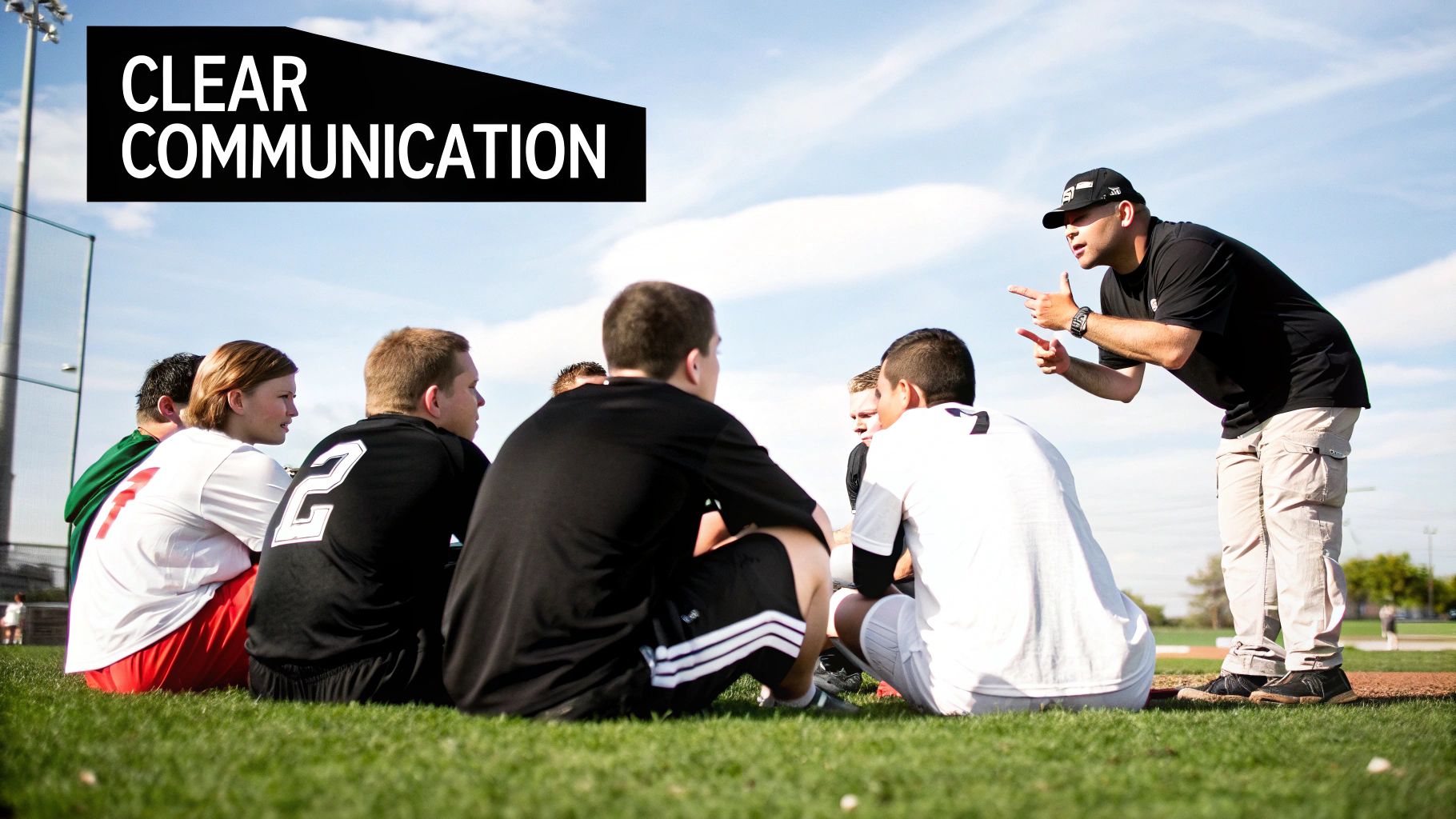
When a team learns to communicate with clarity and trust, they become more resilient and cohesive. This proactive approach to building team culture is one of the most impactful team building activities for sports teams, as it directly addresses the interpersonal issues that can undermine talent and strategy. It transforms a group of skilled individuals into a unified, high-functioning unit.
How to Implement Communication and Leadership Sessions
Start by creating a safe and confidential environment. These sessions are most effective when athletes feel they can speak openly without fear of judgment. Begin with an icebreaker or a small-group activity to ease into deeper topics. A facilitator can then guide the team through exercises focused on active listening, giving and receiving constructive feedback, or navigating conflict scenarios.
For leadership development, you might present a hypothetical team challenge, such as "Our star player is in a slump and showing frustration; how do we support them?" and have small groups brainstorm solutions, with each member taking a turn to lead the discussion. The goal is to create practical, experience-based learning that athletes can immediately apply in practices and games.
Practical Tips for Success
- Establish Ground Rules: Begin every session by co-creating rules for respectful dialogue, confidentiality, and active listening. A key rule could be: "Listen to understand, not just to reply." This builds the foundation for psychological safety.
- Model Vulnerability: Coaches and team leaders should be the first to share their own communication challenges or areas for growth. This encourages others to do the same.
- Use Structured Exercises: Start with structured activities like role-playing common conflicts (e.g., a disagreement over playing time) before moving to open, large-group discussions. This provides a framework for productive conversation.
- Connect to Performance: Explicitly link the quality of team communication to on-field results. Discuss how a breakdown in communication led to a specific error or how strong leadership turned a game around.
For teams looking to integrate these advanced psychological principles, the work of sports psychologists like Dr. John F. Murray offers valuable frameworks for building elite team cultures. By investing in communication and leadership, you are investing in the very fabric of your team’s competitive identity.
5. Confidence and Self-Efficacy Building Programs
Confidence and self-efficacy programs are structured psychological interventions designed to strengthen an athlete's belief in their ability to succeed. Rooted in Albert Bandura's self-efficacy theory, these programs go beyond simple pep talks, focusing on building sustainable confidence through skill mastery, positive reinforcement, and emotional regulation. This approach develops a robust self-belief that withstands pressure, slumps, and adversity.
When a team collectively works on building confidence, it creates a powerful culture of mutual belief and resilience. Teammates learn to trust not only their own abilities but also the capabilities of those around them. This shared conviction is a hallmark of championship-caliber teams and makes these programs one of the most impactful team building activities for sports teams seeking mental fortitude.
How to Implement Confidence and Self-Efficacy Programs
Begin by identifying specific confidence gaps within the team. This could be a collective fear of late-game situations or individual players struggling after a mistake. Create a safe environment where athletes feel comfortable discussing their doubts without judgment.
Next, design activities that create "mastery experiences." These are structured, progressively challenging drills where athletes can achieve tangible success. For instance, a basketball player struggling with free throws might start with shots very close to the basket, gradually moving back as they consistently succeed. This process provides concrete evidence of their capability, which is the strongest foundation for confidence. Another example is a "highlight reel" session where the team watches clips of their past successes to reinforce their capabilities.
Practical Tips for Success
- Create Deliberate Mastery: Design drills that are challenging but achievable. The goal is to build a ladder of small successes that lead to a larger belief in one's ability.
- Use Positive Persuasion: Coaches and teammates should provide specific, credible encouragement. Instead of "You got this," say, "Your defensive positioning on that last play was perfect; I know you can replicate it."
- Develop Confidence Statements: Have athletes write and regularly review personalized affirmations tied directly to their skills and preparation. For example, "My dedicated practice has prepared me to execute under pressure."
- Celebrate Incremental Progress: Acknowledge and celebrate small wins and improvements, not just major victories. For instance, publicly praise a player for improved footwork in practice, reinforcing the value of the process and building momentum.
For a comprehensive guide on building mental toughness, you can explore detailed strategies on how to improve confidence in sports. By systematically building belief, you equip your team with a psychological asset that is just as critical as physical skill.
6. Resilience and Adversity Management Training
Resilience and Adversity Management Training is a structured program designed to equip athletes with the psychological tools to handle setbacks, maintain motivation, and bounce back from failure. This training moves beyond simply telling athletes to "be tough" and instead uses cognitive-behavioral strategies and mindset coaching to reframe challenges as opportunities for growth. It helps teams develop the psychological hardiness to navigate the inevitable highs and lows of a competitive season.
When a team learns to manage adversity collectively, it transforms their culture from one that fears failure to one that learns from it. This shared mental fortitude prevents a single bad play or tough loss from derailing their season, making it one of the most critical team building activities for sports teams aiming for long-term, sustainable success.
How to Implement Resilience Training
Begin by normalizing adversity as a predictable part of the competitive journey. Hold a team meeting to discuss past challenges and how the team responded. Introduce the concept of a "growth mindset," where skills are developed through effort and learning from mistakes, rather than being fixed.
Create structured activities that simulate pressure or setbacks in a controlled practice environment. For example, start a scrimmage with one team already trailing by a significant margin. Afterward, facilitate a debrief focused not on the outcome but on the team's communication, emotional control, and strategic adjustments under pressure. Ask specific questions like, "Who stepped up as a leader when we were down?" or "What was our body language like?"
Practical Tips for Success
- Create Resilience Rituals: Establish a team process for analyzing losses or mistakes. This could be a "24-hour rule" where the team is allowed to feel disappointed, followed by a structured, forward-looking debrief where the focus is only on solutions.
- Keep Resilience Journals: Encourage athletes to document challenges they've faced, the strategies they used to overcome them, and what they learned. This reinforces their own capacity for resilience.
- Frame Setbacks as Feedback: Teach athletes to view a loss not as a failure, but as valuable data on where they need to improve. Shift the language from "we lost" to "we learned."
- Celebrate Growth: Publicly acknowledge and celebrate instances of resilience, such as a player bouncing back from a mistake or the team overcoming a mid-game deficit, even if the final result isn't a win.
Building resilience is an ongoing process that strengthens a team's foundation. Inspired by the work of experts like Carol Dweck on growth mindset, this training ensures your team is prepared not just to win, but to endure.
7. Goal-Setting and Performance Planning Workshops
Goal-setting workshops are structured sessions where teams learn to establish clear, psychologically effective objectives. This goes beyond simply stating a desire to win; it involves creating detailed performance plans that connect long-term ambitions to daily actions. The process teaches athletes the science behind motivation, including the importance of specificity, challenge, and feedback, transforming vague hopes into a strategic roadmap for success.
When a team sets goals together, it creates a powerful shared purpose and enhances accountability. Each athlete understands how their individual effort contributes to the collective mission, making these workshops one of the most foundational team building activities for sports teams. This alignment builds a culture of continuous improvement and resilience, ensuring everyone is pulling in the same direction.
How to Implement Goal-Setting Workshops
Start by dedicating uninterrupted time for the workshop, away from the typical training environment. Begin with a discussion about the team’s ultimate vision for the season. From there, break it down into smaller, tangible components that athletes can influence directly.
Introduce the different types of goals: outcome (e.g., win the championship), performance (e.g., increase free throw percentage to 85%), and process goals (e.g., follow a consistent pre-shot routine every time). Guide athletes to set goals in each category, ensuring team objectives are supported by individual plans. For effective tracking and personal reflection, providing athletes with tools like personalised notebooks can be highly beneficial.
Practical Tips for Success
- Differentiate Goal Types: Explicitly teach the difference between outcome, performance, and process goals. Emphasize that focusing on process goals gives athletes the most control. For example, a runner can't control winning the race (outcome), but they can control their pacing strategy (process).
- Make Them SMART: Ensure every goal is Specific, Measurable, Achievable, Relevant, and Time-bound. Instead of "get stronger," use "increase back squat by 10% in 12 weeks."
- Create Public and Private Goals: Have athletes set both team goals that are shared publicly (e.g., on a whiteboard in the locker room) and individual goals they review privately or with a coach. This fosters both group accountability and personal ownership.
- Schedule Regular Reviews: Goals are not a "set it and forget it" exercise. Schedule monthly or quarterly check-ins to review progress, celebrate milestones, and adjust plans as needed.
By integrating structured goal-setting, you equip your team with a clear "why" behind their hard work, turning daily practices into purposeful steps toward a shared victory.
8. Pre-Performance Routines and Ritual Development
Pre-performance routines are structured sequences of thoughts and actions that athletes deliberately follow before a competition or specific in-game task. These rituals are not superstitions but are instead carefully designed psychological tools to manage arousal, focus attention, and trigger a state of readiness. By creating a consistent mental and physical runway to performance, athletes reduce variability and increase their chances of entering an optimal competitive state.
When developed as a team, these routines create a shared sense of purpose and a predictable environment, which is crucial for high-pressure situations. This shared process of preparation builds cohesion and ensures every member is mentally and physically aligned before the first whistle. This makes it one of the most powerful team building activities for sports teams focused on achieving competitive consistency.
How to Implement Routine Development
Begin by educating the team on the difference between a routine (controllable) and a superstition (uncontrollable). Facilitate a workshop where athletes identify what helps them feel focused, calm, and confident. Guide them to build individual routines that incorporate physical, mental, and emotional components, such as a specific warm-up, a key visualization, or listening to a specific song.
Next, create a standardized team routine for key moments like pre-game warm-ups or halftime. This might involve a specific sequence of drills followed by a team huddle with a set mantra, like "One play at a time." The goal is to create a collective trigger for focus and unity that everyone can rely on.
Practical Tips for Success
- Be Multi-Dimensional: A strong routine includes all three elements: physical (dynamic stretches), mental (a specific focus cue or short visualization), and emotional (listening to motivating music or a brief centering breath).
- Practice with Purpose: Routines must be practiced just like any other skill. Integrate them into every training session so they become automatic under the stress of competition.
- Keep it Realistic: Routines should be adaptable and sustainable. A quarterback's pre-snap routine must be quick (3-5 seconds), whereas a golfer's pre-shot routine can be longer. Create a "Plan B" version for when time is short or the environment is disruptive.
- Document and Refine: Encourage athletes to write down their routines and reflect on their effectiveness after performances. This data helps them refine what works best for their individual needs.
By making routine development a collaborative effort, you empower athletes with a sense of control and build a team that is predictable and prepared. This structured approach to readiness transforms pre-game anxiety into focused energy, giving your team a critical advantage before the competition even begins.
9. Team Cohesion and Culture Building Retreats
Team retreats are intensive, multi-day experiences designed to remove a team from its usual environment to focus on strengthening bonds, clarifying shared values, and intentionally building a championship culture. More than just a vacation, these retreats combine structured psychological exercises with informal relationship-building activities. They provide a unique opportunity to establish a strong team identity and foster the psychological safety necessary for athletes to trust, challenge, and support one another at the highest level.
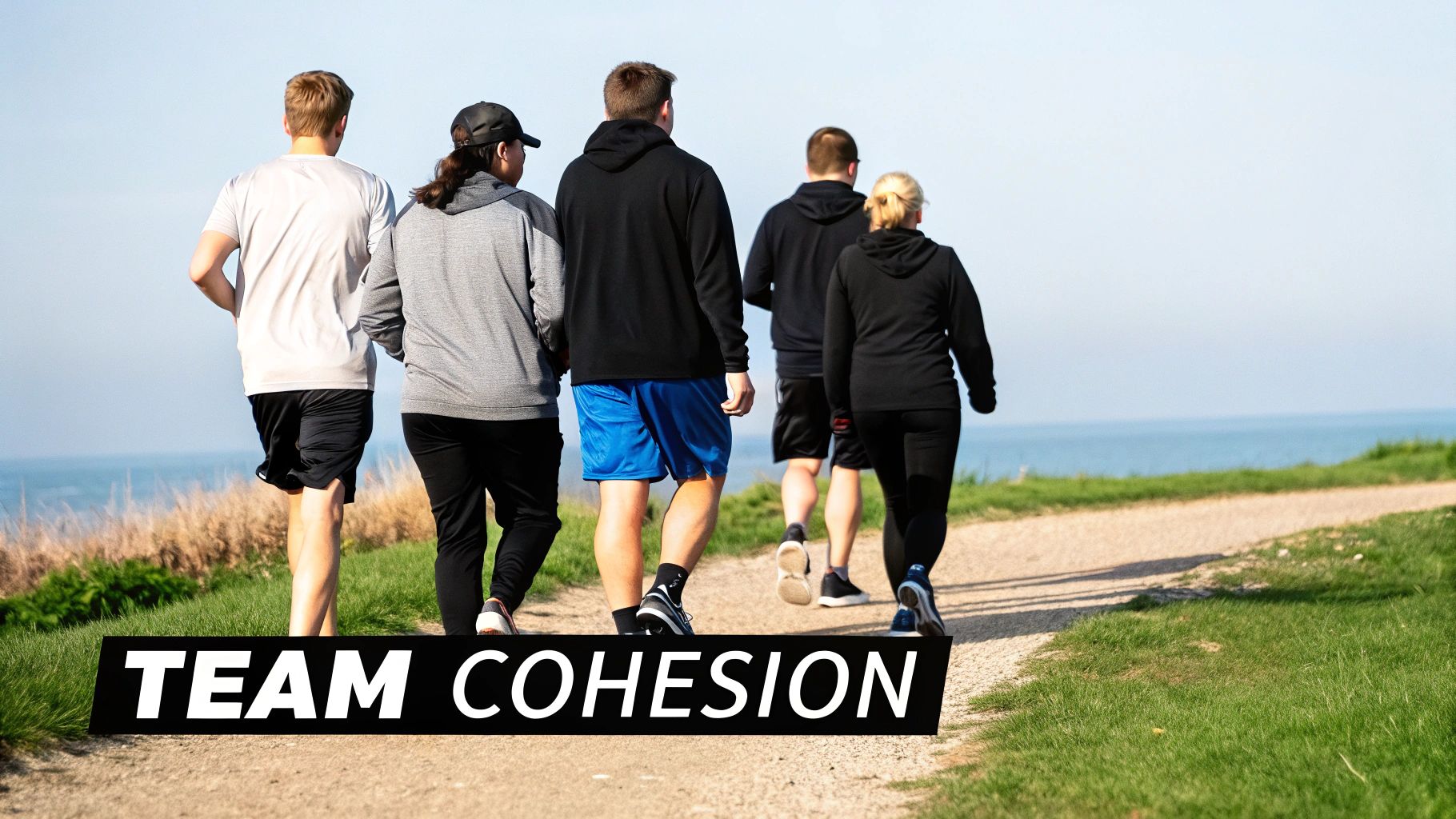
When a team commits to this focused time together, it accelerates the development of cohesion that might otherwise take an entire season to form. This makes retreats one of the most powerful team building activities for sports teams looking to rebuild culture after a poor season, integrate new players, or align a talented group toward a singular mission.
How to Implement a Team Retreat
Begin by defining the core objectives for the retreat. Is the goal to establish team values, improve communication, or build resilience? Once goals are set, plan an agenda that mixes structured workshops with unstructured social time. For example, a morning session on defining team standards could be followed by a shared outdoor activity like a ropes course and an evening team-cooked meal where athletes can connect on a personal level.
Coaches should participate as equals, modeling the vulnerability and openness they expect from players. Use team values and season goals as the framework for discussions and activities, ensuring every element of the retreat is purposeful and directly contributes to the team's on-field objectives.
Practical Tips for Success
- Schedule Early: Conduct the retreat before the season begins to set the cultural foundation and behavioral norms early on.
- Balance Structure and Fun: Mix serious workshops (e.g., goal setting, defining roles) with enjoyable activities like hiking, cooking together, or friendly competitions in other sports. To further strengthen team bonds and cohesion, exploring a variety of exceptional team building activities can provide fresh perspectives and proven strategies.
- Establish Follow-Up Systems: The retreat is the starting point, not the destination. Create systems like accountability partners or weekly culture check-ins to ensure the principles established are maintained throughout the season. For example, start each week by asking, "Who lived our value of 'relentless effort' this past week?"
- Unplug and Engage: Implement a "no phones" rule during structured activities and meals to encourage genuine, present-moment interaction among teammates.
By investing in a well-designed retreat, you build a resilient, unified culture that fuels performance long after the event ends. For more strategies on this topic, you can learn how to build team cohesion from sports psychology experts.
10. Sport-Specific Psychology Counseling and Individual Coaching
While group activities build collective cohesion, individual performance is often unlocked through personalized mental coaching. Sport-specific psychology counseling provides one-on-one support for athletes facing unique challenges like performance anxiety, recovery from injury, or motivational slumps. This tailored approach addresses the root causes of mental blocks in a confidential setting, allowing for deeper, more impactful work than group sessions can offer.
When key players on a team are mentally and emotionally at their peak, their confidence and resilience elevate the entire group. By investing in the individual mental health of its members, a team builds a stronger, more stable foundation. This makes individual coaching one of the most powerful, albeit indirect, team building activities for sports teams focused on long-term, sustainable success.
How to Implement Individual Coaching
Implementing a psychology program starts with connecting athletes to a qualified clinical or sports psychologist. The process is confidential, with the coach and athlete collaborating to identify specific, measurable goals, whether it's overcoming a performance plateau or managing competitive stress. These sessions are scheduled regularly, often weekly or bi-weekly, to build momentum and track progress over time.
For example, an NCAA athlete recovering from an ACL tear might work with a psychologist to rebuild confidence and manage the fear of re-injury. Similarly, a professional athlete in a slump could receive coaching to identify and dismantle negative thought patterns that are sabotaging their performance. The key is normalizing this support as a performance tool, not a sign of weakness.
Practical Tips for Success
- Set Clear Goals: Work with the psychologist to define specific performance outcomes, such as improving free-throw percentage under pressure or reducing pre-game anxiety.
- Ensure Confidentiality: Create a safe space where athletes feel comfortable discussing sensitive issues without fear of judgment or repercussions from coaching staff.
- Integrate When Appropriate: With the athlete's consent, the psychologist can share relevant insights with the coaching staff to align on-field strategies with mental game plans. For example, they might suggest specific cues a coach can use to help an athlete refocus.
- Track Progress Objectively: Use tools like performance anxiety scales or mental skills assessments to measure improvement and adjust the coaching strategy as needed.
- Be Patient: Significant psychological shifts and skill development require consistency, often taking 8-12 weeks or more to see tangible results.
Investing in personalized mental performance support is a testament to a team's commitment to its players' total well-being. For more on this approach, explore the work of pioneers like Dr. John F. Murray, whose decades of experience with elite athletes have proven the immense value of individualized sports psychology.
10-Point Comparison: Team Building Activities for Sports Teams
| Intervention | Implementation Complexity 🔄 | Resource & Speed ⚡ | Expected Outcomes 📊 | Ideal Use Cases 💡 | Key Advantages ⭐ |
|---|---|---|---|---|---|
| Visualization and Mental Imagery Sessions | Moderate 🔄 — guided practice, scripting needed | Low resources; slow-to-moderate onset ⚡ | Reduced anxiety; improved confidence; neural rehearsal 📊 | Pre-competition prep; skill rehearsal; anywhere practice 💡 | Evidence-based; low physical fatigue; portable ⭐ |
| Focus and Attention Training Drills | Moderate–High 🔄 — progressive, sport-specific drills | Moderate resources; measurable, moderate speed ⚡ | Better concentration; faster decisions; distraction control 📊 | Sports with high information load (QB, golf, tennis) 💡 | Direct transfer to performance; measurable gains ⭐ |
| Stress and Anxiety Management Workshops | Moderate 🔄 — group CBT techniques & breathing | Moderate resources; medium-term effects ⚡ | Lower performance anxiety; shared coping strategies 📊 | Teams facing collective pressure; pre-season boosters 💡 | Builds team coping language; improves wellbeing ⭐ |
| Team Communication & Leadership Development Sessions | High 🔄 — group dynamics, sustained reinforcement | High resources; slower cultural change ⚡ | Improved cohesion; conflict resolution; distributed leadership 📊 | Teams with communication breakdowns or leadership gaps 💡 | Strengthens trust and adaptive culture ⭐ |
| Confidence & Self‑Efficacy Building Programs | Moderate 🔄 — assessment + mastery experiences | Moderate resources; gradual, durable gains ⚡ | Increased authentic confidence; better risk-taking 📊 | Athletes returning from slumps/injury; development phases 💡 | Grounded in self‑efficacy theory; sustainable growth ⭐ |
| Resilience & Adversity Management Training | High 🔄 — mindset work + CBT elements | Moderate–High resources; long-term development ⚡ | Greater psychological flexibility; improved recovery 📊 | Injury rehab, long seasons, recovering teams 💡 | Enhances longevity; life-skill transfer ⭐ |
| Goal‑Setting & Performance Planning Workshops | Low–Moderate 🔄 — structured frameworks (SMART) | Low resources; rapid implementation & tracking ⚡ | Clear priorities; sustained motivation; measurable targets 📊 | Season planning; individual career development 💡 | Aligns team and metrics; improves focus ⭐ |
| Pre‑Performance Routines & Ritual Development | Moderate 🔄 — individualized routine design | Low–Moderate resources; relatively quick conditioning ⚡ | Consistent readiness; arousal regulation; lower variability 📊 | Pre-game prep; athletes needing repeatable states 💡 | Triggers optimal states; improves reliability ⭐ |
| Team Cohesion & Culture Building Retreats | High 🔄 — intensive, experiential work | High resources (time/cost); deep but medium-term impact ⚡ | Strong trust; shared identity; peer accountability 📊 | New teams, culture rebuilds, critical off-seasons 💡 | Deep bonding; lasting team narrative ⭐ |
| Sport‑Specific Psychology Counseling & Individual Coaching | High 🔄 — clinical assessment and tailored plans | High resources; gradual, deep change ⚡ | Resolves blocks; clinical support; personalized performance plans 📊 | Elite athletes, persistent problems, injury recovery 💡 | Confidential, customized, clinically validated ⭐ |
Integrating Mental Skills into Your Team's DNA
Building a championship-caliber team is an ongoing process, a deliberate fusion of physical prowess and psychological fortitude. The powerful team building activities for sports teams detailed throughout this article are not isolated events or quick fixes. Instead, they represent a toolkit for weaving mental skills directly into the fabric of your team’s daily culture, creating an environment where resilience, focus, and cohesion can flourish. The journey from a group of talented individuals to a truly unified, high-performing team is paved with consistent, intentional practice of these mental fundamentals.
The most common mistake coaches and leaders make is treating mental training as a separate, optional add-on. True integration means these activities become as routine as physical conditioning or tactical drills. Think of it as building psychological muscle memory. Just as an athlete repeats a motion to perfect it, a team must consistently practice communication, focus, and resilience to make them instinctual under pressure.
From Activities to Habits: A Practical Roadmap
The key to lasting impact is shifting from isolated activities to ingrained habits. Merely completing a goal-setting workshop at the start of the season is not enough. The real value comes from making this an active, living process.
Here’s a practical approach to embedding these concepts:
- Start Small and Specific: Don't try to implement everything at once. Identify your team's most significant challenge right now. Is it communication breakdowns during critical moments? Or perhaps a struggle to bounce back after a tough loss? Select one or two activities from our list that directly address that pain point. For example, if communication is the issue, commit to running the "Team Communication and Leadership Development Sessions" bi-weekly.
- Schedule and Protect the Time: Mental skills training deserves a dedicated spot on the calendar. Treat it with the same importance as a film session or weightlifting. An actionable step is to schedule a 15-minute "Mental Monday" session each week dedicated to one of these skills. When you schedule it, you signal to your athletes that this work is non-negotiable and vital to their success.
- Link Debriefs Directly to Performance: The debrief is the most critical part of any team-building activity. Always connect the dots. After a "Focus and Attention Training Drill," ask questions like, "How did that feeling of intense focus translate to our scrimmage today?" or "When we lost focus in the drill, what parallels do you see in the second half of our last game?" This makes the abstract concepts of mental skills tangible and relevant.
The Cumulative Effect of Consistent Mental Training
Over time, this commitment yields profound results. A team that regularly practices "Resilience and Adversity Management Training" no longer panics when trailing on the scoreboard. Instead, they have a shared language and a set of trusted strategies to regroup and execute. Similarly, a team that has mastered "Pre-Performance Routines" steps onto the field or court with a quiet confidence, grounded and ready to perform, regardless of the external pressures.
Key Insight: The goal isn't just to do team-building activities; it's to become a team that embodies the principles behind them. The activities are the vehicle, but a resilient and cohesive culture is the destination.
By prioritizing these team building activities for sports teams, you are making a strategic investment in your program's long-term success. You are moving beyond the X's and O's to cultivate the intangible qualities that define champions: unwavering trust, elite communication, and the collective will to overcome any obstacle. You are not just coaching a sport; you are developing resilient, focused, and mentally tough competitors prepared for success both in their sport and in life.
Ready to elevate your team's mental game with an expert-led, customized approach? Partner with Dr. John F. Murray, a renowned clinical and sports psychologist who has helped elite athletes and top-tier teams unlock their full potential. Visit Dr. John F. Murray to learn how his evidence-based strategies can build a championship mindset within your organization.