
Building unshakable confidence in sports isn't about hoping for a good feeling on game day. It's about systematically building a solid mental foundation through consistent preparation, positive self-talk, and an honest look in the mirror.
Think of it this way: you wouldn't leave your physical conditioning to chance, so why leave your mental game up in the air? This guide provides actionable steps and practical examples to help you take control of your confidence and elevate your performance.
Building Your Foundation For Unshakable Sports Confidence
Many athletes fall into the trap of thinking confidence is something you're born with. You either have it or you don't. That's just not true. Confidence is a skill, and like any other skill, you can build it with the right framework and deliberate practice.
The connection between your mental game and your physical performance is undeniable. A meta-analysis of 47 studies confirmed this, finding a significant link that accounted for almost 6% of the shared variance between self-confidence and performance. Interestingly, the study showed this connection was nearly twice as strong for individual athletes compared to those on a team, which really drives home the need for personalized mental strategies.
Start With An Honest Self-Assessment
Before you can build anything, you need to know what you're working with. A self-assessment isn't about judging yourself or finding flaws; it’s about getting a clear, honest snapshot of your current mental strengths and pinpointing where you can get better. It's your starting line.
"The first step toward building genuine confidence is knowing exactly where you stand. An honest look at your mental habits—both good and bad—provides the clarity needed to create an effective plan for improvement."
An effective self-assessment goes beyond just "I feel good" or "I feel bad." It's about digging into the specifics with practical steps:
- Identify Your Triggers: What situations, thoughts, or actions make you feel unstoppable? Is it nailing a difficult drill in practice? A specific pre-game song? Getting a high-five from your coach? Actionable Tip: For one week, keep a small notebook or a note on your phone. Every time you feel a surge of confidence, write down exactly what just happened.
- Pinpoint Your Blockers: When does your confidence take a hit? Is it after a mistake, when you're facing a particular opponent, or when you feel rushed and unprepared? Be brutally honest. Actionable Tip: Do the same for confidence drops. A soccer player might note, "My confidence dipped after I mis-trapped an easy pass in the first 5 minutes." This creates awareness.
This process is critical. When we understand our personal patterns, we can start to control them. This foundation is especially vital for young athletes, where building self-assurance from the beginning can make all the difference. Programs that focus on this, like How JC Sports Builds Confident Young Players, offer great insights into how to foster this early on.
To get you started, here’s a quick checklist. Take a few minutes to fill this out. It will give you a baseline to work from as you move through the rest of this guide.
Your Confidence Self-Assessment Checklist
Use this quick-start table to identify your current confidence levels across key performance areas before diving into the training.
| Performance Area | Confidence Level (1-5) | Notes on Triggers or Blockers |
|---|---|---|
| Pre-Game Preparation | ||
| Performing Under Pressure | ||
| Technical Skill Execution | ||
| Bouncing Back From Mistakes | ||
| Physical Fitness & Endurance | ||
| Communicating With Teammates/Coaches | ||
| Facing a Tough Opponent |
Once you've filled this out, you'll have a much clearer picture of where your mental training needs to focus first. Keep it handy—we'll be referring back to these areas.
Taming Your Inner Critic: A Guide to Productive Self-Talk
Let's be honest: your thoughts can make or break your performance. That little voice in your head can be your biggest ally or your harshest critic. If you let the negative self-talk run wild, it'll eat your confidence alive before you even get in the game. The good news is, you can learn to control that conversation. It's one of the most crucial mental skills an athlete can develop.
It all starts with simply paying attention. You have to catch yourself in the act of thinking negatively before you can do anything about it. Think of it as developing a mental alarm that goes off anytime you hear that voice saying, "I'm going to mess this up," "I'm not good enough," or the classic, "Don't choke."
Once you've caught a thought, don't just accept it. Challenge it. Question its validity. Are you really a terrible free-throw shooter, or did you just miss one? This isn't about lying to yourself or pretending mistakes don't happen. It's about pulling apart a single event from your identity as a competitor.
The Art of the Reframe
The final piece of the puzzle is the reframe. This is where you consciously swap out that negative, unhelpful thought for one that's constructive and puts you back in control. It's a fundamental technique in cognitive restructuring, and it's a game-changer.
Here’s how it plays out in a real situation. Imagine a basketball player misses a must-make free throw with seconds left on the clock.
- Catch the Thought: "I'm such a choker. I just lost the game for us."
- Challenge It: Is that 100% true? You've hit clutch shots all season. You drain these in practice every day. One miss doesn't define your entire performance.
- Reframe It: "Okay, that one didn't drop. Shake it off. Next time, I'm back to my routine: two dribbles, spin, breathe, and release. Focus on the next play."
That shift is everything. You're not dwelling on the past or a negative label. You're acknowledging the mistake and immediately refocusing on a specific, actionable process for the future.
Building Your Self-Talk Playbook
Modern sports psychology points to self-talk as one of the most powerful and practical tools in an athlete's mental kit. When you're intentional with your inner voice, research shows it can sharpen focus, regulate emotions, and directly lead to better performance.
Let's break your new self-talk down into two go-to categories with practical examples:
- Instructional Self-Talk: This is your technical and tactical inner coach. It keeps your mind on the task.
- Practical Example (Golfer): "Smooth takeaway, stay behind the ball, finish high."
- Practical Example (Swimmer): "High elbow, powerful pull, long reach."
- Practical Example (Volleyball player): "Low stance, platform ready, move feet to the ball."
- Motivational Self-Talk: This is your hype man. It's all about energy, effort, and belief.
- Practical Example (Runner): "You've got this, pump the arms, finish strong."
- Practical Example (Weightlifter): "Explode up, drive through the floor, you're stronger than this."
- Practical Example (Team player): "Dig deep for your teammates, one more stop."
When you master your inner dialogue, you're not just building confidence. You're also laying the groundwork to achieve flow state, that sweet spot where great performances feel almost effortless. This kind of mental control goes hand-in-hand with other powerful techniques. To build out your complete mental toolkit, you can use visualization in our complete guide.
Build Daily Routines for Consistent Confidence
Confidence isn't something you just have. It’s built, brick by brick, through deliberate, daily habits. Think of it like strength training—you wouldn't expect to get stronger by hitting the gym once a month. Your mind works the same way.
The most effective way athletes build this mental muscle is by breaking their training into three distinct phases: before, during, and after a performance. This approach gives you a clear structure, ensuring you're actively shoring up your confidence at every critical stage.
Pre-Performance Priming
What you do in the hours and minutes before you compete sets the entire mental stage. The goal here isn’t to get artificially hyped up; it's about centering yourself and activating a state of calm, focused belief. A simple, repeatable pre-performance routine is your anchor in the storm of pre-game nerves.
Here are a few powerful and practical routines to add to your pre-game toolkit:
- 5-Minute Success Reel: Find a quiet spot. Close your eyes and run a mental movie of your performance. See yourself executing your skills perfectly, feeling strong and composed, and smoothly handling any challenges that pop up. Actionable Tip: Be specific. A quarterback should visualize a perfect spiral, a linebacker should feel the impact of a solid tackle.
- Confidence Cue Card: This is old-school, but it works. Write down three to five statements that remind you of your strengths and preparation. Things like, "I have outworked my opponent," or "I trust my instincts." Actionable Tip: Put this card in your gym bag or tape it inside your locker so you see it every time.
- Mind-Body Connection: Create a specific playlist that puts you in a powerful headspace. Combine this with dynamic stretching to get your mind and body on the same page, signaling that it’s go-time. Actionable Tip: Your playlist should have a flow—calmer music for focus, more intense tracks for your physical warm-up.
This kind of structured prep takes the guesswork and anxiety out of the equation. You walk into the arena feeling prepared and in control, not just hoping for the best.
In-Competition Reset Cues
It's one thing to feel confident when everything's going your way. The real test is what happens after a mistake. An in-game reset cue is your secret weapon for bouncing back fast, stopping one error from snowballing into a full-blown confidence crisis.
Your reset cue should be a quick physical action paired with a simple mental phrase. Actionable Tip: Pick one physical and one mental cue and practice it in training.
- Example 1 (Tennis): Adjust racket strings + think "Next point."
- Example 2 (Basketball): Clap hands once + think "Defense now."
- Example 3 (Baseball): Step out of the batter's box, take a deep breath + think "See the ball."
This tiny ritual shatters the negative momentum and pulls your focus right back to the present moment—the only thing you can actually control. The key is to manage your inner dialogue on the fly.
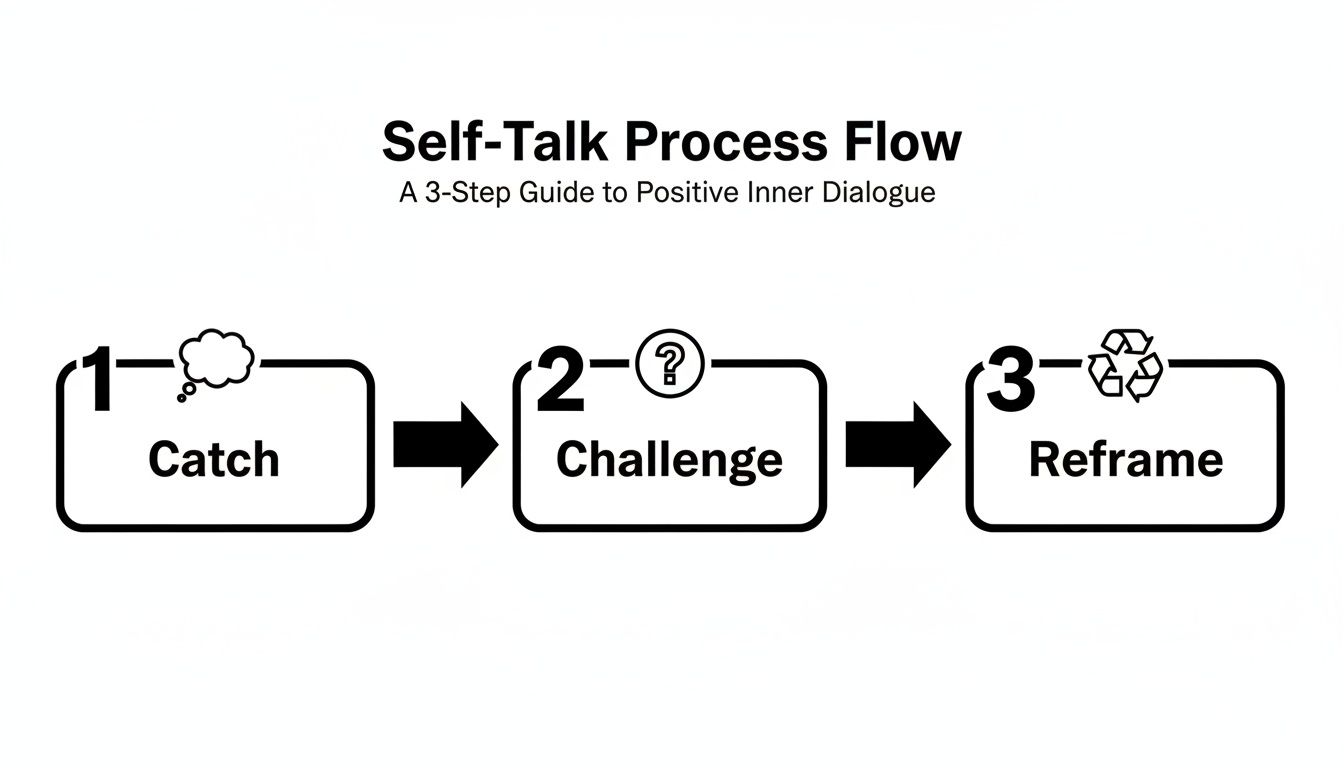
This Catch, Challenge, and Reframe model is the engine behind an effective reset. It turns a potentially confidence-shattering moment into a tactical, focused response.
Post-Performance Reflection
How you break down a performance—win or lose—has a massive impact on your confidence for the next one. A structured reflection stops you from dwelling on the negatives or, just as bad, glossing over valuable lessons. It’s all about extracting confidence from every single experience.
Instead of asking, "Did I win or lose?" I teach my athletes to ask, "What did I learn?" and "What did I do well?" This simple shift builds a foundation of confidence based on effort and growth, not just the final score.
Actionable Tip: After each game or key practice, take ten minutes to answer these questions in a journal:
- What are three things I did well today, no matter the outcome? (e.g., "I stayed positive," "My first step was explosive.")
- What is one specific area where I can get better? (e.g., "My communication on defense.")
- How will I work on that one thing in my next practice? (e.g., "I will call out screens on every defensive possession.")
This process trains you to find the positives, take ownership of your development, and end every performance with a clear, constructive plan.
To see how this all fits together, here’s what a typical training week might look like.
Your Daily Confidence Training Schedule
This sample schedule shows how easy it is to weave these quick mental exercises into your existing routine. Consistency is far more important than intensity.
| Time of Day | Monday | Wednesday | Friday | Weekend Competition Day |
|---|---|---|---|---|
| Morning | 5-min visualization of upcoming practice goals. | Review Confidence Cue Card with breakfast. | 5-min success reel visualization for the weekend game. | Run through full pre-performance priming routine (visualization, music, cue card). |
| During Training/Game | Practice in-competition reset cues after mistakes in drills. | Practice in-competition reset cues during scrimmage. | Practice in-competition reset cues during light practice. | Execute in-competition reset cues as needed. |
| Evening | 10-min post-performance reflection on today's practice. | 10-min post-performance reflection on today's practice. | Review cue card one last time before bed. | 10-min post-performance reflection on the game. |
By consistently applying these daily routines, you stop leaving your mental state to chance. You start systematically building the unshakable self-belief that defines elite athletes.
Develop Resilience to Overcome Slumps and Setbacks

Sooner or later, every athlete hits a wall. Whether it's a nagging slump or a serious setback, it’s an inevitable part of the journey. What separates the good from the great isn’t avoiding these moments, but how they respond. It’s all about resilience—the ability to not just get back up, but to come back mentally stronger than before.
A performance slump can absolutely shred your confidence. Your focus shifts from what you can do to all the things that might go wrong. Suddenly, you're worrying about the score, dreading the next mistake, and imagining what everyone else is thinking. This is the critical moment where you have to consciously grab the steering wheel and redirect your attention to what you actually control.
Navigating a Performance Slump
Trying to force your way out of a slump by focusing on results is a losing battle. The real key is to let go of the outcome and get back to basics. You have to rebuild your confidence from the ground up by concentrating entirely on the process—the small, controllable actions that create a great performance. This approach gives you back a sense of control and silences the negative self-talk.
Here’s a practical game plan to get back on track:
- Set Two Process Goals: For the next week, forget about winning or stats. Instead, choose two tiny, technical goals for every single practice. A basketball player struggling with their shot might focus on "holding the follow-through" and "bending the knees" on every attempt. That's it.
- Track Effort, Not Outcomes: After each session, jot down notes only on how well you stuck to your two process goals. Actionable Tip: Use a simple checkmark system. Did you focus on your process goal? Yes/No. This makes tracking quick and easy.
- Shrink Your Focus: During competition, use a simple trigger word like "reset" or "now" to snap your focus back to the present moment. This is your tool to stop your mind from spiraling over a past error or getting anxious about the next play.
When you break that cycle of outcome-based anxiety, you create the space for your confidence to heal. It becomes grounded in what you can actually manage moment by moment. For any serious athlete, understanding the mental side of navigating failure in sports is a non-negotiable skill for a long career.
Rebuilding Confidence After an Injury
Coming back from an injury is a unique kind of mental warfare. Your body might get the all-clear, but your mind is often still on the injured list. It’s filled with the fear of getting hurt again and a deep-seated distrust of your own body. Your mental recovery plan is every bit as important as your physical therapy.
Your return-to-play strategy has to be about actively rebuilding the trust between your mind and your body. It takes deliberate, progressive steps that prove to yourself—over and over—that you are strong, capable, and ready to go all-out without hesitation.
To get this right, your mental work needs to mirror your physical rehab with these actionable steps:
- Visualize Healing: While you're still in rehab, spend five minutes a day visualizing the injured area repairing itself, getting stronger, and becoming more robust. Imagine blood flowing to the area, strengthening the ligaments and muscles.
- Mentally Rehearse Movements: Long before you're physically cleared to make a sharp cut or a powerful throw, rehearse it perfectly in your mind. See and feel yourself executing the movement with fluid, fearless precision.
- Build a Performance Hierarchy: Sit down with your coach or therapist and create a list of skills, ordered from least to most intimidating. For an ACL injury, it might start with jogging, then running straight, then gentle cuts, then explosive cuts. Don't move to the next level until you feel at least 90% confident in the current one.
This methodical process systematically dismantles the fear and replaces it with cold, hard proof of your body's readiness. Turning a setback into a comeback is the ultimate test of mental toughness.
Measure and Track Your Mental Progress
You can't manage what you don't measure. It's a classic saying for a reason. Athletes religiously track their physical stats—mile time, max lift, batting average—but often leave their mental game completely to chance. How can you expect to build real, durable confidence if you have no idea where you stand?
This is where most athletes get it wrong. They treat confidence as this vague, mysterious feeling that just shows up on good days. It's not. It's a skill. And like any skill, it can be measured, tracked, and improved. The simplest, most powerful tool for this is a dedicated performance journal. Think of it less like a diary and more like a logbook for your mental game.
Identifying Your Key Mental Metrics
To make this work, you need to know what to track. Actionable Tip: After every single practice or competition, take just five minutes to honestly rate yourself on a simple 1-10 scale in a few key areas. No overthinking it, just a quick gut-check rating.
Here are the three metrics I have all my athletes start with:
Quality of Self-Talk (1-10): How was your inner voice? Was it your biggest critic or your best coach? A 1 is that nagging, negative voice that rips you apart after a mistake. A 10 is a constructive, supportive inner coach that helps you reset and refocus.
Focus & Concentration (1-10): How well did you stay in the moment? A low score means your mind was wandering—thinking about a past error, worrying about the final score, or getting distracted by the crowd. A 10 means you were completely locked in on the task at hand.
Emotional Regulation (1-10): How did you handle the emotional ups and downs? A 1 means you let frustration, anxiety, or even over-excitement get the best of you. A 10 means you stayed calm and composed, no matter what the situation threw at you.
Putting a number to these things makes them real. It pulls them out of the fuzzy, abstract world of "mental toughness" and puts them right in front of you in black and white.
The simple act of scoring yourself provides instant feedback. You might have lost the match, but a quick look at your journal shows you scored a personal best 9/10 in emotional regulation. That's a massive win, and it's that kind of progress that builds unshakeable confidence.
Turning Data into Confidence
After a few weeks, this journal becomes your secret weapon. It’s a bank of hard evidence showing you’re getting mentally stronger. When you hit a rough patch or feel your self-belief start to waver, you can flip back through those pages and see undeniable proof of your progress.
Here’s what this tracking system really does for you:
- It Reveals Patterns: You might notice your focus score consistently tanks in the last 30 minutes of practice. Bingo. Now you know you need to work on your mental endurance.
- It Highlights Small Wins: Seeing your self-talk score climb from a 5 to a 7 over two weeks is a concrete victory. That’s how you build momentum.
- It Demands Consistency: Knowing you have to log those numbers after every session keeps your mental training at the front of your mind, right where it belongs.
Ultimately, tracking your mental game gives your brain the proof it needs to truly buy in. It shows that confidence isn't something you just hope for—it's a skill you're building every single day, one measurable step at a time.
A Coach's and Parent's Guide to Supporting the Athlete
An athlete's confidence isn't built in a vacuum. As a coach or parent, your voice often becomes their inner voice on the field, in the pool, or on the court. That makes your role in their mental game absolutely essential. One of the most powerful things you can do is create a psychological environment where their self-belief can truly take root and grow.
The foundation for this is all in how you communicate. It’s a subtle but powerful shift: focus less on the outcomes they can't control (like the final score) and more on the processes they can (like their effort, attitude, and focus). This one change helps defuse the immense pressure they feel and builds a more resilient sense of self-worth that isn't shattered by a single loss.
Communication That Builds Confidence
Your words carry incredible weight. When you praise an athlete's hard work, their resilience after a mistake, or their smart strategic thinking, you're teaching them what really matters—the process of improvement. This builds a tough, durable confidence that can weather the inevitable storms of a competitive career.
Here are a few simple and practical communication swaps you can start using today:
Instead of: "You have to win this game!"
Try this: "Let's focus on giving max effort on every single play. I'm already proud of how hard you've prepared."
Instead of: "Why did you miss that shot?"
Try this: "Tough break. What can we adjust for the next opportunity? Shake it off and reset."
Instead of: "Great goal!" (Outcome-focused)
Try this: "I loved how you found the open space to take that shot. Great awareness!" (Process-focused)
This kind of feedback is constructive, not critical. It keeps the athlete in a problem-solving mode instead of letting them spiral into fear or disappointment. This is a core principle in effective sports psychology for young athletes.
The goal is to be their biggest supporter, not their biggest critic. Your belief in their ability to learn and grow—especially right after a mistake—becomes the bedrock of their own self-belief.
Building Self-Esteem That Lasts a Lifetime
Participating in sports from a young age is an incredible vehicle for developing self-esteem that goes far beyond the game. The research backs this up time and again, showing a strong link between being involved in athletics and having higher self-worth.
One landmark study found that students who played sports before college had significantly higher self-esteem than their non-athletic peers. The key drivers? Peer acceptance and a reduction in anxiety. If you're interested in the details, you can explore the research on early sports participation and self-esteem here.
This really underscores how important it is to make those early sports experiences positive and centered on development. The confidence an athlete gains from mastering a new skill, being a good teammate, or pushing through a tough drill creates a psychological foundation they'll build on for the rest of their lives.
As a coach or parent, you can actively reinforce this foundation. Here are actionable tips:
- Set Realistic Goals: Work with your athlete to set small, achievable process goals for each practice and game. Think "make five sharp cuts" instead of "score three goals."
- Celebrate the Grind: Make a huge deal out of their hustle, focus, and positive attitude, no matter what the scoreboard says.
- Give Actionable Feedback: Frame your advice around specific things they can actually do. A great tool is the "sandwich method"—start with a positive ("Your defensive stance looks solid"), offer the critique ("Now let's focus on keeping your head up"), and end with another piece of encouragement ("You're getting better every day").
By fostering a supportive environment that values growth over just winning, you give your athlete the resilience and self-belief they need to thrive—not just in sports, but in life.
At Dr. John F. Murray, we specialize in building the mental skills that create elite performers. If you're ready to take your mental game to the next level, discover our evidence-based programs at https://www.johnfmurray.com.