
The mental game of tennis is what separates the good from the great. It’s the art of mastering your thoughts, taming your emotions, and sharpening your focus when the pressure is on. This isn't just theory; it’s the invisible skillset that often matters more than your forehand when a match hangs in the balance.
The Unseen Advantage in Every Match

We've all seen it play out. A player with flawless strokes builds a solid lead, then completely crumbles when the score gets tight. On the other side of the net, a grinder with less-than-perfect form hangs tough, claws their way back, and finds a way to win. The real battle isn’t happening across the net—it’s going on right between your ears.
This is where matches are won and lost. The top players don’t necessarily win every point; they win the right points. They know that a single lapse in concentration or a rush of frustration can flip an entire set. The mental game isn't some abstract idea for pros. It's a real, trainable skill, just like your serve or backhand.
Why Your Mind Matters More Than Your Racquet
Once you reach a competitive level, the physical and technical skills between players start to look remarkably similar. The real separator? Mental toughness.
And that’s not just my opinion; the data backs it up. A huge analysis of over 3 million points played at the professional level found clear "mentalities" that directly influenced who won. While most players got rattled by the momentum swings, champions like Djokovic, Federer, and Nadal consistently showed a 'cool-headed' mentality. They were unshakable on serve and incredibly adaptable on return, no matter what the scoreboard said.
This kind of resilience isn't something you're born with. It's built through deliberate practice and a real commitment to mental conditioning.
Turning Theory into On-Court Action
Think of this guide as your roadmap to building that champion's mindset. We’re going to move past the fluff and get into concrete steps, routines, and drills you can use to fortify your mental game. The mission is to give you the tools to manage your mind under pressure, turning what might be a weakness into a powerful weapon. You’ll learn to build:
- Unwavering Focus: How to stay locked into the current point, shutting out distractions and shaking off past mistakes.
- Bulletproof Confidence: Developing a core belief in your game that a few unforced errors can't shake.
- Emotional Resilience: The skill to handle frustration, keep your cool, and bounce back fast when things go wrong.
The best tool a tennis player has is a short memory. When you learn to let go of the last point—good or bad—you free yourself up to play the next one with total commitment. That one skill can change the entire course of a match.
By working on these key areas, you can start winning that internal battle and play with the kind of clarity the best in the world possess. The principles of sports psychology provide a clear path to unlocking your true potential. You can learn more about applying these principles through our resources on sports psychology and performance.
Building Your Mental Arsenal
Winning the mental game in tennis isn't about finding some magic bullet. It's about methodically building a collection of mental skills you can pull from when the pressure is on. Just like you wouldn't go into a match with only a forehand, you can't expect to win the tough points with a one-dimensional mental game.
These skills all work in tandem, creating the kind of mental toughness that truly separates the good players from the great ones.
So, let's break down the four core pillars that will become the weapons in your arsenal. We're going to get practical here—no fluff, just actionable strategies you can start using in your very next practice.
Unwavering Focus
Let's be clear: focus in tennis isn't about maintaining unbroken concentration for two hours. That’s impossible. It’s about the ability to lock in completely for the 15-20 seconds a point is actually live, and then resetting—again and again. The biggest threat to that focus is your own mind, which loves to replay that last unforced error or jump ahead to the fear of losing.
To fight this, you need a simple anchor to pull you back to the present. One of the most powerful tools for this is a cue word. This is just a single, action-oriented word you repeat to yourself right before the point starts.
- Practical Tip: Choose a word that connects to a physical action. For example, if you tend to get tight, your cue word could be "Loose." Before returning serve, you can say "Loose" to yourself while physically wiggling your fingers on the racquet.
- More Examples: "Ready," "Move," "Watch," or even just "Breathe."
- How it works: As your opponent is about to serve, you silently say your word. That simple act interrupts the negative self-talk—the chatter about the double fault you just hit or the score. It forces your attention back to the only thing that matters: the incoming ball.
Think of it as changing the channel on a TV. Your mind is stuck on the "worry" channel, and your cue word instantly flips it back to the "play" channel. It's a skill, and like any skill, it gets stronger the more you practice it.
Bulletproof Confidence
Real confidence has nothing to do with hoping you'll play well. It's about knowing you are prepared to compete, no matter what the scoreboard says. It's easy to feel confident when you're up 4-1, but the true test is whether you still believe when you're down a break in the third. This is where a "confidence resume" becomes your most valuable asset.
This isn't a list of your trophies or biggest wins. It's a mental checklist of all the hard work you put in before you even stepped on the court.
Your confidence has to be rooted in your preparation, not your performance. Preparation is the one thing you can always control; performance will always have its ups and downs.
Actionable Insight: Before your next match, take five minutes to write down three specific things from your past week of practice that you can draw confidence from.
- Drill Repetitions: "I hit 500 backhands down the line this week."
- Fitness Benchmarks: "I pushed through all my fitness sessions and my endurance is solid."
- Strategic Preparation: "I've scouted my opponent and I have a clear game plan A and B."
When doubt creeps in mid-match, you don't have to resort to hope. You can recall these concrete facts. Instead of thinking, "I'm playing horribly," you can switch to, "I've done the work. I am ready for this. Stick to the plan." This builds a stable, resilient self-belief that isn't so easily rattled by a few bad points.
Emotional Mastery
Frustration after a dumb mistake is probably the single most destructive force in tennis. One moment of anger can easily poison the next three or four points, sending you into a tailspin. Emotional mastery isn't about becoming a robot and suppressing your feelings—it’s about acknowledging the emotion and having a system to release it fast.
For this, you need a physical reset ritual. Doing something with your body is a proven way to discharge that negative energy and signal to your brain that it's time to move on.
The Error Reset Ritual in Action:
Imagine you just dumped an easy approach shot into the net. The anger flares up. Instead of letting it stew, you immediately execute your ritual.
- Step 1 (Turn): Turn your back to the net. This is a non-negotiable first step. It physically breaks your connection to the mistake.
- Step 2 (Touch): Walk to the fence and deliberately fiddle with your strings for a moment. This physical action anchors you in the present.
- Step 3 (Breathe): Take one deep, controlled breath. Exhale slowly as you walk back to the baseline. Feel the tension leave your shoulders.
This quick sequence creates a crucial mental buffer. The physical acts—turning away, touching the strings, breathing—stop you from dwelling on the error. You've given the frustration a brief, contained outlet and then signaled that it's over. Now you're ready for the next point with a clear head.
Resilience and Grit
Resilience is what allows you to bounce back from a bad line call, a lost set, or a tough opponent. It's the grit that keeps you fighting when it feels like the match is slipping away. One of the best ways to build this is by actively reframing how you see challenges.
Instead of seeing a tough situation as a threat, you train your mind to see it as an opportunity. This isn't just fluffy positive thinking; this cognitive reframing actually changes your emotional and physiological response to stress.
| Threat Mindset (Negative) | Opportunity Mindset (Positive) |
|---|---|
| "I can't believe I'm down 0-40." | "This is a great chance to show I can hold under pressure." |
| "This umpire is killing me with these calls." | "Okay, this means I need to focus even harder on what I can control." |
| "I'm going to lose this match." | "How can I solve this problem and get back into this?" |
Practical Tip: Practice this during training. When you're playing a practice set and find yourself in a tough spot, say the "opportunity" phrase out loud (or to yourself). Hearing the words helps solidify the new thought pattern, making it more automatic during a real match.
Implementing Actionable On-Court Routines
Knowing the principles of a strong mental game is one thing; applying them in the heat of a match is another beast entirely. The real difference-maker is translating those powerful concepts into simple, repeatable routines on the court. These structured habits become your anchor, grounding you when the pressure is on and your mind starts to race.
Think of routines as your pre-programmed response to the chaos of a tennis match. Instead of getting derailed by a double fault or a missed sitter, you have a concrete set of actions to fall back on. This section breaks down specific, battle-tested routines for every phase of a match—before, during, and after—to give you a systematic approach to owning your mental game.
The Pre-Match Mental Warm-Up
Your mental preparation must begin long before the first serve. Just as you warm up your body, you have to warm up your mind. A targeted mental warm-up primes your focus, reinforces your strategy, and sets a positive and proactive tone for the entire match. One of the most potent tools for this is visualization.
This isn't just about daydreaming of victory; it's a detailed mental rehearsal. Find a quiet spot 15-20 minutes before you play and run through a mental script.
- Feel the Environment: In your mind’s eye, see the court, the net, and feel the grip of your racquet. Hear the sound of the ball on the strings and feel your feet moving on the court surface. Make it sensory.
- Rehearse Your Strengths: Picture yourself executing your "A" patterns flawlessly. Example: Mentally rehearse hitting a deep, heavy first serve to your opponent's backhand, followed by an aggressive forehand to the open court. See it, feel it, repeat it.
- Prepare for Challenges: This is key. Visualize yourself responding positively to adversity. See yourself hit a double fault and immediately reset with calm body language. Picture a bad line call and watch yourself take a deep breath and refocus, ready for the next point.
This mental practice actually builds and strengthens the neural pathways for your desired responses, making them far more automatic under duress. You're essentially pre-loading your brain with the correct reactions, which is a cornerstone of effective decision making under pressure.
The Between-Point Reset
The roughly 20 seconds between points is the most critical time for managing your mental game. It's where matches are truly won and lost. Without a plan, this time is often wasted replaying mistakes or fretting about the score. A structured "Between-Point Reset" transforms this gap into your greatest strategic advantage.
The goal is to create a four-part ritual that helps you cleanly release the last point and lock in your focus on the next one.
This quick routine is a game-changer for maintaining composure and strategic clarity.
The 20-Second Between-Point Mental Reset Routine
| Phase | Action | Purpose |
|---|---|---|
| 1. Release (First 5 Seconds) | Turn your back to the net. Perform a physical cue, like adjusting your strings or taking a slow walk toward the back fence. | This creates a physical and mental break from the previous point, preventing emotional baggage from carrying over. |
| 2. Relax (Next 5 Seconds) | Take one deep, diaphragmatic breath. Inhale slowly through your nose for a count of four, then exhale slowly through your mouth for a count of six. | This simple action calms the central nervous system, lowers your heart rate, and clears mental clutter. |
| 3. Prepare (Next 5 Seconds) | As you walk back to the baseline, set your tactical intention. For a serve: "Heavy first serve to the backhand." For a return: "Deep down the middle." | This shifts your focus from the past to a clear, proactive plan for the immediate future. |
| 4. Ritual (Last 5 Seconds) | Perform your final pre-serve ritual, like bouncing the ball three times. Say a cue word ("Commit," "Attack") as the point is about to begin. | This is the final trigger that tells your brain you are 100% committed and ready for this specific point. |
This repeatable sequence ensures you start every single point with a clear head and a specific plan, no matter what just happened.
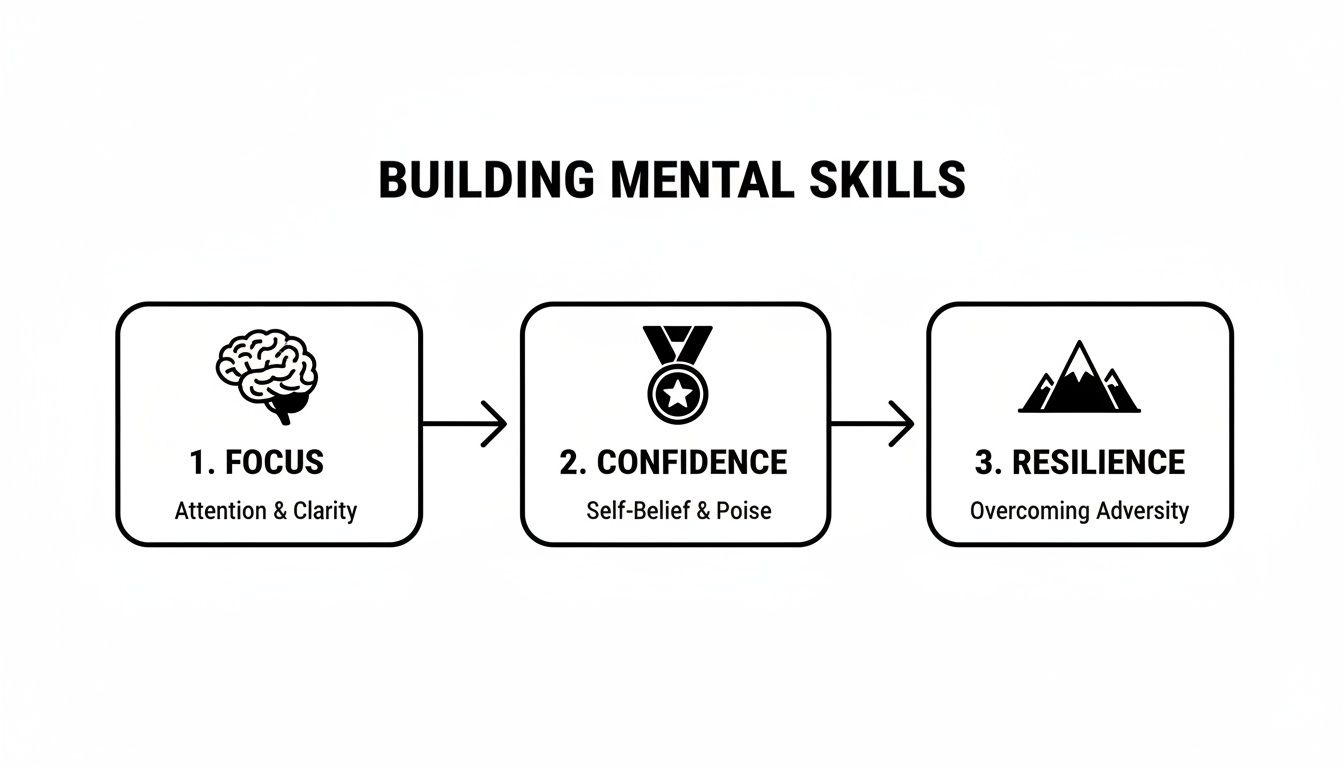
This diagram shows how these on-court routines are designed to build the three pillars of a champion's mind: Focus, Confidence, and Resilience. They are distinct but deeply interconnected.
The Strategic Changeover
Changeovers are not just for hydration; they are 90-second strategic timeouts. Too many players waste this valuable time stewing over bad games or getting lost in a spiral of negative thoughts. A structured changeover strategy is your chance to reset emotionally, analyze tactically, and prepare for the next two games.
Your approach should be simple and consistent.
- First 30 Seconds – Physical Reset: Sit down, towel off, and take several slow, deep breaths while you drink. Focus only on calming your body and mind. Don't think about the score or the last game.
- Next 30 Seconds – Tactical Analysis: Ask yourself two brutally honest questions: "What's working?" and "What's not working?" Based on the answers, make one small, specific adjustment. Example: "My backhand slice down the line is pulling my opponent off the court and forcing errors. I will look for that shot on the first ball of the next return game."
- Final 30 Seconds – Future Focus: Put your racquet down. Close your eyes and visualize yourself successfully executing that one adjustment. As you walk back to the baseline, your mind should be clear and focused only on your plan for the very next point.
This framework pulls you out of the past and turns every changeover into a productive, forward-looking planning session.
The Post-Match Cool-Down
Your mental work isn't over when the final ball is struck. How you process a match—win or lose—has a profound impact on your long-term confidence and development. A Post-Match Cool-Down routine provides the structure for objective self-assessment. It stops you from being overly critical after a loss or unrealistically euphoric after a win.
Win or lose, the goal is always to learn. An objective review of your mental performance is where the most valuable lessons are found.
Within an hour of finishing, spend five minutes reflecting on these key questions. I highly recommend jotting down your answers in a performance journal.
- On a scale of 1-10, how well did I execute my between-point routines?
- When I faced a pressure moment (like a break point), how did I respond with my body language and self-talk?
- Did I stick to my intended game plan, or did I let my opponent dictate the patterns of play?
- What was my single best mental moment in the match, and how can I replicate that feeling and focus?
This process forces you to separate your performance from the result. It allows you to find wins within a loss (e.g., "I reset extremely well after losing the first set") or find areas to improve after a victory (e.g., "I lost focus and got sloppy up 4-1 in the second"). This balanced perspective is the bedrock of lasting mental toughness.
Drills and Exercises to Sharpen Your Mental Edge
You put in the hours drilling your serve, your forehand, and your footwork. But are you training your mind with that same level of discipline?
Improving your mental game isn’t a passive activity—it demands specific, repeatable exercises designed to forge resilience and sharpen your focus when the pressure is on. These drills are what bridge the gap between knowing what to do and actually doing it when the match is on the line.
On-Court Pressure Simulation Games
One of the best ways to build mental toughness is to get comfortable with being uncomfortable in practice. You need to intentionally create high-stakes scenarios to inoculate yourself against the anxiety you’ll inevitably feel in a real match. It’s about making pressure feel familiar, not overwhelming.
- Actionable Drill: The "Deficit Tie-Break." Forget starting at 0-0. You start down 0-4. This immediately throws you into a do-or-die situation, forcing you to execute with absolute precision from the very first ball.
- Actionable Drill: Playing "Golden Point Games." In this drill, every single point is a game point. There are no warm-up rallies. It trains you to bring maximum intensity and focus to every exchange, perfectly replicating that tense, deciding-point feeling.
Laser-Focus Concentration Drills
Your ability to concentrate is a muscle. It gets stronger with training and fatigues if you don't use it properly. These drills are designed to help you quiet the mental chatter and lock in on the only thing that really matters during a point: the ball.
Try the "Seam Calling Drill." It's deceptively simple but incredibly powerful. During a rally, your only job, besides hitting the ball, is to see the seams. As the ball comes over the net, quietly say "seams" if you can see them spinning or "blur" if it's just a yellow fuzz.
- Why it works: This task is so specific that it forces your brain to filter out everything else. You can't be worrying about the score, your last mistake, or what your opponent is doing if you’re laser-focused on spotting the seams of a fast-moving tennis ball.
- The benefit: Over time, this trains your mind to automatically lock onto the ball. The result? Better tracking, quicker reaction time, and deeper concentration.
You don't rise to the level of your goals; you fall to the level of your training. Simulating pressure in practice is the only way to ensure your mental game holds up when it matters most.
Off-Court Mental Training Routines
The work doesn't stop when you walk off the court. Off-court exercises build the foundational mental skills that support your performance under pressure, particularly in the crucial areas of self-awareness and preparation.
Mindfulness and Meditation
Even just 5-10 minutes of daily mindfulness can dramatically improve your ability to stay present and manage your emotions. It doesn't have to be complicated.
- Practical Tip: Use an app like Calm or Headspace for a guided 5-minute meditation. Or, try a simple breathing exercise: sit quietly, close your eyes, and focus only on the sensation of your breath. When your mind wanders, gently guide your attention back to your breath without judgment. This is a direct parallel to tennis—noticing your mind has drifted to a bad call and calmly bringing it back to the present point. For those looking for more structured guidance, a dedicated mental skills training program can provide a clear path.
Detailed Visualization Scripts
Before a big match, run through a full mental rehearsal. This is much more than just picturing yourself holding a trophy. True visualization means experiencing the entire match in your mind, especially the challenging moments.
Here’s a snippet of what that might sound like:
- “I see myself walking onto the court, feeling the sun and the slight breeze. I take a deep breath. I jump forward to a tough moment: serving at 3-4, 30-40. I feel the nerves rise, and I acknowledge them instead of fighting them. I see myself taking a calming breath, bouncing the ball three times, and hitting a confident, heavy first serve to my opponent's backhand. I see myself responding calmly to the outcome, win or lose the point, and readying for the next.”
This process prepares your nervous system for adversity, making you far less likely to panic when those situations actually happen.
At the elite levels of tennis, the physical and technical skills are often remarkably similar. The real differentiator is the mind. Many experts and pros estimate that the mental game accounts for 75-80% of success in the top 100-200 ATP rankings. This isn't just opinion; a study of over 3 million points played between 2011 and 2015 showed that mental traits like 'cool-headedness' were better predictors of who would win than technical skill alone. This is a common topic of discussion on tennis forums and discussions, where the consensus is clear: the mind matters most.
Tracking Your Mental Performance
Let’s be honest: you can’t improve what you don’t measure. In tennis, we’re obsessed with stats like first-serve percentage and unforced errors. But what about the numbers that really dictate the outcome of a match? It’s time to start tracking your mental game tennis skills with the same rigor you apply to your forehand.
This isn’t about fuzzy feelings; it’s about collecting hard data. A data-driven approach pulls the abstract idea of ‘mental toughness’ out of the clouds and makes it something you can actually work on. By tracking a few key mental indicators, you’ll start to see patterns you never knew existed—like how your focus tanks after a long rally, or how you get tight on break points.
Defining Your Mental Key Performance Indicators
To get started, you need to define what, exactly, you're measuring. Forget vague goals like "be more focused." We need to pinpoint concrete, observable behaviors that serve as a proxy for your mental state on the court.
Here are three powerful Key Performance Indicators (KPIs) you can start tracking today:
- Routine Commitment (Scale 1-10): How disciplined were you with your between-point routine? A perfect 10 means you executed it after every single point, win or lose, no exceptions. A 5 means you only did it when you remembered or after a particularly bad shot.
- Body Language Post-Error (Scale 1-10): What did you look like right after a mistake? A 10 is pure composure—head up, shoulders back, immediately turning to face the next point. A 1 is the classic slumping shoulders, racquet abuse, or exasperated gesture to your coach.
- Game Plan Adherence (Scale 1-10): Did you actually play the match you planned to play? A 10 means you trusted your strategy and stuck to your patterns, even when things got tense. A 3 means you panicked, abandoned the plan, and started just hitting the ball.
Creating Your Post-Match Mental Scorecard
After every match or intense practice, take just five minutes to rate yourself on these KPIs. This isn't about beating yourself up; it's purely about data collection. A small notebook or a note on your phone is all you need.
Your scorecard might look something like this:
| Mental KPI | Rating (1-10) | Notes |
|---|---|---|
| Routine Commitment | 6 | Was solid until I went up 4-1, then got lazy with it. |
| Body Language Post-Error | 4 | Started dropping my head after double faults in the 2nd set. |
| Game Plan Adherence | 7 | Stuck to attacking the backhand but got passive in the final games. |
This simple exercise gives you instant, actionable feedback. The notes are where the gold is—they provide the why behind the numbers, showing you the exact moments your mental game slipped.
Turning your mental game into measurable data is the fastest way to achieve real progress. It removes the emotion from self-assessment and gives you a clear roadmap for what to work on next.
This is exactly what the pros are doing, just with more sophisticated tools. At the highest level, analytics platforms can even calculate a "Mental Toughness Rating" by analyzing performance in high-stakes situations like tiebreaks and deciding sets. The data reveals how players like Roger Federer and Andy Murray consistently find another gear when it matters most—a skill built on relentless mental discipline.
You can actually see some of these fascinating mental toughness statistics and how the top players compare. By tracking your own mental KPIs, you're applying the very same principles to your game, building the resilient mental game tennis players need to win.
Answering Your Top Tennis Mental Game Questions
Even with the best plan in hand, you're bound to have questions as you start digging into the mental side of tennis. It can feel a bit abstract at first, but trust me, the challenges you're facing are the same ones players at every level grapple with.
Here are some of the most common questions I get from players and coaches, along with some practical, no-nonsense answers.
How Long Does It Take to Improve My Mental Game?
This is the big one, and the honest answer is that building true mental fortitude is a career-long pursuit. But you can absolutely see real, tangible changes in your on-court focus and composure within just a few weeks of consistent work.
- Actionable Tip: For the next two weeks, commit to doing two things without fail: 1) Execute your between-point routine after every single point in practice. 2) Fill out your mental scorecard after every practice. This focused effort will produce noticeable results quickly.
The key is repetition. Think of it like building a new neural pathway—the more you use it, the stronger it gets. Lasting change takes months, but those initial wins can happen fast if you stick with it.
How Can I Control My Nerves Before a Big Match?
First, let's get one thing straight: nerves are a good thing. They mean you care. The goal isn't to get rid of them; it's to get them working for you. A rock-solid pre-match routine is your best friend when it comes to taming that overwhelming anxiety.
The trick is to pull your focus away from the outcome—the win or the loss—and plant it firmly on the things you actually control. Your breathing. Your game plan. Your effort.
- Reframe the Feeling: That fluttery feeling in your stomach? Instead of calling it "anxiety," try calling it "excitement" or "readiness." It's a simple mental switch, but it can completely change how your body responds.
- Use Deep Breathing: Before you step on the court, find a quiet corner and do some box breathing. Inhale for four seconds, hold for four, exhale for four, and hold for four. This is a scientifically proven way to calm your nervous system right down.
- Practical Example: Many pros listen to the same playlist on the way to a match. This isn't just about music; it's a routine that signals to their brain, "It's time to compete." Create your own simple, repeatable pre-match sequence.
What Is the Single Most Important Mental Skill in Tennis?
If I had to boil it all down to one thing, it would be the ability to reset and focus entirely on the next point. Tennis is just a relentless series of mistakes and opportunities. The player who can let go of a double fault just as quickly as they move on from a screaming winner is the player who stays stable and wins.
Learning and mastering the 20-second between-point routine is, without a doubt, the fastest way to build this "short memory" on the court. It's what stops one bad point from bleeding into the next and spiraling into a lost game or set.
The greatest weapon against pressure is a plan. Having a repeatable routine for the moments between points gives you an automatic, positive response when your mind is most vulnerable to negative thoughts.
Can Mental Training Help Me Return from an Injury?
Absolutely. In fact, it's critical. When you're coming back from an injury, the psychological hurdles can be even bigger than the physical ones. Mental training is what helps you get over the fear of re-injury and manage the intense frustration of not being where you were before.
- Actionable Insight: Use visualization to practice your on-court movements without physical strain. Mentally rehearse a perfect serve or a fluid sprint to a drop shot. This keeps the neural pathways sharp and helps rebuild trust in your body.
- Practical Tip: Set process-based goals for your recovery, not outcome-based ones. For example, instead of "I want to win my first match back," focus on "I will complete my full dynamic warm-up and cool-down without pain." This keeps you motivated and reduces the pressure to perform perfectly right away.
At Dr. John F. Murray, we specialize in building the mental frameworks that allow athletes to perform at their peak under any condition. If you are ready to turn your mental game into your greatest weapon, explore our customized programs and start your journey today. Learn more at https://www.johnfmurray.com.